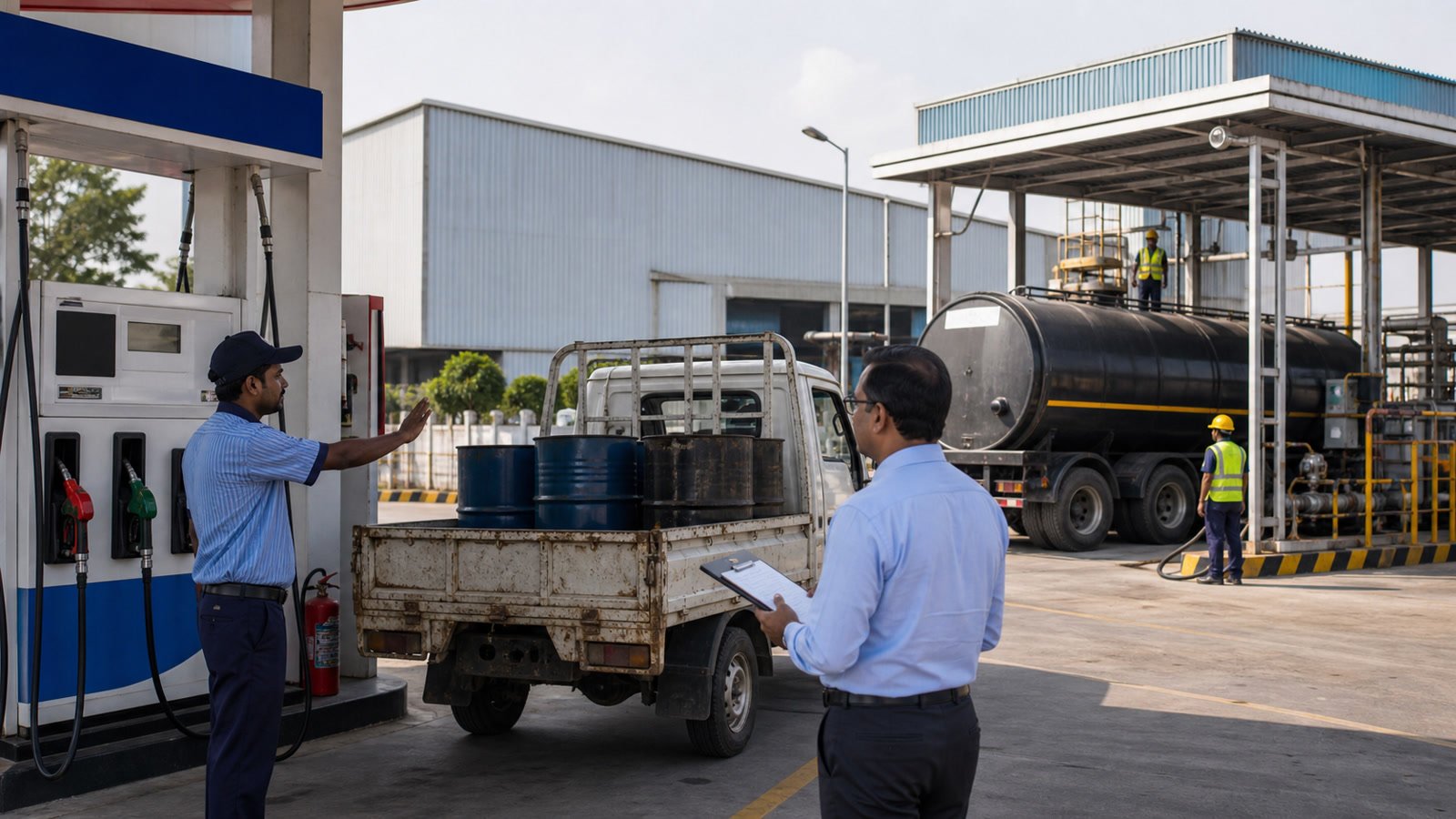
India's fuel market has a new compliance point for large buyers. The Centre has barred industrial, commercial and institutional users from buying petrol and diesel at retail fuel outlets, according to a June 12 Times of India report. These users must move to the bulk purchase route instead of drawing fuel from ordinary petrol pumps.
The rule matters because it is not only a paperwork change. It affects how factories, transport operators, construction firms, hotels, hospitals, telecom tower operators, cold storages, educational institutions, housing societies and other large facilities plan diesel and petrol procurement. Many of these users depend on diesel for generators, machinery, captive fleet movement or emergency backup. If they were buying from retail outlets because retail diesel was cheaper or easier to access, the new direction changes both cost planning and supply logistics.
What Changed
The reported directive says industrial, commercial and institutional users should not purchase petrol or diesel from retail pumps and must instead procure through bulk sellers. The aim is to keep retail outlets focused on regular consumer and vehicle demand, while routing large-volume fuel consumption through the channel designed for bulk supply.
This follows weeks of concern over bulk diesel users shifting to retail pumps. On May 28, Times of India reported that the government had warned industrial consumers against buying diesel from retail outlets because differential pricing was contributing to artificial fuel shortages in parts of the country. A May 22 report also said the government had dismissed rationing rumours and attributed long queues at some pumps to bulk consumers moving to retail outlets due to a large price gap.
Why Large Buyers Were Using Retail Pumps
The core reason is price and availability. Economic Times reported earlier that many bulk diesel buyers had shifted to retail pumps when retail fuel was materially cheaper than bulk fuel, contributing to a 30-50% decline in diesel sales to bulk customers for oil marketing companies. TOI's earlier fuel-supply coverage referred to a gap of nearly Rs 42 a litre in some context, while the ET report said retail diesel was about Rs 50 a litre cheaper than bulk supply in the period it covered.
For a small car owner, that gap is a household budget issue. For a facility running diesel generators or a fleet consuming thousands of litres, it can become a major operating-cost difference. That is why the shift to retail pumps was commercially attractive for some users. But from a fuel-distribution perspective, it can distort retail demand, create long queues and put pressure on pumps meant for normal vehicle refuelling.
| User group | Fuel use case | What changes now |
|---|---|---|
| Factories and industrial units | DG sets, process support, internal movement | Need registered bulk procurement and tighter inventory planning. |
| Commercial fleets and contractors | Construction equipment, yard vehicles, high-volume diesel use | Must shift recurring volume away from retail pump lanes. |
| Hospitals, telecom towers and housing societies | Backup power and emergency operations | Need clear documentation to avoid disruption to genuine emergency fuel use. |
| Retail fuel consumers | Cars, bikes, taxis, buses and ordinary refuelling | May see less queue pressure if bulk demand leaves retail outlets. |
Why The Rule Matters For Fuel Users
The immediate benefit for ordinary pump users could be better availability and shorter queues where bulk buying had distorted demand. Retail pumps are designed for vehicle refuelling, not for repeated high-volume industrial draw. When large buyers use retail channels heavily, pump storage, tanker scheduling and forecourt operations can be strained.
For bulk users, however, the impact is more complex. Diesel bought through bulk supply can be costlier than retail fuel. It may also require contract arrangements, minimum order volumes, delivery scheduling, storage compliance and payment discipline. That means companies that casually bought diesel from nearby pumps will need a more formal fuel-procurement process.
The compliance angle is also important. Some industry bodies have supported action against hoarding and black marketing but warned against confusion for genuine users. In Maharashtra, CAMIT asked the state government to clarify a diesel circular, saying vague implementation could lead pump operators to refuse fuel even to legitimate customers such as hospitals, hotels, housing societies, telecom towers, cold storages, banks, construction firms and agricultural users. That concern is relevant nationally too: enforcement should stop disguised bulk buying without interrupting essential operations.
What Businesses Should Do Now
Any business that regularly buys diesel or petrol in significant volume should first classify its use. Fuel for registered vehicles that refuel normally is different from bulk fuel for generators, machinery, storage tanks or site operations. The second step is documentation: maintain consumption records, invoices, vehicle or equipment details, storage permissions where applicable, and correspondence with oil marketing companies or authorised bulk sellers.
Procurement teams should also recalculate fuel budgets. If a user had been relying on retail prices, the shift to bulk supply can change per-litre cost and working capital. Operators with critical backup power should avoid last-minute purchase habits and set reorder levels. Fleet and facility managers should check whether delivery lead times, safety rules and storage capacity are adequate before the next high-demand period.
What To Watch Next
The next watch point is implementation clarity. Businesses will need to know whether thresholds, use categories, emergency exemptions or self-declaration mechanisms are specified locally. Fuel retailers will need clear operating instructions so they do not wrongly deny small or legitimate consumers. Oil marketing companies will also need enough bulk-supply capacity and customer support to onboard users who previously relied on retail pumps.
The reader takeaway is straightforward: this is a fuel-supply discipline measure with real cost consequences. For ordinary motorists, it could protect retail pump availability. For industrial, commercial and institutional users, it means fuel buying must move from convenience-based retail purchases to planned bulk procurement. The companies that adapt early will have fewer disruptions and clearer cost control.
Sources: Times of India June 12 directive report, Times of India Maharashtra bulk-diesel report, Times of India CAMIT clarification report, Times of India government warning report, Economic Times bulk-diesel market context.