BYD India is evaluating plug-in hybrid electric vehicles (PHEVs) for the Indian market after a reported 1,735-km road test, Business Standard reported on 13 Nov 2026. The company has not confirmed an India-bound model, price or launch date, so the development is a product study rather than a booking or purchase announcement.
Key takeaways
- BYD India is studying PHEVs, which can be charged externally and also use a petrol engine.
- Business Standard reported that BYD recently tested its plug-in hybrid technology on Indian roads and covered 1,735 km.
- India Book of Records separately describes a BYD DM-i plug-in hybrid journey covering 1,735 km on a single fuel tank and single charge.
- BYD has not named the model it may bring to India or given a launch timeline.
- The road-test figure is not an ARAI-certified mileage or a confirmed range figure for a consumer model.
What BYD has actually said
According to Business Standard's report from an interaction at BYD's Denza launch in Mumbai, Rajeev Chauhan, who heads the company's electric passenger vehicle business in India, said BYD is taking more time to study the scale and reach of PHEV technology in the country. He said the company already has the product portfolio, but is still assessing how the technology fits Indian conditions and how consumers understand the difference between a strong hybrid, a PHEV, a petrol or diesel vehicle and a pure EV.
The wording is important. BYD is evaluating the opportunity; it has not announced a new India product. The company also said its decision would not depend only on government incentives. That leaves the commercial questions open: which body style and price band would be suitable, whether an imported model could be competitive, and how BYD would support high-voltage systems outside its existing EV range.
BYD's same-day Denza debut is a separate confirmed launch of luxury electric vehicles. It does not confirm that a PHEV is coming, but readers can review the Denza D9 and Z9 GT India launch details for the distinction between a current product and a future technology study.
Why the 1,735-km figure needs context
The headline distance comes from two related records. Business Standard quoted Chauhan as saying BYD had recently tested its plug-in hybrid technology on Indian roads and achieved a driving range of 1,735 km. India Book of Records describes a BYD DM-i plug-in hybrid journey that covered 1,735 km on one fuel tank and one charge, with support from BYD India.
The record is useful evidence that the technology was demonstrated in Indian road conditions, but it should not be read as the certified range of a future BYD model. A single-tank and single-charge road journey combines the battery's available energy with petrol in the tank. The published record does not establish how much of the distance was electric, how much fuel or electricity was used, or what speed, traffic, payload, weather and charging conditions applied.
That distinction matters for anyone trying to estimate ownership cost. A road-test total cannot be converted directly into a rupee-per-kilometre figure, and it cannot show how a PHEV will perform on a daily commute after its battery is depleted. A buyer would need the final vehicle's battery size, electric-only range, petrol-tank capacity, charging time, certified efficiency, warranty and on-road price before making a meaningful comparison.
What a BYD PHEV could change for Indian drivers
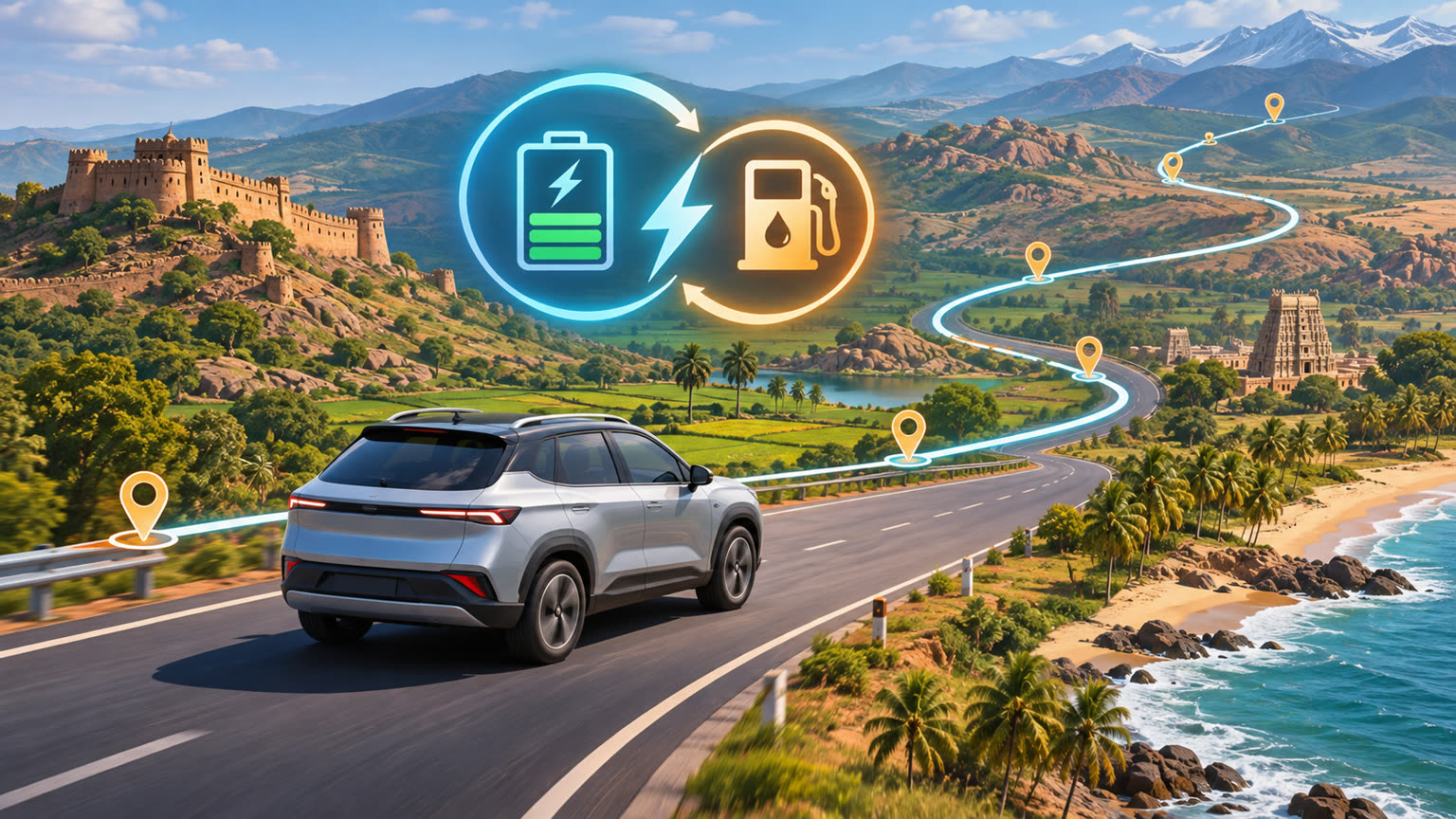
A PHEV combines a larger rechargeable battery with an internal-combustion engine. For journeys that begin with a full charge, the vehicle can use electric power for part of the trip before the petrol engine becomes the main source of propulsion. That creates a possible middle path for drivers who can charge at home or work but still need petrol flexibility on longer routes.
In practice, the benefit would depend on use. A short daily commute with regular charging could make the electric portion more important. A long-distance driver without reliable charging could spend more of the trip using petrol, making the vehicle's weight, fuel efficiency and purchase price more significant. The availability of public charging on a planned corridor can be checked through the state-wise EV charging station directory, but the directory cannot substitute for a confirmed BYD model's charging compatibility or network support.
For a road trip, the useful comparison is not just claimed total range. It is the cost and time of each energy stop, the availability of charging at the destination, and the amount of petrol used when the battery is low. The road-trip planner can help map the route and stop pattern once a vehicle's confirmed battery, fuel and charging data are available.
What buyers and fleet operators should watch
There is no confirmed PHEV to price or book from this announcement. The next meaningful update would be a named model or a formal BYD India release with homologated specifications. Until then, the following checks separate useful information from a promotional range claim:
- Check whether a quoted distance is an official certification figure, a laboratory test, or a road-trip record combining petrol and electricity.
- Look for the vehicle's electric-only range and the conditions used to measure it, rather than relying on a combined headline distance.
- Compare home-charging access, public charging coverage, petrol use after the battery is depleted and service support in the cities where the vehicle will operate.
- Use dated local fuel rates and the vehicle's eventual energy-consumption data in a fuel-cost calculation; do not assume that a longer total range automatically means a lower monthly cost.
For now, the reader takeaway is straightforward: BYD is studying whether its plug-in hybrid technology fits India, and the 1,735-km road test shows a technology demonstration rather than a confirmed showroom product. A model name, price, certified specifications and launch plan are still needed before Indian buyers can compare it with a petrol car, strong hybrid or pure EV.
Sources
- Business Standard — BYD eyes plug-in hybrids in India, expands luxury EV play with Denza — 13 Nov 2026
- BYD India — BYD's DM-i Super Plug-In Hybrid EV Technology gets registered in the India Book of Records — 5 Aug 2026
- India Book of Records — Maximum Distance Covered by a Plug-In Hybrid EV on a Single Fuel Tank and Single Charge — 6 Oct 2026