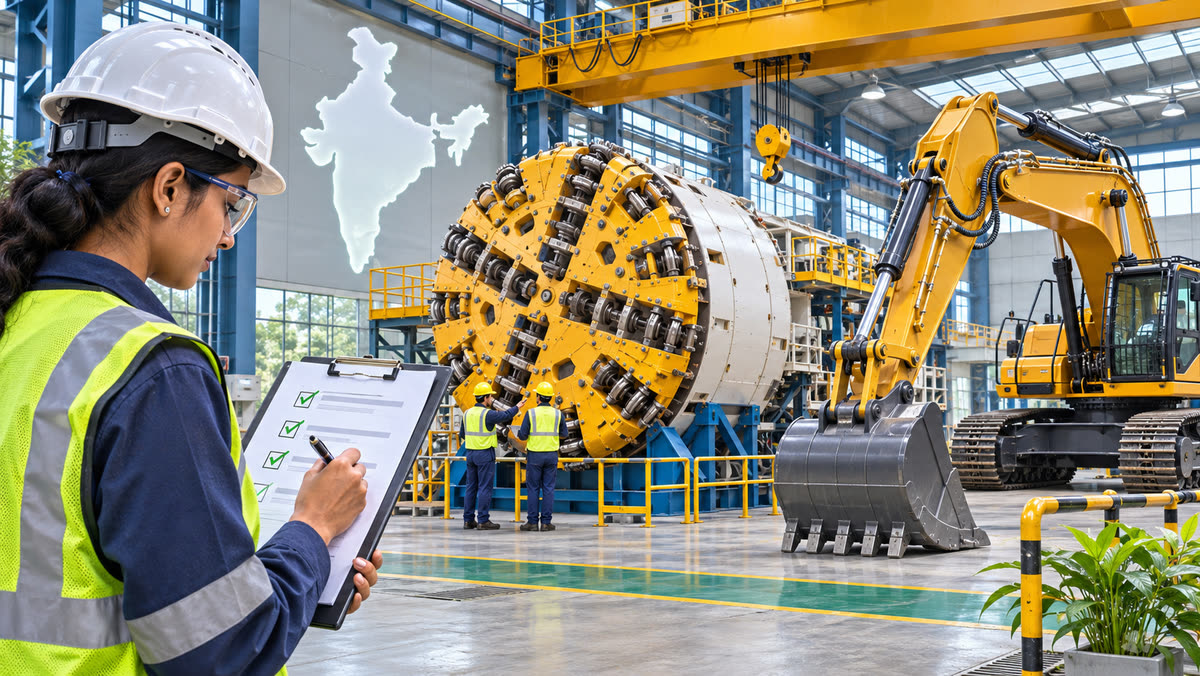
The Union Cabinet approved an ₹11,000-crore scheme on 25 Nov 2026 to expand domestic manufacturing of construction and infrastructure equipment, including tunnel-boring machines, excavators and cranes. For Indian drivers, fleet operators and road builders, the important detail is timing: the factories and testing capacity must be established first, so the announcement does not change today’s tolls, route access or fuel prices.
Key takeaways
- The new Scheme for Enhancement of the Construction and Infrastructure Equipment Manufacturing Ecosystem has a total outlay of ₹11,000 crore, according to the Cabinet release dated 25 Nov 2026.
- Eligible original equipment manufacturers and component makers can receive graded incentives of 8% to 13% on incremental sales over five years.
- The scheme has a two-year gestation period from FY2026–27 to FY2027–28; incentive disbursements are scheduled from FY2028–29.
- A grant of up to ₹375 crore is planned for a dedicated testing facility, which could allow more equipment to be tested and certified in India.
- There is no new toll fee, fuel-price change or immediate road-user discount in the Cabinet announcement.
What the Cabinet approved
The Ministry of Heavy Industries will implement the eight-year scheme, which runs from FY2026–27 to FY2033–34. Its focus is the domestic production of construction and infrastructure equipment and the components used in that equipment.
The government’s 25 Nov release lists technologically advanced machinery such as ship-to-shore cranes, tunnel-boring machines, hydraulic excavators and off-highway trucks. These are not consumer vehicle products, but they are part of the supply chain behind roads, ports, tunnels, housing and other large infrastructure projects.
The scheme has two components. The first is a sales-linked incentive for approved OEMs and component manufacturers. The second is a grant of up to ₹375 crore, structured as viability-gap funding, for a dedicated CIE testing facility. The official release says the facility is intended to support domestic manufacturing and advanced equipment development; it does not announce its final location or operating date.
Why the equipment matters to roads and logistics
A road project depends on more than land, funding and a construction contract. It also needs specialised machinery that can excavate, lift, drill, move material and build safely at the required scale. If a critical machine or component is imported, procurement, certification, shipping and replacement parts can add uncertainty to a project schedule.
The Cabinet says the scheme is intended to strengthen supply-chain security and reduce dependence on imported equipment. That is a policy objective, not a promise that every future highway or tunnel will open sooner. The practical test will be whether Indian manufacturers can produce reliable machines, meet safety requirements and support them with parts and service.
The government estimates that India’s construction and infrastructure equipment industry was worth about ₹97,500 crore in FY2024–25 and projects a market of around ₹2,28,100 crore by FY2029–30. Those figures are government estimates cited in the Cabinet material and independent coverage; they describe the market opportunity, not guaranteed sales for any manufacturer.
The timeline means benefits are later
The scheme does not start paying incentives immediately. The first two financial years, FY2026–27 and FY2027–28, are a gestation period for approved applicants to set up manufacturing facilities. Incentive disbursements are scheduled for five years from FY2028–29 to FY2032–33, with FY2033–34 reserved for settling incentives linked to incremental sales in FY2032–33.
That sequence matters for anyone watching a road or logistics corridor. A Cabinet approval is not the same as a new machine being available at a project site. Before the policy can affect procurement, the Ministry of Heavy Industries will need to publish or apply detailed eligibility rules, manufacturers will need to invest, and the testing system will need to become operational.
Until then, drivers should use the toll-charge calculator for current toll and trip-cost planning. The equipment scheme does not revise a fee schedule. If a construction project later changes a route or adds a diversion, the road-trip planner can help compare the available route and timing.
How the sales-linked incentive works
The benefit is tied to incremental sales value rather than a retail purchase price. The Cabinet release says graded rates will range from 13% to 8% over a five-year period for approved applicants across OEM and component-manufacturer categories. The exact rate will depend on the notified structure and the applicant’s eligibility; the announcement does not provide a consumer rebate or a price cut for trucks, cars or construction machinery.
For fleet operators and contractors, this distinction is important. A domestic-production incentive may gradually affect supplier choice, service coverage or the availability of replacement components, but the cost of a particular machine will still depend on its specification, finance, maintenance, taxes and the manufacturer’s commercial terms. No operator should treat the headline outlay as a guaranteed saving on a current project.
For ordinary motorists, any impact is more likely to be indirect. Better supply and local testing could support project execution and equipment servicing over time, but today’s fuel bill remains a separate calculation. The fuel-cost calculator can estimate a vehicle’s current running cost without applying the new scheme’s manufacturer incentives to the driver.
What to watch next
The next useful signals will be the scheme guidelines, the list of eligible equipment and components, the approved applicants, and the implementation plan for the testing facility. It will also be worth tracking whether manufacturers announce Indian production of tunnel-boring machines, excavators, cranes, off-highway trucks or critical components such as engines, transmissions, hydraulic systems, undercarriages and drive systems.
Road users can then look for outcomes that are easier to verify: equipment orders on major corridors, fewer project delays attributed to imported machinery, local service and parts networks, and whether scheduled road openings are actually met. Those are later indicators, not effects that can be claimed on 25 Nov 2026.
Reader takeaway
The Cabinet’s approval is a long-term industrial and infrastructure-supply measure. It may help India build more of the machinery used on roads, ports and tunnels, but the immediate position for drivers is unchanged: tolls, fuel prices and current route permissions still come from their existing authorities and notifications. The near-term story is the setup phase; the meaningful mobility impact will depend on factories, testing capacity and equipment reaching projects from FY2028–29 onward.
Sources
- Press Information Bureau — Cabinet approves Rs.11,000 crore Scheme for Enhancement of Construction and Infrastructure Equipment Manufacturing Ecosystem — 25 Nov 2026
- Moneycontrol — Cabinet clears Rs 11,000-crore scheme to boost construction equipment manufacturing, offers up to 13% sales incentives — 25 Nov 2026
- Business Standard — Cabinet approves ₹11,000 cr scheme for construction equipment manufacturing — 25 Nov 2026