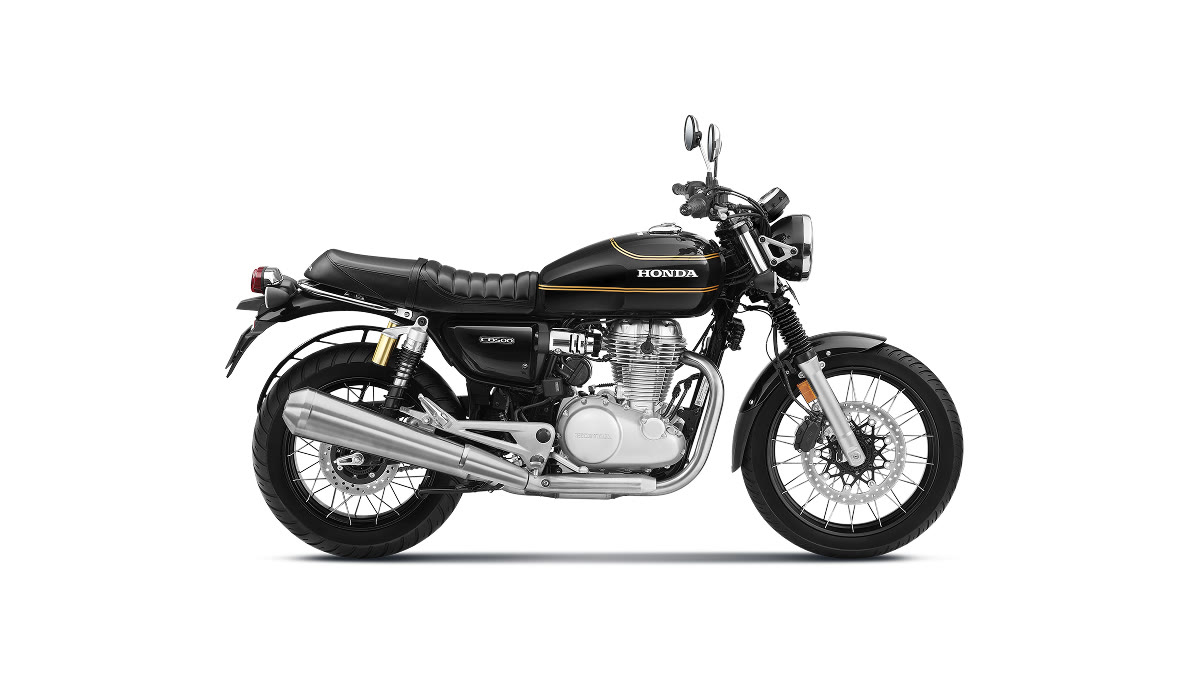
Honda has published detailed India-specification information for the CB500, with prices starting at ₹2,75,000 ex-showroom Bengaluru and reaching ₹3,01,900 for the top variant. The update gives prospective mid-capacity motorcycle buyers a clearer view of the engine, wheel choices, safety kit and variant price gap. Honda’s official CB500 page notes that the listed ex-showroom figure can vary by model, variant, state and the price applicable at delivery.
Key takeaways
- The Honda CB500 is listed in Alloy, Spoke and Spoke with Stripes variants.
- Independent specification reports list a 501.7cc single-cylinder engine producing 28.14 PS and 43.3Nm.
- The motorcycle gets a five-speed gearbox, assist-and-slipper clutch, Honda RoadSync connectivity and dual-channel ABS.
- The official price ladder is ₹2,75,000 to ₹3,01,900 ex-showroom Bengaluru; state-level on-road prices will be different.
Honda CB500 price and variant breakdown
Honda’s current India product page lists all three CB500 versions with different wheel and styling treatments. The figures below are the prices shown on the page on 26 Nov 2026 and are ex-showroom Bengaluru; Autocar India and Rushlane report the same range, with the higher variants commonly rounded to ₹3 lakh and ₹3.02 lakh.
| Variant | Honda-listed price | Main distinction |
|---|---|---|
| CB500 Alloy | ₹2,75,000 | Alloy wheels |
| CB500 Spoke | ₹2,99,900 | Cross-spoke tubeless wheels |
| CB500 Spoke with Stripes | ₹3,01,900 | Cross-spoke tubeless wheels with stripe graphics |
The price step-up is concentrated in the wheel and styling packages. Calculated from Honda’s listed prices, the Spoke version costs ₹24,900 more than the Alloy version, while the top variant adds ₹2,000 over the regular Spoke version. The engine and core safety equipment are shared across the range, so the choice is mainly about the wheel format, finish and graphics rather than a different performance tune.
Engine and hardware
Honda’s official highlight sheet describes the engine as a 501cc air-cooled unit with an oil cooler and lists Honda Selectable Torque Control, all-LED lighting, an analogue-digital meter and front and rear disc brakes with two-channel ABS. The detailed reports from Rushlane and WION Drive give the more precise displacement as 501.7cc and list maximum output of 28.14 PS at 5,250 rpm and peak torque of 43.3Nm at 3,750 rpm.
The small difference between the rounded 501cc figure in Honda’s promotional material and the 501.7cc figure in the detailed specification reporting is a matter of precision, not a separate engine. The important buyer-facing point is the engine’s character: peak torque arrives at a lower engine speed than peak power, which suggests a relaxed, mid-range-focused roadster on paper rather than a high-revving performance motorcycle.
The CB500 uses a five-speed transmission and an assist-and-slipper clutch. The reported hardware package includes telescopic front forks, gas-charged twin rear shocks, a 19-inch front wheel, a 17-inch rear wheel, dual-channel ABS, a 189kg kerb weight, 168mm of ground clearance and a 15.2-litre fuel tank. Honda RoadSync connectivity, Bluetooth pairing, turn-by-turn navigation and a Type-C charging socket add everyday touring and commuting functions, although the availability of some equipment can vary by variant.
What the specification means on the road
The 19-inch front and 17-inch rear wheel combination places the CB500 in a roadster format, while the torque figure and upright design point toward steady city and highway use. That is an interpretation of the published specification, not a claim about real-world performance. Actual acceleration, comfort, fuel consumption and heat management will depend on traffic, rider load, road conditions and riding style.
Availability and buyer checks
Honda’s product page does not present one common delivery date for all three versions. It separates the Alloy variant from the two spoke variants for configuration and delivery timing, with deliveries described as commencing shortly after the respective configuration windows. Buyers should therefore confirm the exact variant’s availability, the state-specific ex-showroom price and the on-road quote with an authorised Honda BigWing outlet before budgeting.
- Check whether the quoted Spoke wheel is the tubeless cross-spoke version and whether the stripe graphics belong to the top variant.
- Ask for the registration, insurance, handling and other on-road charges separately from the ex-showroom price.
- Compare the final quote with the actual delivery date because Honda says the applicable price can vary by state and may be the price in force at delivery.
- Do not treat the 15.2-litre tank as a range claim; a useful range estimate requires a verified mileage figure and the rider’s route conditions.
Fuel and trip-cost context
A 501.7cc petrol motorcycle’s ownership cost will not be captured by its showroom price alone. Riders planning a regular commute can use FuelPrice’s fuel cost calculator with their own distance and observed mileage, then check the live petrol prices for the city or state where the motorcycle will be used. This keeps the fuel estimate separate from registration, insurance, maintenance and financing costs.
For longer rides, the road-trip planner can help map distance and stops before a route is chosen. The CB500’s published tank capacity may be relevant to stop planning, but it should not be converted into a promised range without a verified consumption figure.
What to watch next
The next useful update for buyers is not another headline specification but a clear variant-wise delivery schedule and state-level on-road pricing. Honda’s current listing establishes the product’s core hardware and price range; showroom availability, registration costs, insurance quotes and real-world mileage will determine the final ownership calculation for each rider.
Sources
- Honda Motorcycle & Scooter India, CB500 product page, accessed 26 Nov 2026
- Honda Motorcycle & Scooter India, CB500 product specification sheet, accessed 26 Nov 2026
- Autocar India, Honda CB500 launched at Rs 2.75 lakh, 23 Nov 2026
- Rushlane, Honda CB500 Specs Fully Revealed – 28 PS, 43.3 Nm, TBT Nav, 24 Nov 2026
- WION Drive, Honda CB500 specifications, features revealed: What the ₹2.75 Lakh retro roadster offers, 24 Nov 2026