In one of the most consequential clean mobility moves for Delhi-NCR, the Commission for Air Quality Management set a phased timeline for EV-only registration of new L5 three-wheelers and paired it with a strict PUCC-linked fuel compliance rule. The combined effect could alter fleet procurement, finance choices, operating costs, and urban fuel demand in the region.
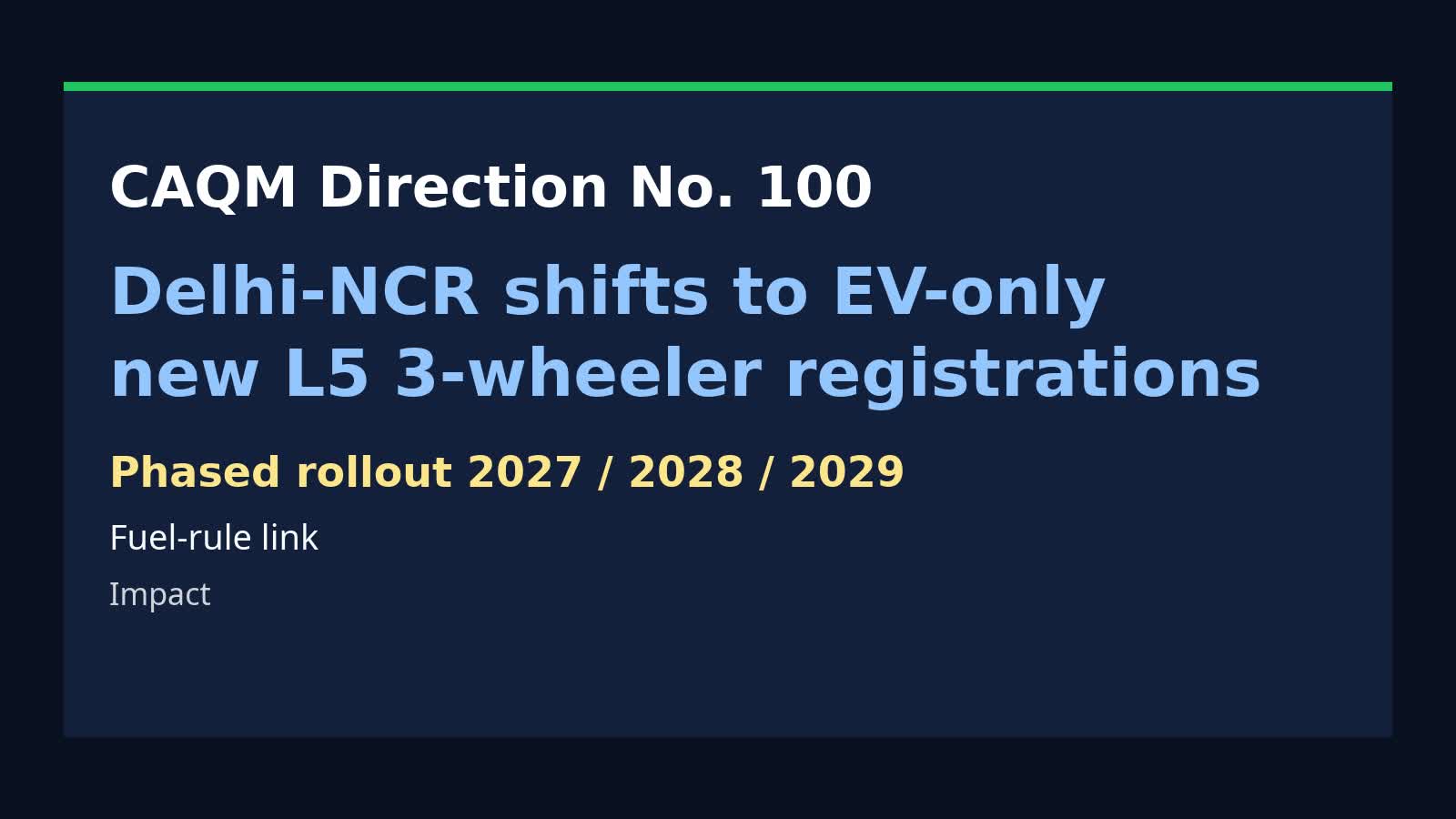
Direction No. 100 introduces a phased EV-only registration path for new L5 passenger and goods three-wheelers in Delhi-NCR.Key Highlights
- Direction No. 100 dated 15 May 2026: only electric L5 three-wheelers for new registration in phased NCR rollout.
- Phase dates: Delhi from 01 Jan 2027, high-vehicle-density NCR districts from 01 Jan 2028, remaining NCR districts from 01 Jan 2029.
- Direction No. 101 linkage: fuel dispensing in NCR tied to valid PUCC from 01 Oct 2026.
- Core emissions logic: CAQM noted that 3-wheelers are a small share of new sales but a disproportionately high source of transport PM emissions.
- Consumer and business implication: this is not only an air policy step, it is also a fleet economics and compliance transition window.
What Happened
At its 28th full Commission meeting on 15 May 2026, CAQM approved and issued a set of directions targeting vehicular pollution in Delhi-NCR. The headline move was Draft Direction No. 100, later notified as a statutory direction, mandating only electric L5 three-wheelers for new registrations in a phased manner across NCR. Alongside this, Direction No. 101 approved restrictions on fuel dispensing to vehicles that do not hold a valid PUCC from 01 October 2026.
This dual framework is important because it addresses both the incoming fleet and in-use compliance at the same time.
Phased Registration Timeline
| Region | Effective Date | Rule |
|---|---|---|
| NCT of Delhi | 01 Jan 2027 | Only electric L5 3-wheelers for new registration |
| Gurugram, Faridabad, Sonipat, Ghaziabad, Gautam Buddha Nagar | 01 Jan 2028 | Only electric L5 3-wheelers for new registration |
| Remaining NCR districts | 01 Jan 2029 | Only electric L5 3-wheelers for new registration |
| Entire NCR fuel stations | 01 Oct 2026 | Fuel only on valid PUCC compliance mechanism |
Why This Matters
The CAQM direction is high-impact because it targets a segment that is deeply embedded in daily urban movement: short-haul passengers, first mile and last mile goods, and app-linked city logistics. In Direction No. 100, CAQM cited expert findings that three-wheelers are a relatively small share in new vehicle sales but a disproportionate contributor to transport particulate emissions in NCR. The same direction notes potential annual PM2.5 reduction benefits from the EV shift in new additions.
In simple terms, regulators are using a high-utilisation vehicle class to deliver faster emissions gains rather than waiting for slower natural fleet turnover in larger segments.
Fuel, Cost and Market Impact
- Fuel demand mix: new urban three-wheeler additions should gradually move from liquid and gaseous fuels toward electricity, especially in Delhi first.
- Fleet capex pressure: operators may face a front-loaded replacement and onboarding cost cycle before savings normalize through lower running cost per km.
- Compliance technology demand: ANPR-linked checks and digital PUCC enforcement can increase formal compliance costs but reduce uncontrolled tailpipe emissions.
- OEM and supplier realignment: EV three-wheeler makers, battery financing platforms, charging and swapping operators can see stronger policy-led demand visibility in NCR.
- Used-vehicle market shifts: residual value expectations for older ICE 3-wheelers in NCR could compress as timeline certainty increases.
Auto Industry Context to Track
SIAM data for April 2026 reported 65,668 three-wheeler domestic sales, with the segment recording strong growth. A policy that locks new NCR L5 registrations to EV in phases can therefore influence a meaningful and fast-moving volume bucket, not a fringe segment.
For manufacturers, the question is no longer if NCR three-wheelers will electrify, but how quickly supply chains, financing tools and service networks can align to the deadline map.
Buyer and Operator Takeaway
- If you are planning a new commercial three-wheeler in Delhi, procurement strategy needs EV-first readiness well before 2027.
- Fleet businesses in Gurgaon, Faridabad, Sonipat, Ghaziabad and Noida should treat 2026 as planning year for financing, charging, route design and driver training.
- PUCC enforcement from October 2026 means in-use compliance risk can directly affect daily uptime at fuel stations.
What to Watch Next
- State and transport department implementation circulars on registration workflow and exemptions.
- Ground execution model for PUCC-linked fuel checks and dispute handling.
- Battery financing rates, swap network expansion, and service uptime metrics in high-density NCR corridors.
- Any harmonization with Delhi EV policy and NCR state-level incentives.
Final Verdict
This is a structural policy signal, not a symbolic announcement. CAQM has moved from broad advisories to timeline-based compliance architecture that can directly rewire urban three-wheeler economics in NCR.
For users, the immediate action is awareness and planning. For operators and OEMs, the message is clear: execute EV transition now, not at the deadline.