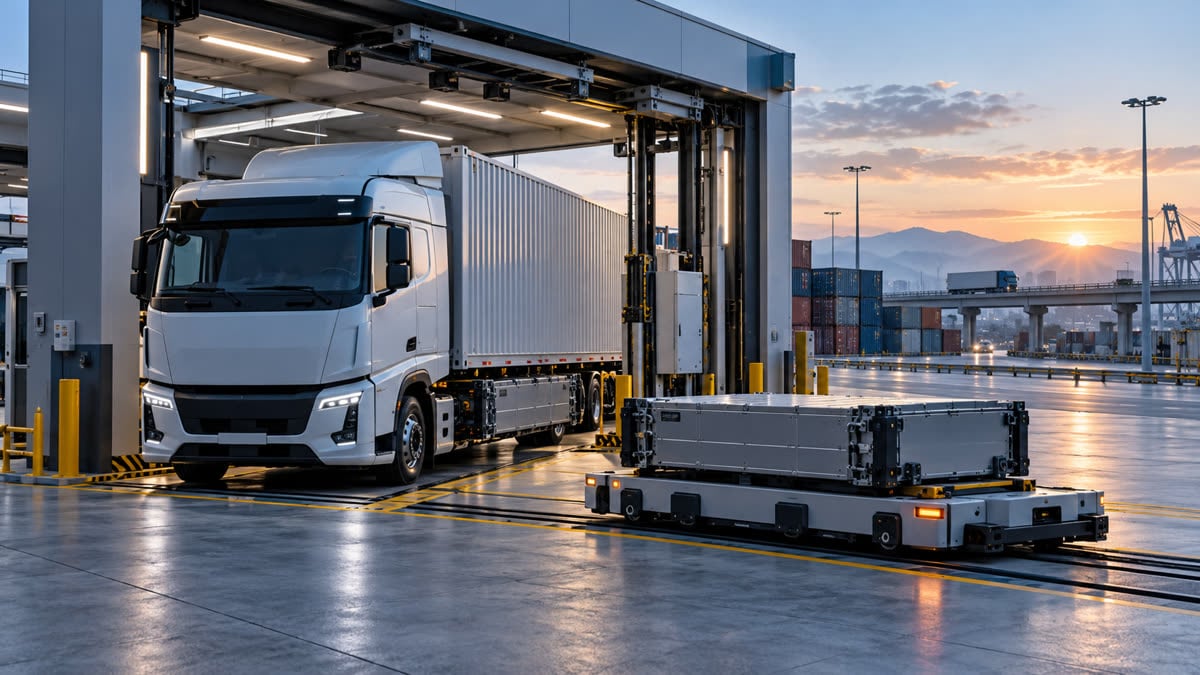
CATL announced on 20 October 2026 that it is pairing a new heavy-truck battery system with its QIJI battery-swapping network, where a compatible truck battery can be replaced in about five minutes. The Chinese battery maker is targeting 900 heavy-truck swap stations in China by the end of 2026 and 2,000 by 2027, with a longer-term goal of 10,000; for global freight operators, the news is a test of whether swap-based electric trucking can reduce replenishment downtime without putting a very large battery on every truck.
Key takeaways
- CATL has unveiled a dual-electric range-extension battery and a new generation of QIJI battery-swapping equipment for heavy-duty trucks.
- CATL says a QIJI swap can be completed in about five minutes, making turnaround time the main alternative to charging a large truck battery while a vehicle is idle.
- The company has set targets for 900 stations in China by the end of 2026, 2,000 by 2027 and 10,000 over the longer term.
- The announced network is China-focused. Its global importance depends on whether compatible trucks, battery standards and swap infrastructure spread to other freight corridors.
What CATL announced
In its 20 October release, CATL described a system built around a standardized swappable battery mounted in the truck chassis and a separate range-extension battery. The company says the arrangement is intended to let the main pack be used more deeply while keeping backup power available for demanding operating conditions. The release also presents flexible battery leasing and asset-management options as part of the operating model.
Reuters independently reported that CATL's new heavy-truck platform includes lighter, thinner and chassis-mounted battery designs for different applications. Its report also said the QIJI system can replace a truck battery in about five minutes. That is the practical promise behind the launch: a freight vehicle can spend less time waiting for energy, provided it reaches a compatible swap station.
This is a different proposition from simply installing a faster charger. A charging site must deliver enough electrical capacity and a truck must remain parked while the battery fills. A swap network instead moves much of the energy-management work to the station, where depleted packs can be charged away from the vehicle and exchanged as needed. That can be valuable on routes where vehicle utilisation is more important than private-car convenience.
The station targets are ambitious, but they are not supply already in place
CATL's plan calls for 900 heavy-truck swapping stations in China by the end of 2026, 2,000 by 2027 and a long-term network of 10,000 stations nationwide. Both the company's release and Reuters describe these as targets. They should not be read as evidence that the full network is already operating or that every truck can use it.
The distinction matters for fleet economics. A station count only changes operating costs when there is enough corridor coverage, compatible truck supply, reliable battery inventory and a commercial model that tells the fleet who owns the battery. A truck that must detour to swap, or wait for a suitable pack, may not achieve the uptime implied by a five-minute exchange at the bay.
Why this matters beyond China
The 20 October announcement is China-focused, so it does not immediately change how a fleet in Europe, North America or another Asian market refuels. But the operating problem is global: long-haul freight needs high utilisation, carries heavy loads and has less tolerance for charging downtime than a passenger car.
CATL had already presented its TECTRANS II commercial-vehicle battery platform at IAA Transportation in Hanover in September, describing it as a solution for global commercial-vehicle electrification. That earlier presentation is context rather than a claim that the new QIJI network is already international. The next test is whether the company and truck makers can take compatible hardware, safety certification and service support into more than one market.
For international operators, the practical watchlist is clear: truck and battery interoperability, local rules for high-voltage equipment, the availability of electricity at swap depots, the ownership or leasing terms for battery packs, and the effect on payload and resale value. These factors will decide whether a swap model is a useful logistics tool or remains concentrated on a limited set of corridors.
What it means for fuel use and trip costs
This launch does not change today's petrol or diesel price at the pump. It is a fleet-infrastructure bet that could change how some freight operators buy energy over time, but the effect would depend on deployment and actual operating costs. A company announcement about future stations is not a promise of lower transport prices for consumers.
For a diesel baseline on a planned journey, readers can use the fuel cost calculator with their vehicle's distance and efficiency. Those comparing electric-freight infrastructure can review the EV station directory, while anyone tracking the conventional-fuel side can check the live fuel-prices tracker. The relevant comparison is energy cost per kilometre plus downtime, maintenance, battery lease or depreciation, payload and route coverage.
For private drivers, the immediate effect is indirect. Freight electrification can eventually influence fleet purchasing, depot design and the energy mix used to move goods, but it does not mean that a passenger vehicle can use a heavy-truck swap station. The technology's near-term audience is commercial transport, where a predictable stop and a standardized pack may be worth more than a headline range figure.
What to watch next
- Whether CATL reports actual station openings against its 900-station target by the end of 2026.
- Which truck manufacturers and freight operators adopt compatible chassis and battery formats.
- Whether QIJI or partners announce pilots outside China, with clear information on certification, pricing and battery ownership.
- How the model performs on payload, maintenance and total operating time compared with diesel trucks on the same corridor.
The useful takeaway is that CATL is treating heavy-truck electrification as an energy-replenishment and asset-management problem, not only a battery-capacity problem. The launch is significant because it puts a measurable station-building target behind that strategy; its worldwide impact will be determined by what happens after the targets meet real freight routes.
Sources
- Reuters, “CATL bets on battery swapping to speed electrification of heavy trucks”, 20 October 2026.
- CATL via PR Newswire, “CATL Unveils Dual-Electric Range Extension Battery to Accelerate Electric Heavy-Duty Truck Adoption”, 20 October 2026.
- CATL, “CATL Launches TECTRANS II at IAA Transportation 2026 to Accelerate Global Commercial Vehicle Electrification”, 14 September 2026.
This article is for general information only and is not financial, insurance or legal advice.