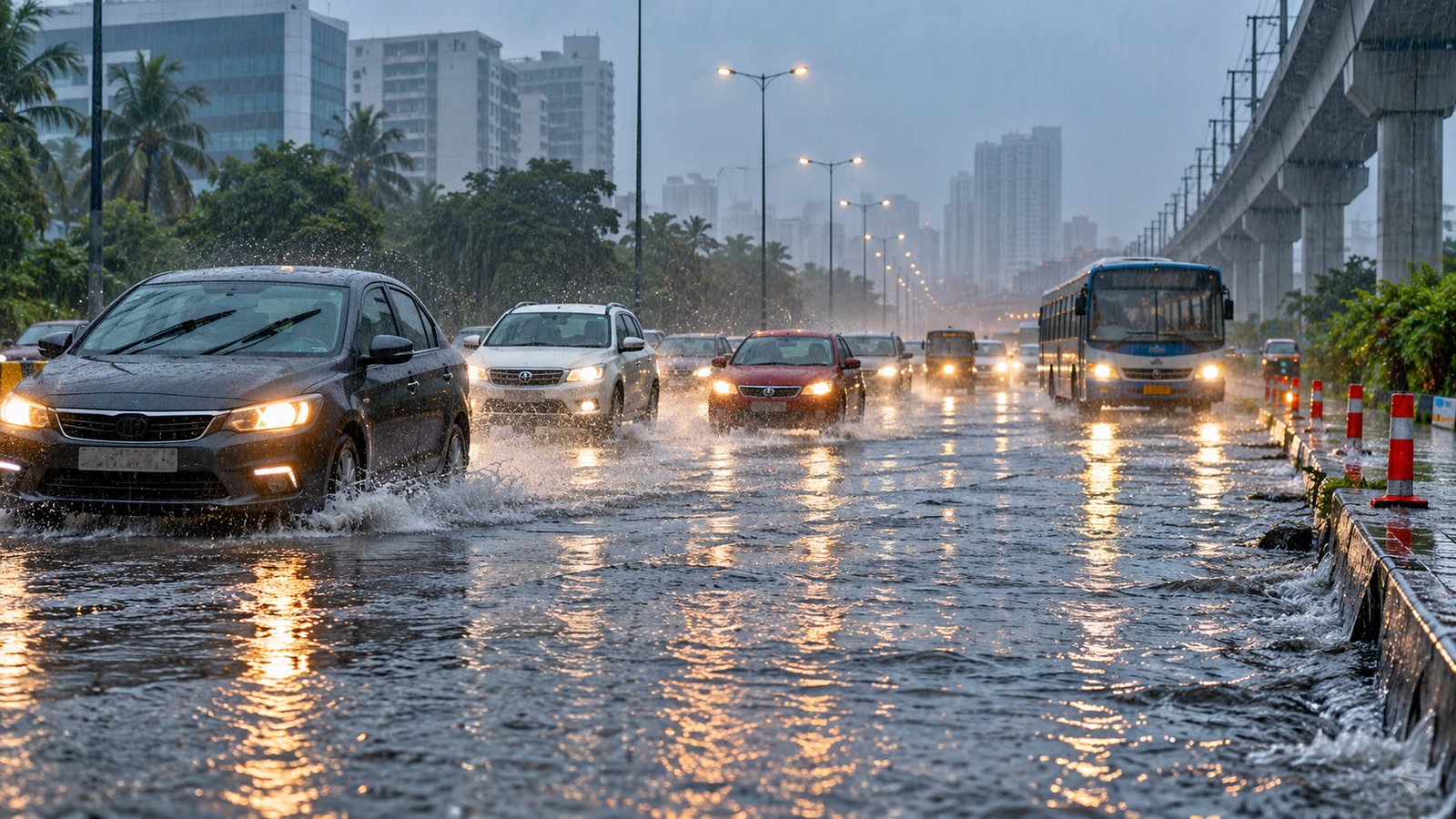
Chennai is entering another rain-risk window after waterlogging and traffic disruption during the Northeast Monsoon. The India Meteorological Department’s Regional Meteorological Centre, Chennai, has warned of very heavy rain over Tamil Nadu and Puducherry on 21–22 October 2026, followed by heavy rain from 23–27 October, so drivers should check the route and local advisories before leaving.
Key takeaways
- The current IMD warning covers very heavy rain on 21–22 October and heavy rain through 27 October.
- Recent showers flooded roads in parts of Chennai, with North Chennai among the worst-affected areas.
- Rain can add delay, stop-start idling and detour distance even when a road remains open.
- There is no citywide closure in the current warning; route conditions can change street by street.
- Drivers should avoid visibly flooded roads, allow extra time and keep a fuel or charging margin for a changed route.
What the current warning means for Chennai trips
The IMD warning is a regional weather forecast, not a blanket order that every Chennai road will close. It does, however, signal a higher chance of reduced visibility, surface water, slippery stretches and traffic buildup, especially in low-lying areas and on roads where drainage is slow. A route that is usable in one part of the city can still be difficult a few kilometres away.
For commuters, the practical question is not only whether rain is forecast but whether the planned route includes an underpass, a low bridge approach, a narrow service road or a work zone that can collect water. For taxis, delivery vehicles, buses and small freight operators, a delay can also affect the next trip, loading slot or driver shift. Treat the IMD outlook as a reason to recheck the route close to departure, not as a guarantee that a particular road is closed or open.
What the recent waterlogging showed
The latest heavy spell already produced a measurable road-impact event. The New Indian Express and NDTV Profit, citing rainfall data from Chennai civic and disaster-management systems, reported that Kathivakkam recorded 310.2 mm and Parrys 300.9 mm by midnight during the 18 October spell. Those are reported readings from the earlier event, not a prediction that the same amount will fall again, but they show how quickly a short, intense spell can overwhelm parts of the road network.
Hindustan Times reported flooding and traffic congestion across several parts of Chennai, while also reporting that civic teams were deployed to clear waterlogged roads and respond to complaints. The New Indian Express separately reported slow-moving traffic around bus terminals during the holiday travel rush after rain affected roads outside the terminals. The combination matters to drivers: even after water drains from one stretch, queues can remain on the approaches and alternate roads.
Why rain can change the fuel and trip bill
A weather disruption does not need a fuel-price hike to raise the cost of a journey. A detour adds kilometres, standing traffic increases idling and repeated acceleration, and a delayed trip can require an extra refuelling or charging stop. On a longer journey, the time cost can be as important as the fuel cost for a fleet or a cab operator.
Once the latest route is known, use the road-trip planner to review distance and stop timing, then use the fuel cost calculator with a realistic mileage assumption. If the safer alternative moves onto a tolled highway, check the toll-charge calculator separately rather than assuming the original toll estimate still applies.
Checks before you leave
- Check the latest warning and traffic update. The IMD outlook gives the weather risk; local traffic authorities and road operators are better placed to identify a current barricade, diversion or flooded underpass.
- Do not enter water when the road edge is not visible. Standing water can hide open drains, potholes, broken shoulders and stalled vehicles. Turn around if the route looks unsafe instead of following the vehicle ahead.
- Prepare the vehicle. Check wipers, lights, tyre condition and brakes before a rain-heavy commute. Two-wheeler riders should also account for reduced grip and splash from larger vehicles.
- Keep a margin. Leave enough fuel or charge for a slower route and an unplanned stop. A nearly empty tank or low battery makes a weather-related detour harder to manage.
- Recalculate after a diversion. If a route changes, update the distance, expected travel time and toll assumption before setting out. A navigation app can suggest a route, but it may not know that a waterlogged local road is unsuitable for the vehicle.
What to watch next
The next useful updates are the IMD’s daily warning changes and location-specific traffic directions from Chennai authorities. The current IMD schedule keeps Tamil Nadu and Puducherry under a heavy-rain outlook through 27 October, but the actual effect on a trip will depend on where rain falls, how quickly water drains and whether traffic control teams impose a diversion.
Drivers should also watch for fresh advisories affecting bus terminals, airport approaches, OMR, North Chennai and other low-lying or heavily travelled corridors. Those are operational updates, not a new fuel or toll rule. They may nevertheless change the time and cost of a journey on the day.
Reader takeaway
Chennai’s immediate issue is route reliability, not a change in fuel prices or toll charges. With very heavy rain forecast on 21–22 October and heavy rain expected to continue through 27 October, the safest planning habit is to check conditions shortly before departure, avoid submerged stretches and budget for a slower or longer route.
Sources
- India Meteorological Department, Regional Meteorological Centre Chennai — Sub-division-wise warnings (21 Oct 2026)
- Hindustan Times — Rain lashes Chennai as northeast monsoon gets active in Tamil Nadu; roads flooded, traffic snarls (18 Oct 2026)
- NDTV Profit — Tamil Nadu Monsoon Alert: Why Chennai Is Facing Heavy Waterlogging And What IMD Predicts Till Oct 23 (18 Oct 2026)
- The New Indian Express — Chennai hit by cloudburst-like rain, 1st 300 mm event of northeast monsoon (18 Oct 2026)
- The New Indian Express — Downpour no dampener, 1.5 lakh leave Chennai (19 Oct 2026)