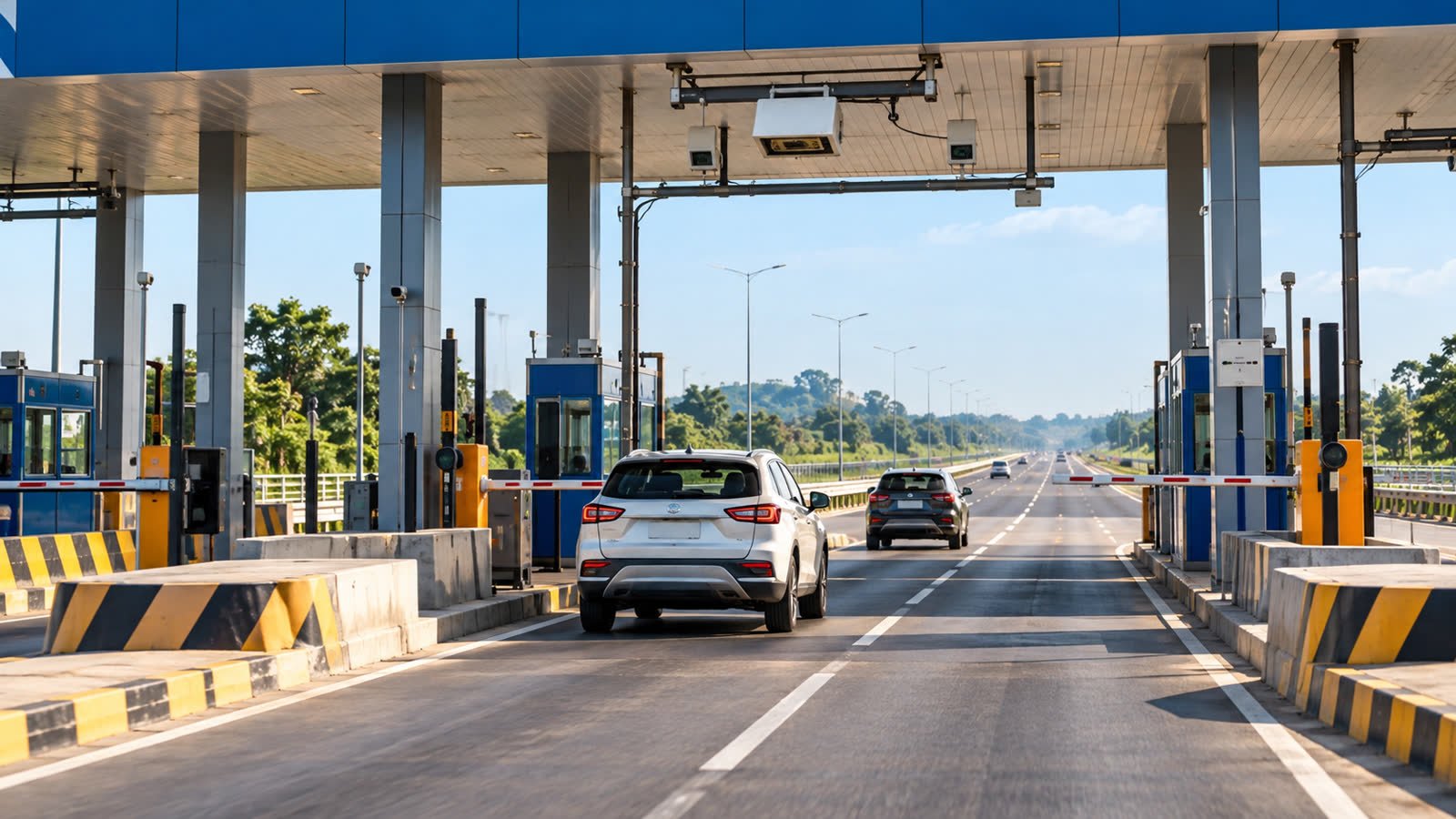
Average time for a vehicle to cross a National Highway fee plaza through electronic toll collection (ETC) was 40 seconds in the 2024–25 assessment, compared with 12.23 minutes under the earlier manual system, according to the Ministry of Road Transport and Highways. The gap matters to Indian drivers because shorter toll stops can make queueing and trip-time planning more predictable, although it does not change the toll charged.
Key takeaways
- The official 2024–25 NETC assessment puts the average ETC crossing at 40 seconds.
- The comparable average under the earlier manual tolling system was 12.23 minutes, or about 734 seconds.
- The time improvement is not a reduction in the notified toll fee; it mainly affects delay, idling and queue uncertainty.
- Barrier-free Multi-Lane Free Flow (MLFF) tolling is being rolled out on selected stretches, but it is not yet a guarantee for every highway route.
- Drivers should keep FASTag active, properly affixed and funded before entering an electronic tolling zone.
What the latest data says
A Ministry of Road Transport and Highways release posted on 29 January 2026 said an impact assessment of the National Electronic Toll Collection programme during 2024–25 found that a vehicle took an average of 40 seconds to cross a fee plaza under ETC. The same release compared it with 12.23 minutes per vehicle under the earlier manual tolling system and described the result as an improvement in traffic flow and congestion.
ETInfra reported the comparison on 20 October 2026 as a reduction from 734 seconds in 2014 to 40 seconds on RFID-based FASTag lanes. The 734-second figure is the rounded-second equivalent of 12.23 minutes, so the two reports describe the same broad shift rather than two different toll-time datasets. The figures are averages: a busy plaza, a malfunctioning tag, a lane change or a traffic incident can still make an individual crossing slower.
What changes for a highway user
For a private driver, the practical benefit is more predictable time at the plaza. On the official averages, the gap between manual and ETC crossing time is about 11.6 minutes per crossing. That is a useful way to understand the scale of the improvement, but it is not a promise that every vehicle will save 11.6 minutes on every trip. The older manual average and the newer ETC average describe different operating systems and network conditions.
The change also does not mean the toll itself has become cheaper. A driver still pays the applicable user fee for the vehicle class and plaza. For a route-specific estimate before leaving, the toll charge calculator can help separate the fee from the time spent at toll points.
There can be a fuel-use effect when vehicles spend less time braking, idling and accelerating in a queue. The Ministry says barrier-free tolling is intended to reduce fuel consumption and travel time, but it has not published a single litre or rupee saving that applies to all vehicles. Drivers can estimate the wider journey cost with the fuel cost calculator, using their own vehicle efficiency, fuel price and route distance.
For fleets and frequent highway users, a shorter average crossing can improve scheduling and reduce uncertainty around delivery or arrival times. It should still be treated as one input: loading stops, roadworks, weather, urban congestion and diversions can have a larger effect than the toll plaza itself. The road-trip planner is useful for combining route timing with planned stops.
Where barrier-free tolling fits
FASTag lanes still require a vehicle to pass through a tolling point, even when the tag is read automatically. A separate MLFF system is designed to remove the physical stop altogether on selected stretches. In a 25 June 2026 release, the Ministry said the Gharaunda toll plaza on NH-44 had begun using overhead gantries, cameras and electronic toll collection to identify vehicles and deduct the user fee without requiring them to stop or slow down.
The same official release said NHAI had already implemented MLFF at Choryasi in Gujarat, Mundka in Delhi and Daulatpura in Rajasthan. ETInfra’s 20 October report described further 2026 expansion, but route coverage remains location-specific. Drivers should follow the signs and lane instructions at each plaza rather than assume that a normal FASTag lane is barrier-free.
MLFF also makes a functioning payment trail important. The Ministry says an unsuccessful FASTag payment on an MLFF stretch can generate an e-notice. Its published process gives the vehicle user 72 hours to pay at the normal applicable toll rate; payment after 72 hours is at twice the applicable rate, and a grievance can be submitted within 72 hours if the notice is believed to be incorrect. The FASTag toll-rules guide covers the related checks for wrong deductions and complaints.
What to check before a long drive
- Check that the FASTag is active, correctly fixed to the windscreen and linked to a payment source with sufficient balance.
- Keep the vehicle registration and number plate clear. The Ministry’s MLFF advisory specifically calls for compliant High Security Registration Plates and adherence to signs in the tolling zone.
- Check the toll points on the planned route. Faster crossing time does not remove the need to budget for each notified user fee.
- Keep payment alerts and e-notices available after the trip so a failed transaction can be checked within the stated window.
What to watch next
The next meaningful change will be the spread of MLFF and other automated tolling systems beyond the initial selected stretches. The policy direction is clear, but the driver experience will depend on how consistently payment failures, number-plate reads, enforcement and grievance handling work on each corridor.
For now, the 40-second figure is best read as a network-level performance signal, not a guaranteed arrival-time promise. It shows why keeping FASTag functional matters: the less a vehicle has to stop at the toll point, the more of the journey can be spent moving rather than waiting.
Sources
- Press Information Bureau, “Collection and Fastag Adoption”, 29 Jan 2026
- ETInfra, “From 734 to 40 seconds: How technology turns around toll time at national highways”, 20 Oct 2026
- Press Information Bureau, “NHAI Rolls Out Multi-Lane Free Flow (MLFF) Tolling at Gharaunda Toll Plaza on NH-44”, 25 Jun 2026