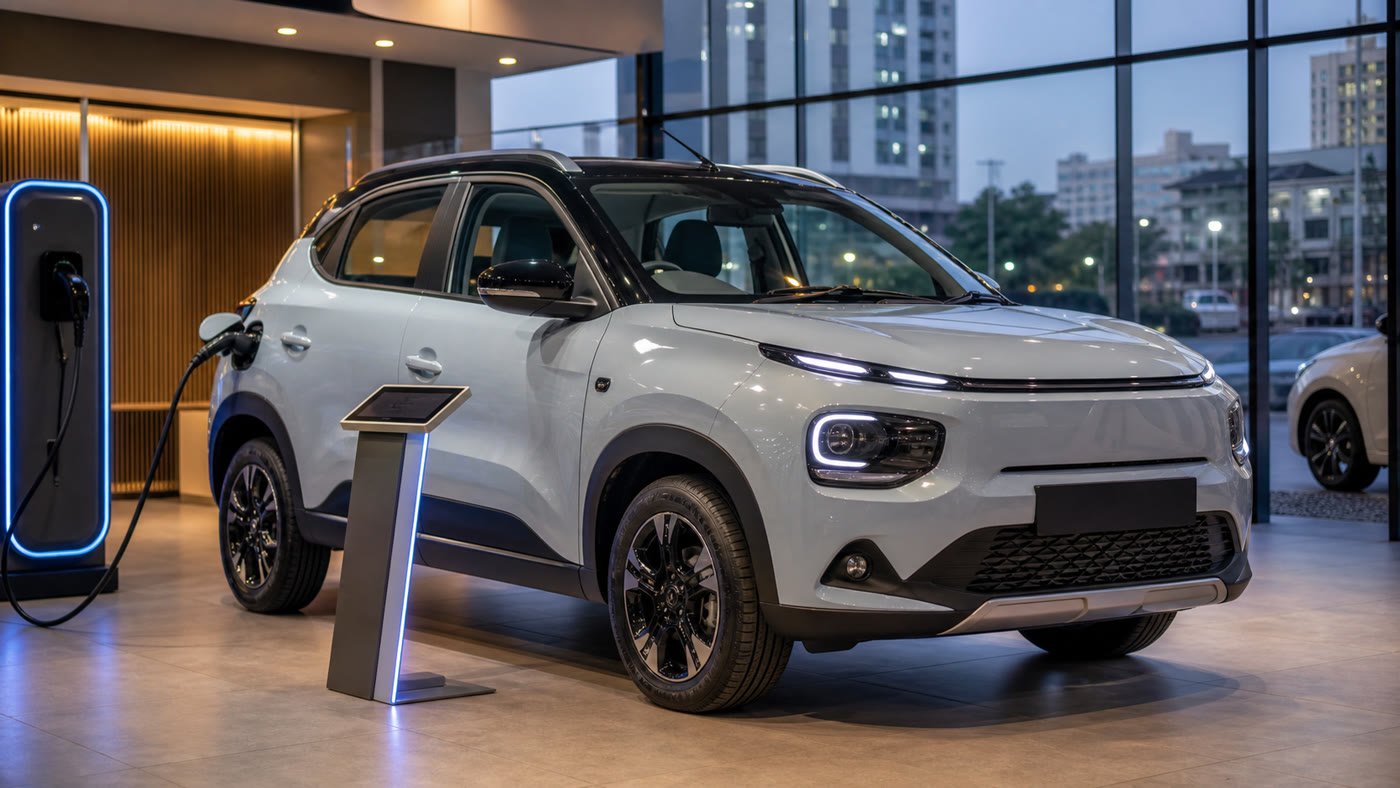
Citroen has teased the eC3 X ahead of its India launch, signalling a much-needed refresh for the brand's only electric offering in the country. The update is important for FuelPrice readers because the eC3 sits in the affordable urban EV space, where buyers compare electric running cost against petrol, CNG and compact SUV alternatives rather than simply looking at badge value.
The latest teaser, reported by NDTV Auto and autoX on 3 June 2026, points to an updated eC3 carrying Citroen's new X suffix. The refreshed model is expected to receive styling, cabin and safety changes, while the battery and motor package is likely to remain close to the current eC3 baseline.
What Happened
Citroen has previewed the updated eC3 X for India, bringing the electric hatchback closer to the brand's newer X-badged petrol models. NDTV Auto reports that the teaser shows visual revisions such as a redesigned front bumper, LED daytime running lamps, LED fog lamps, ORVM-mounted turn indicators and dual-tone alloy wheels. autoX also says the cabin is expected to get a more premium treatment, with likely leatherette finishes and comfort-focused changes.
Most of the reported updates are feature and positioning changes rather than a clean-sheet EV redesign. That matters because the current eC3 already has a defined mechanical identity: a compact electric hatchback based on the C3, aimed primarily at city use, ride comfort and practical EV running costs. The X update appears designed to make the same basic EV more competitive in showroom comparison.
Expected Feature and Safety Changes
The eC3 has often been discussed as an EV with useful space and ride comfort but relatively modest equipment. The eC3 X teaser therefore lands at the right point in the product cycle. NDTV Auto expects additions such as automatic climate control, cruise control with speed limiter, USB Type-C charging ports, auto-dimming IRVM, LED ambient lighting and possibly a 360-degree camera. autoX reports that safety equipment could improve with six airbags and tyre pressure monitoring.
These additions are not cosmetic for the Indian EV buyer. In a price-sensitive segment, a buyer comparing an EV with a petrol hatchback, CNG hatchback or a compact electric SUV often asks three practical questions: is the car safe enough, is it comfortable enough for daily use, and does the ownership cost justify the higher purchase price? If Citroen adds stronger safety and convenience equipment without a sharp price jump, the eC3 X could become easier to justify for both private users and fleet operators.
Battery, Range and Charging Baseline
Mechanically, the eC3 X is expected to remain close to the existing eC3. Citroen's official India eC3 brochure lists a 29.2 kWh lithium-ion battery pack, a permanent magnet synchronous motor producing 57 PS and 143 Nm, a single-speed automatic transmission, Eco and Standard drive modes, and a top speed of 107 km/h for private users. The same brochure lists DC fast charging from 10 percent to 80 percent in 57 minutes, and charging from a 15 amp plug point from 10 percent to 100 percent in about 10 hours 30 minutes, subject to conditions.
Media reports on the eC3 X expect the same 29.2 kWh battery and motor setup. NDTV Auto refers to a claimed range of around 320 km, while autoX notes that real-world range is likely to remain closer to roughly 240-250 km depending on use. That distinction is important for readers: brochure or certified range is useful for comparison, but air-conditioning use, driving speed, traffic, battery temperature and charging habits decide the cost-per-kilometre experience in real use.
Why It Matters for FuelPrice Readers
The eC3 X is relevant because India's entry-level EV market is no longer judged only by low running cost. Electricity is still cheaper per kilometre than petrol for most urban users, but buyers now expect more complete products. A private user wants comfort, safety and connected features. A fleet operator wants predictable uptime, straightforward charging and low operating cost. A family replacing a petrol hatchback wants range confidence and enough equipment to avoid feeling short-changed after paying an EV premium.
Citroen's challenge is that the eC3 competes against strong domestic EV options, especially from Tata Motors, and increasingly against feature-rich petrol and CNG cars at lower entry prices. The current eC3 price band has generally been around Rs 12.90 lakh to Rs 13.41 lakh ex-showroom, according to marketplace listings such as CarDekho. At that level, the buyer expects a better balance of range, equipment and safety than early-generation EVs offered.
Buyer Impact: What Changes If the eC3 X Is Priced Well
- Private city buyers: A richer cabin and better safety kit can make the eC3 X feel less like a cost-saving EV and more like a complete family hatchback.
- Fleet and ride-hailing users: If the battery and charging setup remain familiar, operators can assess the refresh mainly on uptime, acquisition cost and passenger comfort.
- Petrol and CNG switchers: A stronger feature package can reduce the hesitation around paying more upfront for lower running costs.
- Citroen dealers: The X update gives showrooms a clearer reason to re-open conversations with buyers who rejected the old eC3 for missing features.
What To Watch Next
The launch price will decide how strong this update really is. If Citroen keeps the eC3 X close to the existing price band while adding meaningful safety and comfort features, it can improve the value equation. If the price rises too much, buyers may still move toward alternatives that offer stronger feature depth or broader charging confidence.
The second watch point is the confirmed safety list. Six airbags, ESP, TPMS and hill-hold assist would make the update more meaningful than a design refresh. The third watch point is whether Citroen announces any real efficiency gain, warranty update, charging-support package or fleet ownership programme with the eC3 X. Those elements would directly affect EV running-cost confidence.
Final Takeaway
The Citroen eC3 X teaser is a focused but important EV update. It does not appear to be a major battery-platform shift, but it could correct the feature and safety gaps that made the current eC3 harder to recommend against newer rivals. For city buyers and fleets watching fuel bills, the real story will be whether Citroen can combine the eC3's low EV running cost with a more complete cabin, stronger safety package and disciplined launch price.