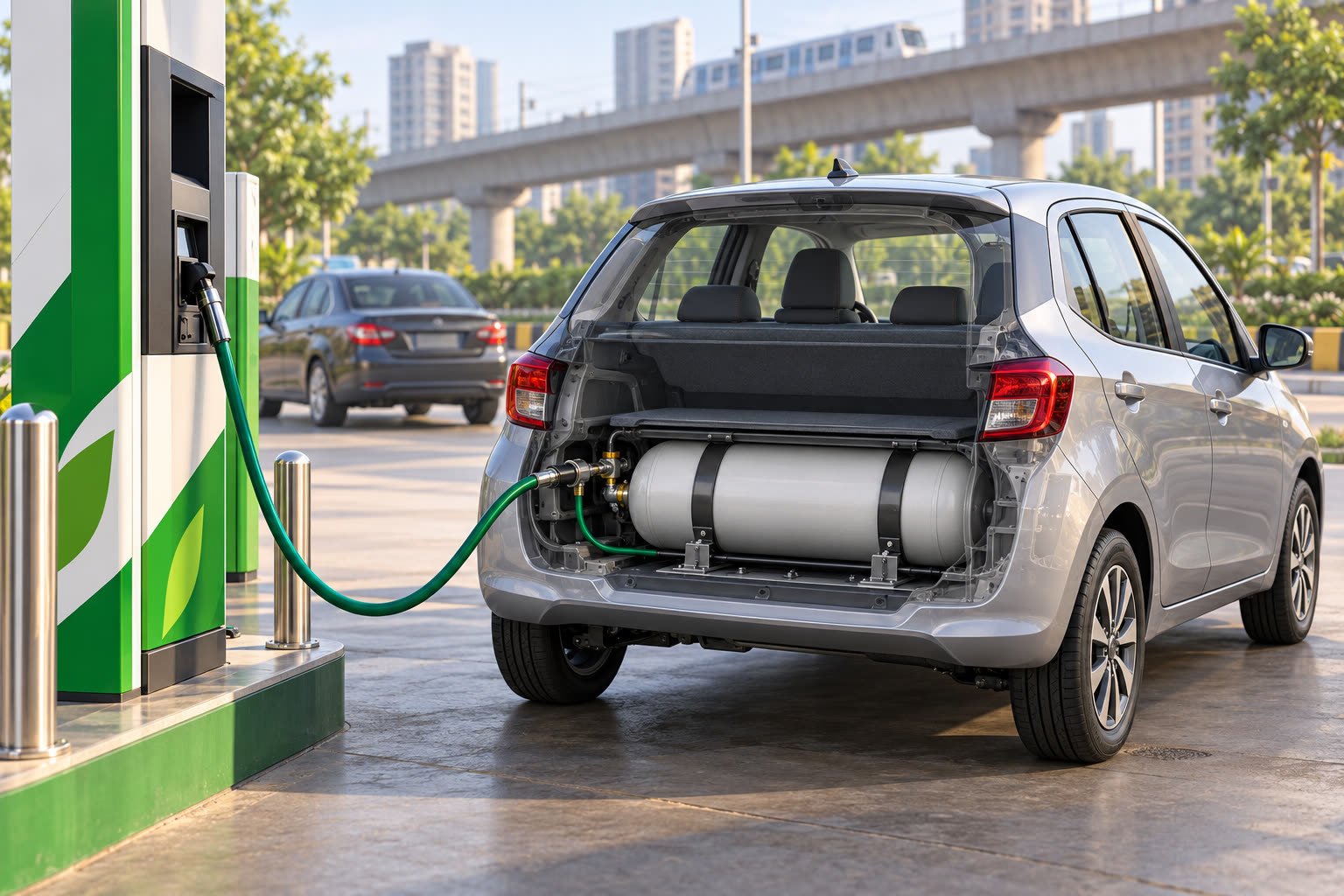
CNG-led passenger-vehicle retail overtook diesel in India's FY2025–26 fuel mix, according to FADA data highlighted in fresh 7 Oct 2026 auto coverage. The shift matters to buyers comparing running costs, but it is a market signal rather than a universal recommendation: station access, luggage needs and route pattern still decide whether CNG fits a particular vehicle.
Key takeaways
- FADA's official FY2025–26 fuel-wise table records CNG/LPG at 21.98% of passenger-vehicle retail, ahead of diesel at 18.08%.
- The gap is 3.90 percentage points, calculated from the two FADA shares; recent reports commonly describe the grouped CNG/LPG category as CNG.
- The crossover shows that the Indian passenger-vehicle market is becoming more multi-fuel. It does not mean diesel has stopped making sense for every use case.
- CNG can appeal to high-use city buyers when the local network is convenient, while boot space, performance and long-distance access remain important checks.
- A route-specific fuel-cost comparison is more useful than choosing from the national share alone.
What the data actually shows
FADA's release dated 6 Apr 2026 reports the FY2025–26 all-India passenger-vehicle fuel mix. Its official table places CNG/LPG at 21.98% and diesel at 18.08% of passenger-vehicle retail for the financial year. CarWale and CarLelo independently highlighted the same comparison in reports published on 7 Oct 2026.
That puts the CNG/LPG category 3.90 percentage points ahead of diesel, a calculation from FADA's published shares. The category label matters: FADA combines CNG and LPG in its table, while the fresh auto coverage uses CNG as the shorthand because CNG is the larger and more visible part of the factory-fitted alternative-fuel market. The data therefore supports a CNG-led shift, not a claim that LPG alone overtook diesel.
The result is also about retail mix, not fuel availability or a nationwide pump-price change. It tells us what proportion of new passenger-vehicle registrations fell into each powertrain category during FY2025–26. It does not tell a buyer what a CNG kilogram costs in a particular city today, how long a queue will be at a station or how a specific car will perform with a full load.
Why CNG is winning more buyer comparisons
The appeal is practical. A factory-fitted CNG car keeps the familiar internal-combustion layout while giving high-use drivers another fuel option. Where CNG is readily available, the combination of local pump rates, real-world efficiency and regular driving distance can make the running-cost calculation attractive compared with a petrol or diesel alternative.
That calculation is local, so the first check is the rate and coverage around the owner's normal route. FuelPrice's CNG price listings for Indian cities can help establish the starting assumption, but the displayed rate should still be checked at the station before a purchase or trip.
The cost advantage has conditions
A CNG comparison works best when the vehicle can refuel without repeated detours. A driver who passes a reliable station on the daily commute may value the lower operating cost differently from someone whose regular work involves remote highways or irregular routes. The same national market share can therefore hide very different ownership experiences.
For a useful comparison, record the distance travelled, the vehicle's actual consumption and the price paid at the stations used most often. Then run the same route through the fuel cost calculator for the available powertrains. The aim is to compare the owner's own pattern, not a brochure mileage figure or a national average.
CNG does not replace diesel one-for-one
CarWale and CarLelo both note that CNG comes with trade-offs. The tank can reduce usable boot space, performance may differ from an equivalent petrol or diesel version, and the ownership experience depends on the reach of the CNG network. These are practical constraints for families carrying luggage, drivers covering long inter-city distances and operators who cannot choose when or where to refuel.
Diesel also retains a role in parts of the market where highway range, load carrying and strong low-speed torque matter more than the lowest possible city running cost. The FY2025–26 crossover should therefore be read as a change in the buyer shortlist, not as proof that one fuel has become the correct answer for every SUV, MPV or fleet vehicle.
The broader signal is that petrol, CNG, diesel, hybrids and EVs are now competing on different combinations of purchase price, route convenience, performance and operating cost. CNG has gained ground in the price-sensitive, high-use part of that comparison; it has not removed the reasons some buyers continue to consider diesel or electric options.
Checks before choosing a powertrain
- Map refuelling access. Check stations along the daily commute, school or work route and the highways used most often. For longer journeys, the road-trip planner can help test whether fuel stops fit the route.
- Compare the full vehicle layout. Inspect the boot floor, spare-wheel arrangement and seating configuration with the CNG tank in place. Do not assume that two cars with the same fuel label offer the same luggage practicality.
- Use the factory-fitted details. Ask for the documented warranty, service schedule and equipment list for the exact variant. A market trend does not substitute for checking the vehicle-specific terms.
- Separate price from usage. Compare the delivered vehicle cost, expected annual distance and actual fuel access together. A lower fuel bill can be offset by inconvenient refuelling or a vehicle layout that does not work for the household.
- Keep the comparison open. Include diesel, hybrid and EV alternatives where they suit the route. The right result depends on how the vehicle is used, not only on which fuel currently has the larger share.
What to watch next
The next useful data point is whether CNG keeps its lead as festive-season retail develops and as manufacturers add or refine factory-fitted options. New monthly fuel-mix releases will show whether the FY2025–26 result is a sustained structural change or part of a market that keeps moving between powertrains.
For buyers, the practical takeaway is narrower and more useful: CNG is now too significant to ignore in a high-mileage comparison, but the national percentage does not calculate an individual's ownership cost. Check station access, luggage needs, vehicle-specific terms and a realistic route-cost estimate before treating the market trend as a purchase decision.