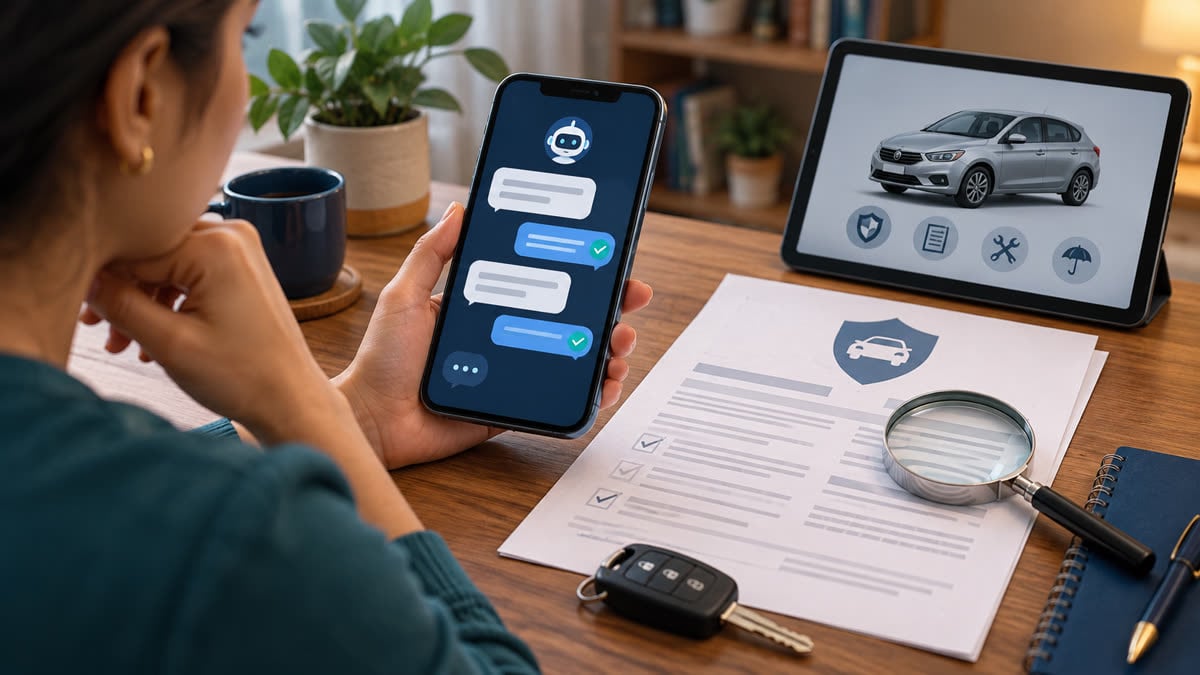
Indian car owners are increasingly turning to AI chatbots to decode motor-insurance terms during research and renewal, according to a report published on 7 Oct 2026. The usefulness is limited: chatbots can explain concepts such as IDV, no-claim bonus and add-ons, but the policy schedule - not a chatbot answer - sets the cover, exclusions and price that apply to a vehicle.
Key takeaways
- A 2026 peer-reviewed study of 245 experienced insurance-chatbot users in India found that ease of use, usefulness and trust shape adoption.
- The same study found that perceived risk reduced trust but did not stop continued use, making verification important when an answer sounds plausible.
- IRDAI's seven-member AI working group is preparing governance recommendations for insurers; it has not changed the terms of motor-insurance policies for buyers.
- Third-party motor cover remains a legal requirement for vehicles used on public roads, while own-damage and add-on protection depend on the policy wording.
- During renewal, the quote, policy schedule, exclusions and insurer-issued documents remain the records that control the transaction.
Why this matters during renewal
Motor insurance is a product where a short answer can hide a long list of conditions. A chatbot can make terms such as Insured Declared Value, deductible, depreciation and no-claim bonus easier to understand. It cannot see every detail that an insurer uses for a particular vehicle, including the declared value, claims history, registration location, policy dates, selected add-ons or the wording attached to the quote.
That distinction matters most when a policy is about to expire. The car-insurance renewal and NCB guide explains the difference between third-party cover, own-damage protection and the no-claim bonus. A chatbot can help a reader frame a question about those terms, but an answer generated from general web information is not a renewal confirmation.
What the India study found
The research article Insurance chatbot adoption and continued usage in emerging markets: impact of human-agent access, published by Emerald in the International Journal of Bank Marketing, examined survey data from 245 experienced insurance-chatbot users in India. The study used a technology-acceptance model to test the role of usefulness, ease of use, trust, perceived risk and access to human help.
Its finding is more nuanced than a simple technology-versus-human story. Convenience and usefulness were significant drivers of adoption, while trust affected both first use and continued use. Perceived risk weakened trust, but did not deter continued use. In practical terms, a customer may know that a chatbot can be wrong and still use it because it is quick, available outside office hours and easier for basic questions.
A separate ServiceNow India customer-experience report, cited in the recent coverage, found that 80% of Indian consumers used AI chatbots for tasks such as checking complaints, getting product recommendations or accessing self-help guides, while 78% used them when reviewing investment options. Those figures describe general consumer behaviour, not car-insurance purchases. They do, however, show why insurance owners may arrive at a renewal conversation after first asking an AI tool to translate the jargon.
What a chatbot can explain - and what it cannot confirm
| Question | Useful role for AI | Record that confirms the answer |
|---|---|---|
| What is IDV? | Explain that it is the declared value used in the policy and claim settlement framework. | The insurer's quote and policy schedule for the vehicle. |
| What does an add-on cover? | Translate terms such as zero depreciation or engine protection into plain language. | The exact add-on wording, limits, waiting conditions and exclusions. |
| What happens to NCB? | Explain the general idea of a claim-free discount and the questions to ask at renewal. | The previous policy, claim record and insurer-issued renewal document. |
| Is third-party cover enough? | Describe the difference between liability cover and protection for the insured vehicle. | The selected policy type and certificate of insurance. |
IRDAI's motor-insurance guidance for policyholders says third-party liability insurance is mandatory for vehicles plying on public roads. That legal requirement is separate from the question of whether a vehicle also has own-damage, theft, flood or add-on protection. A chatbot may describe the categories, but it cannot convert a general explanation into cover that is absent from the issued policy.
IRDAI is working on AI guardrails, not new renewal rules
IRDAI constituted a seven-member working group on AI in June 2026, chaired by Professor Sandeep K. Shukla of IIIT Hyderabad. The group was asked to study AI adoption and governance in insurance and recommend safeguards around ethical, transparent and explainable use, including claims processing and fraud prevention. Its recommendations were to be submitted within three months of constitution.
This is a governance exercise for regulated entities, not a rule that currently changes a customer's premium, renewal date, IDV or claim entitlement. The recent car-insurance chatbot coverage correctly places the regulator's work alongside the consumer question: as insurers adopt more AI, policyholders need clearer explanations and a way to verify decisions against the underlying documents.
Checks that matter before acting on an AI answer
The most useful output from a chatbot is a list of questions to take to the quote or policy schedule. The important checks are:
- Policy identity: the vehicle registration, make, model, variant, policy period and owner details match the records.
- IDV and premium: the quoted IDV, own-damage premium, third-party component, deductible, taxes and any service charges are visible and dated.
- NCB: the discount shown on the renewal quote matches the prior policy and claim history; a general chatbot answer cannot validate eligibility.
- Add-ons: every selected add-on has a named limit, condition or exclusion in the wording, rather than only a marketing description.
- Claims route: the policy shows how to report a claim and which documents or inspection steps may be required.
For EV owners, battery, charger and water-ingress questions can add another layer of exclusions; the EV versus petrol car-insurance guide covers the policy questions that differ by powertrain. Riders can use the bike-insurance renewal guide for the equivalent third-party, own-damage, NCB and IDV checks.
The reader takeaway
AI can make insurance language less intimidating and can help a vehicle owner prepare sharper renewal questions. It should not be treated as an underwriter, claims assessor or substitute for the issued policy. When a chatbot answer conflicts with the insurer's quote, schedule or wording, the document is the relevant record to resolve the difference.
Sources
- Business Standard - AI in the Driver's Seat: How Consumers Are Using Chatbots to Shop Car Insurance - 7 Oct 2026
- Emerald Publishing - Insurance chatbot adoption and continued usage in emerging markets: impact of human-agent access - 20 Feb 2026
- ServiceNow Newsroom - AI to bridge India's customer service gap as 80% of consumers rely on chatbots for key services - 24 Mar 2025
- Business Standard - IRDAI sets up working group to guide AI adoption in insurance sector - 18 Jun 2026
- IRDAI - Motor Insurance, Policy Holder guidance - accessed 8 Oct 2026
- TaxGuru - IRDAI Forms AI Working Group to Strengthen Governance in Insurance Sector - 17 Jun 2026
This article is for general information only and is not financial, insurance or legal advice.