Online commercial vehicle insurance adoption in India rose 46% year on year in October 2026, according to Policybazaar data reported separately by ETAuto on 24 Nov 2026 and Fortune India on 25 Nov 2026. The increase was led by smaller goods vehicles, three-wheelers and e-rickshaws, giving owners and fleet operators a useful signal about how commercial cover is being bought online—not a change in premiums or a new insurance rule.
Key takeaways
- Policybazaar’s online commercial-vehicle insurance adoption rose 46% year on year in October 2026, according to both ETAuto and Fortune India.
- Non-heavy commercial vehicles made up 91% of the reported online-adoption mix, pointing to strong participation from last-mile and small-business vehicles.
- Goods-carrying three-wheelers below 2.5 tonnes accounted for 19% of the mix, followed by 2.5–3.5-tonne goods vehicles at 16% and e-rickshaws at 14%.
- Comprehensive policies accounted for 75% of reported online purchases, compared with 25% for third-party-only policies; add-on adoption was 30%.
- The figures describe Policybazaar’s online adoption data. They do not show a nationwide premium increase, a market-wide policy count or a saving available to every operator.
What changed in October 2026
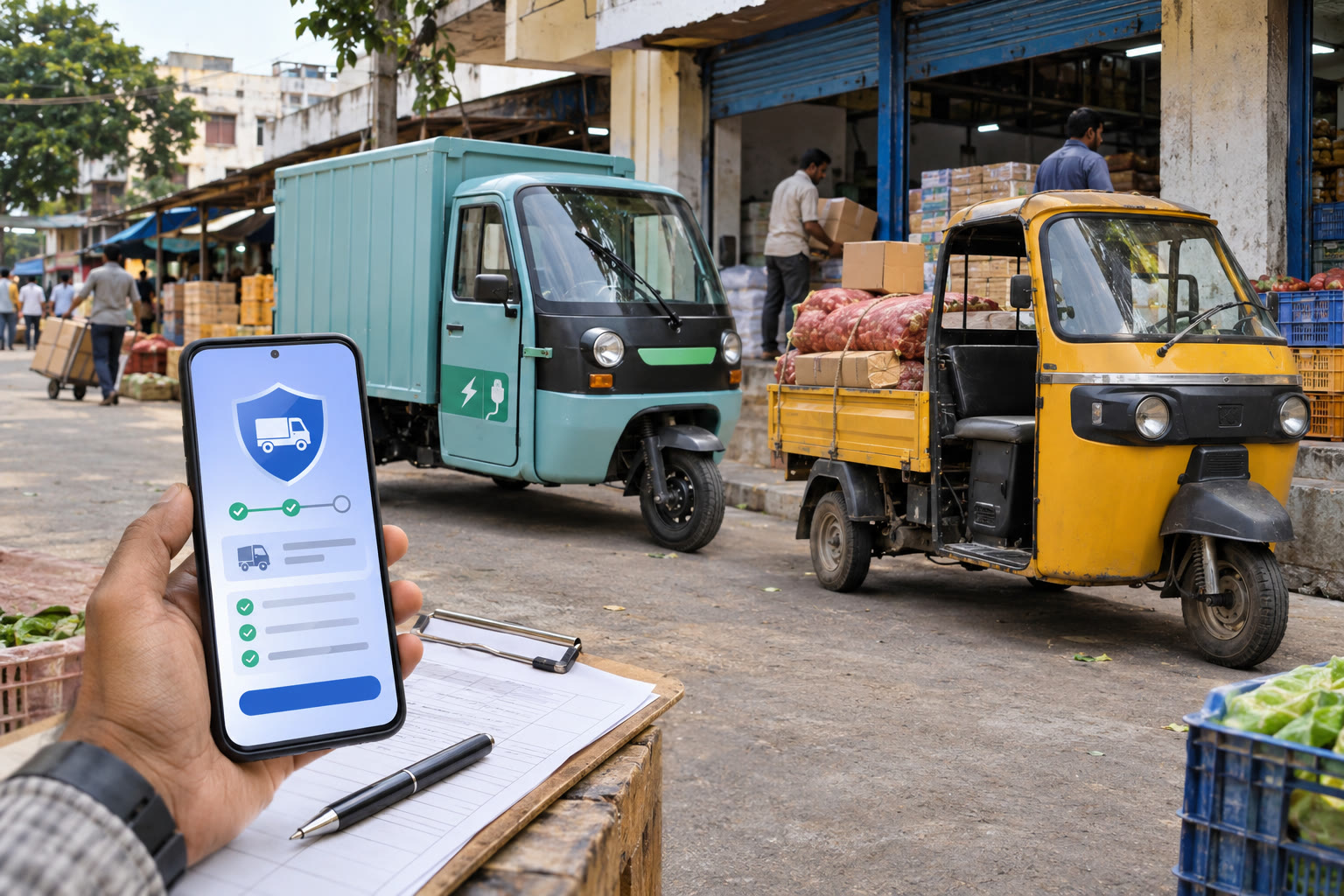
ETAuto’s 24 Nov 2026 report and Fortune India’s 25 Nov 2026 report both attribute the figures to Policybazaar. They say online commercial vehicle insurance adoption increased 46% year on year in October 2026. The reports also put non-heavy commercial vehicles at 91% of the online-adoption mix. In practical terms, the reported demand was concentrated in vehicles used for local goods movement, passenger trips, agriculture and other short-haul work rather than in the heaviest truck categories.
The distinction between adoption and the overall market matters. Policybazaar’s figures are based on activity on its online platform. They are not a census of all commercial vehicles registered in India, and they do not say that premiums rose or fell by 46%. They also do not establish that an online policy is cheaper or better than another route. The useful reading is narrower: among buyers using that platform in October, smaller commercial vehicles were a major part of the demand.
| Reported category | Share of online adoption | Why it matters |
|---|---|---|
| Goods-carrying three-wheelers below 2.5 tonnes | 19% | The largest category in the reported mix. |
| Goods-carrying vehicles, 2.5–3.5 tonnes | 16% | Shows demand beyond passenger autos and e-rickshaws. |
| E-rickshaws | 14% | Highlights the role of electric last-mile mobility. |
| Agricultural tractors and JCBs | 13% | Adds farm and construction use to the online mix. |
These shares are reported by both sources from the Policybazaar dataset and are not a ranking of every commercial vehicle on Indian roads. The remaining categories included other goods vehicles, auto-rickshaws, heavier goods vehicles, maxi cabs and buses.
Why smaller commercial vehicles lead
A reasonable interpretation—not a finding measured directly by the reports—is that last-mile vehicles have a close link to daily income. A goods auto, e-rickshaw, small pickup or local passenger vehicle may be used repeatedly through the week, so a missed renewal or a long repair period can disrupt deliveries or passenger earnings. That makes the ability to compare and purchase cover digitally useful, but it does not remove the need to check the policy’s conditions.
Operating cost remains part of the same decision. Owners comparing a petrol, diesel, CNG or electric vehicle can use the fuel-cost calculator for a trip or recurring route separately from an insurance quote. The insurance percentage cannot be converted into a fuel saving, and a lower running-cost estimate does not by itself establish that a particular policy or vehicle is financially preferable.
Comprehensive cover versus third-party-only cover
According to the two reports, 75% of online commercial vehicle insurance buyers chose comprehensive policies in October 2026, while 25% chose third-party-only cover. Add-on adoption stood at 30%, with zero depreciation, India Motor Tariff Endorsement 23 (IMT 23) and personal-accident cover for paid drivers among the key choices reported.
The legal baseline is different from the product choice. Section 146 of the Motor Vehicles Act, 1988 requires a policy covering third-party risk before a motor vehicle is used in a public place. That requirement does not mean every third-party policy pays for damage to the insured vehicle. Owners comparing a package or comprehensive policy should read the own-damage section, exclusions, deductibles and insured declared value rather than treating the label alone as a guarantee of claim payment.
For a commercial vehicle, the most relevant cover depends on how the vehicle is registered and used. A goods carrier, passenger auto, e-rickshaw, tractor and construction vehicle can have different declarations, permits and operating risks. Add-ons can also have limits and exclusions. The reported 30% add-on adoption is a market signal, not a recommendation to add every available option. The commercial-vehicle insurance renewal and claims guide covers the policy details that need to be checked before renewal.
Diesel still leads, but electric and CNG shares are visible
The Policybazaar data reported by ETAuto and Fortune India puts diesel vehicles at 59.19% of online commercial vehicle insurance adoption in October 2026. Electric vehicles contributed 20.86%, CNG vehicles 16.37%, petrol vehicles 2.96% and LPG vehicles 0.56%. These are fuel-type shares within the reported online-adoption dataset, not national vehicle sales or the fuel mix of every commercial fleet.
The nearly 21% electric share is relevant to last-mile operators because e-rickshaws were also one of the largest individual categories in the same dataset. It does not prove that electric commercial vehicles have lower insurance costs or higher claims performance. An EV operator still needs to check how the policy treats the battery, charger, accessories, downtime and accident-related damage. Those terms vary by product and insurer. Owners planning electric routes can also use the state-wise EV charging directory to assess charging access separately from insurance.
What commercial vehicle owners should check now
- Match the vehicle and use: Confirm the registered class, gross vehicle weight, goods or passenger use, permit details and declared operating area before paying for a policy.
- Separate the legal minimum from wider cover: Third-party liability is the statutory baseline. Read whether own-damage protection is included, what the deductible is and how the insured declared value is set.
- Read exclusions and claim conditions: Check the requirements for a valid driving licence, permitted use, inspection, notice of loss and supporting documents. Keep the RC and other vehicle records current.
- Compare add-ons by risk: Zero depreciation, IMT 23 and paid-driver personal-accident cover were among the choices reported, but eligibility, limits and exclusions depend on the policy wording.
- Check alternative-power details: For CNG and electric vehicles, verify how the kit, battery, charging equipment and accidental damage are treated. Do not assume a private-vehicle policy or a standard commercial policy covers every component.
What the 46% figure does not tell you
The report does not provide a rupee premium for a particular three-wheeler, truck, e-rickshaw or state. It does not show whether individual owners paid more or less at renewal, and it does not compare claim settlement outcomes between policy types. Actual offers vary with vehicle age, class, location, declared use, insurer, coverage, deductibles and the operator’s profile.
That limitation is important for fleet budgeting. A 46% rise in online adoption cannot be multiplied by a current premium to estimate a business’s insurance bill. A fleet should instead use its own vehicle list, renewal dates, claims history and policy terms, then keep insurance separate from fuel, toll and maintenance lines. A route-specific estimate can be paired with live fuel prices for operating-cost context, but it is not an insurance quote.
What to watch next
The next useful signal will be whether the smaller-vehicle and electric-vehicle shares persist in later monthly data, or whether October’s mix was affected by festive buying and renewal timing. Owners should also watch official insurance notifications and their own insurer’s policy wording for any effective-date or coverage change. For now, the verified development is a rise in reported online adoption, with three-wheelers and other non-heavy commercial vehicles at the centre of the dataset.
Sources
- Fortune India, “Online commercial vehicle insurance adoption jumps 46%, three-wheelers lead demand”, 25 Nov 2026.
- ETAuto, “Online CV insurance adoption rises 46% in October, 3Ws drive demand: Report”, 24 Nov 2026.
- India Code, “The Motor Vehicles Act, 1988”, accessed 25 Nov 2026.
- Policybazaar, “Commercial Vehicle Insurance”, accessed 25 Nov 2026.
This article is for general information only and is not financial, insurance or legal advice.