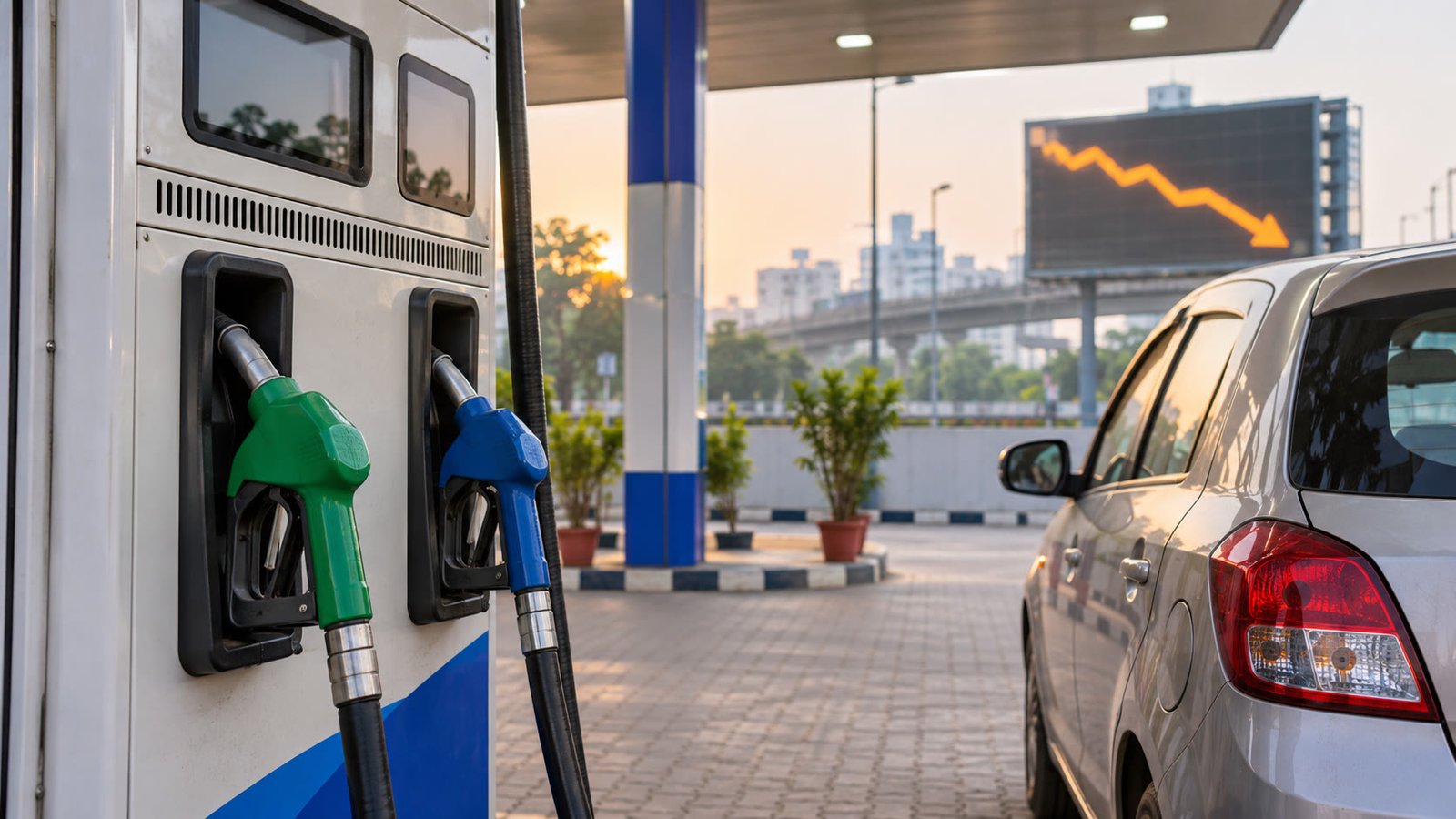
Crude benchmarks have fallen below $100 a barrel, but petrol and diesel pump rates in India were unchanged on 7 Nov 2026. For drivers, the immediate result is simple: the cheaper crude signal has not yet reduced the price paid at the pump. Any later benefit will depend on whether the decline lasts, how the rupee and other costs move, and whether oil marketing companies (OMCs) revise retail rates.
Key takeaways
- Business Standard and the Times of India reported crude benchmarks below $100 on 6–7 Nov, amid easing concern about West Asian supply risks. The reports refer to different benchmarks, not the same price.
- Petroleum Planning and Analysis Cell (PPAC) records for 6 Nov list Delhi petrol at ₹102.12 per litre and diesel at ₹95.20 per litre. V3Cars’ 7 Nov update showed no change in the metro rates.
- Crude is only one part of a retail fuel bill. Refining, freight, dealer commission, central excise, state levies and the rupee-dollar rate also affect what motorists pay.
- A lower crude quote is not a confirmed consumer price cut. The next meaningful signal is an official daily retail-price revision for the relevant city or outlet.
What changed in the crude market
Business Standard reported on 6 Nov that Brent crude had moved below the $100 mark after a sharp weekly fall. The Times of India reported on 7 Nov that the Indian crude basket had also reached a two-month low. Both reports linked the move to reduced concern about the West Asia conflict and the availability of commercial shipping through the Strait of Hormuz.
Those are important developments for India because crude is the main imported input behind transport fuels. But Brent, the Indian basket and a retail pump price are different points in the chain. A change in an international benchmark can improve the cost outlook for refiners and OMCs without creating an automatic change in the price displayed at a petrol station the same day.
What motorists are paying
PPAC’s official 6 Nov records put Delhi petrol at ₹102.12 per litre and diesel at ₹95.20 per litre. V3Cars’ 7 Nov morning update reported the same metro rates with no day-on-day change. The figures are therefore a dated snapshot, not a promise that every outlet will show an identical price.
| Fuel | Delhi rate as of 6 Nov 2026 | 7 Nov status |
|---|---|---|
| Petrol | ₹102.12 per litre | No change reported |
| Diesel | ₹95.20 per litre | No change reported |
IndianOil says daily petrol and diesel price changes are effected at 6 am. It also notes that the indicative rate can vary between outlets within a city or town. Drivers checking a refill should use the latest local listing; FuelPrice’s live petrol and diesel prices page is the relevant place to check the current city-level rate.
Why crude and pump prices can diverge
Crude is one input, not the whole bill
The retail price is built from more than the crude component. The cost of bringing fuel to the outlet, refining and blending, dealer commission, central excise and state-level taxes all sit between an imported barrel and the final litre. Petrol and diesel are outside the GST system, so state-level tax differences also help explain why prices vary across cities.
One market move may not be enough
International crude is traded continuously, while retail prices are checked at a set daily window. A short-lived fall may not be enough to trigger a revision, particularly if it is offset by currency movement, freight, refining costs or earlier inventory bought at a different price. This is why a lower market quote should be treated as a possible pressure release for OMCs, not as proof of an imminent cut for consumers.
The recent reporting also matters for the wider economy. Business Standard said a sustained crude decline could ease marketing pressure on OMCs, LPG under-recoveries and freight costs. That is a potential second-order benefit, but it is not the same as a confirmed reduction in a household’s fuel bill.
What it means for drivers and fleets
Private cars and two-wheelers
There is no immediate saving at the pump from this crude move. As an illustration using the PPAC Delhi petrol rate as of 6 Nov, a 40-litre fill would cost ₹4,084.80 before any other change. If the retail rate later moved by an illustrative ₹1 per litre, the same fill would change by ₹40. That arithmetic shows the sensitivity of a fuel bill; it is not a prediction of a price cut. For a trip-specific estimate, use the fuel cost calculator with the current local rate and your vehicle’s actual mileage.
Diesel users and commercial operators
For diesel cars, buses, trucks and delivery fleets, the lack of a pump-price change means current operating budgets should not be revised on the basis of crude headlines alone. Fuel is only one part of a route cost: distance, mileage, traffic, tolls, loading and waiting time also matter. Operators planning a run can compare those inputs in the road-trip planner and update the estimate when a confirmed retail revision appears.
What to watch next
- Whether crude remains below $100 across several sessions rather than only one market update.
- The next PPAC and OMC retail-price records, including the relevant city and outlet.
- Movement in the rupee, freight and refining costs, as well as any tax or pricing decision that changes the pass-through.
Reader takeaway
For now, cheaper crude has not translated into cheaper petrol or diesel at Indian pumps. The practical distinction is between a market signal and a confirmed retail rate: monitor the dated local price, and change a trip or monthly fuel calculation only after the price revision is actually recorded.
Sources
- Times of India — “Crude cost for Indian companies at 2-month low” — 7 Nov 2026
- Business Standard — “Crude price cool-off likely to soften cost squeeze on oil companies” — 6 Nov 2026
- Petroleum Planning and Analysis Cell — “RSP of Petrol/Diesel in Delhi as per IOCL outlet as on 06-November-2026” — 6 Nov 2026
- V3Cars — “Fuel Prices in India Today - (7 Nov)” — 7 Nov 2026
- IndianOil — “Petrol and Diesel Price” — accessed 7 Nov 2026
- The Economic Times — “Petrol Price in Mumbai Today” — 7 Nov 2026