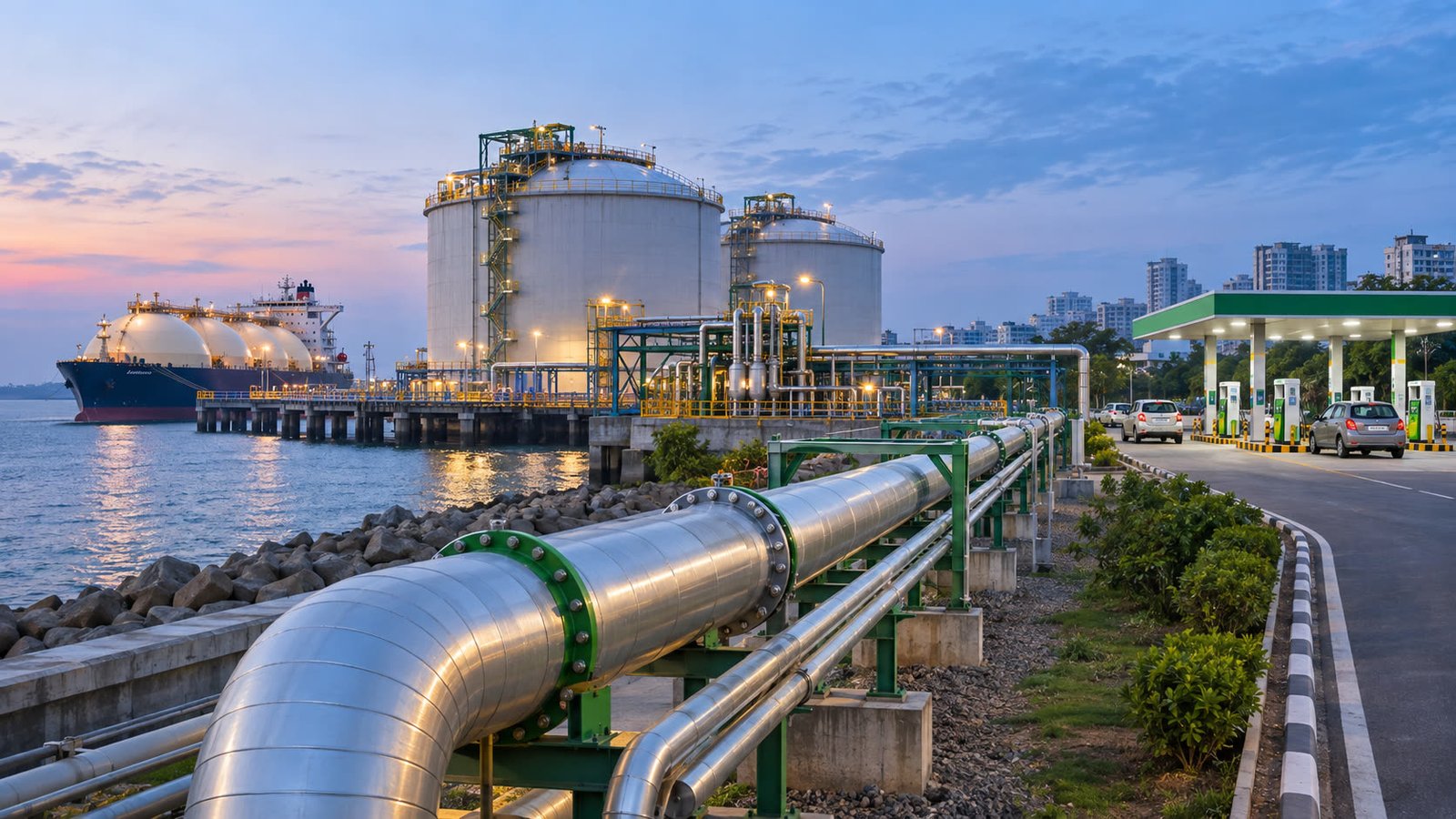
Gujarat Energy signs long-term LNG supply deal
Gujarat Energy signed a long-term agreement with Abu Dhabi National Oil Company (ADNOC) on 6 Nov 2026 to procure liquefied natural gas (LNG) for India. The agreement covers up to 4 million tonnes over 10 years starting in 2028, so it could improve future gas-supply visibility for the company’s city-gas network but does not announce an immediate CNG rate change for motorists.
Key takeaways
- Gujarat Energy will procure 0.4 million tonnes per annum (MMTPA) of LNG from ADNOC Trading, according to its stock-exchange filing.
- ADNOC’s announcement describes the arrangement as up to 4 million tonnes over 10 years, with deliveries starting in 2028.
- The price is linked to the Henry Hub benchmark under the supply agreement; no consumer CNG price per kg was announced.
- The announcement is about future supply security. It is not a notice of a CNG tariff cut or hike effective today.
What the ADNOC agreement covers
Gujarat Energy’s filing says it has signed a long-term Sales and Purchase Agreement with ADNOC Trading for 0.4 MMTPA of LNG, with pricing linked to Henry Hub. ADNOC separately said the company will receive up to 4 million tonnes over 10 years from 2028. The two descriptions are consistent: 0.4 million tonnes a year for 10 years equals 4 million tonnes, while “up to” describes the maximum quantity disclosed in the announcement.
ADNOC called this its fifth LNG supply agreement in India. The company said the gas will come from the international portfolio of XRG, ADNOC’s international investment company, through its global LNG marketing and trading platform. Gujarat Energy’s own disclosure gives the commercial terms available at this stage, but it does not publish a retail CNG price, a city-wise pass-through formula or an immediate effective date for motorists.
Why the deal matters for CNG users
Gujarat Energy’s network is described by ADNOC as operating across 44 districts in six states. That network serves more than one category of customer, so the new LNG is not being earmarked exclusively for CNG vehicles. It may support industrial, commercial, household and transport demand through the wider gas system, depending on how the company schedules imports, regasification and distribution.
That distinction matters for drivers and fleet operators. A long-term import contract can give a gas distributor more visibility when planning supply, but it does not automatically lower the price displayed at a CNG station. The announcement does not say that a particular city will receive cheaper gas, that a new CNG station will open, or that any operator must revise its retail tariff.
The contract also starts in 2028, not immediately. Until then, current CNG rates remain a local price question. Drivers can check the latest published rates through our state-wise CNG price hub, rather than treating the LNG announcement as a same-day price update.
What Henry Hub-linked pricing means
Henry Hub is a widely used US natural-gas benchmark. In this agreement, the reference means the LNG purchase price is tied to a benchmark formula rather than being described as a fixed rupee price at the pump. The filing does not disclose a consumer tariff, a rupee-per-kilogram CNG rate or the full chain of costs between imported LNG and a local filling station.
The eventual retail price can also reflect regasification, pipeline movement, city-gas distribution, taxes, operating costs and local pricing decisions. For that reason, a benchmark-linked procurement contract should not be read as a promise of savings. It may improve supply planning, but any benefit for a CNG customer would depend on downstream costs and the distributor’s future pricing decisions.
What changes now for drivers and fleets
For private motorists, there is no new refuelling rule or action attached to the 6 Nov 2026 announcement. A CNG car, taxi or auto-rickshaw continues to be charged the rate posted by its local city-gas operator. If an operator later changes its price, the relevant signal will be an official tariff notice or an updated station price, not the LNG contract alone.
Fleet operators can keep the agreement in their medium-term fuel-planning file, especially if they operate in Gujarat Energy’s service areas. But route budgets should continue to use the current local rate and the vehicle’s actual efficiency. Our fuel-cost calculator can help compare a trip’s CNG, petrol or diesel cost once the route, mileage and current price are entered.
For a longer journey, it is also useful to separate fuel price from route choice. A lower-cost fuel can be offset by a longer route, tolls or limited refuelling access. The road-trip planner lets readers consider the route and trip-cost elements together instead of assuming that a future supply deal changes today’s total travel cost.
What to watch before 2028
The next useful updates will be practical rather than promotional: confirmation of the delivery schedule, regasification and terminal arrangements, how the imported gas is allocated across customer groups, and whether the city-gas network expands in specific districts. Any change that affects motorists should come through a dated retail price notice or a clearly identified station and service area.
Readers should also watch the wording of future announcements. “Up to 4 million tonnes” is a contract ceiling, not a guarantee that all volume will be delivered on one date or used by CNG vehicles. Likewise, “Henry Hub-linked” describes procurement pricing; it is not the same as a published CNG price in Delhi, Gujarat or any other city.
Bottom line
Gujarat Energy’s ADNOC agreement is a meaningful long-term gas-supply development, with deliveries scheduled from 2028 and a disclosed volume of 0.4 MMTPA. For drivers, the immediate takeaway is narrower: the deal may support future supply resilience, but it does not change the CNG price to use for today’s trip or monthly fuel budget.
Sources
- ADNOC: “ADNOC Signs Agreement to Supply India’s Gujarat Energy up to 4 Million Tonnes of LNG” — 6 Nov 2026
- Gujarat Energy: “Disclosure Under Regulation 30 — Execution of agreement with ADNOC” — 6 Nov 2026
- ETEnergyWorld: “Gujarat Energy signs 10 year LNG supply deal with ADNOC for up to 4 Mt” — 6 Nov 2026
- Reuters, carried by MarketScreener: “ADNOC signs 10-year LNG supply agreement with India’s Gujarat Energy” — 6 Nov 2026