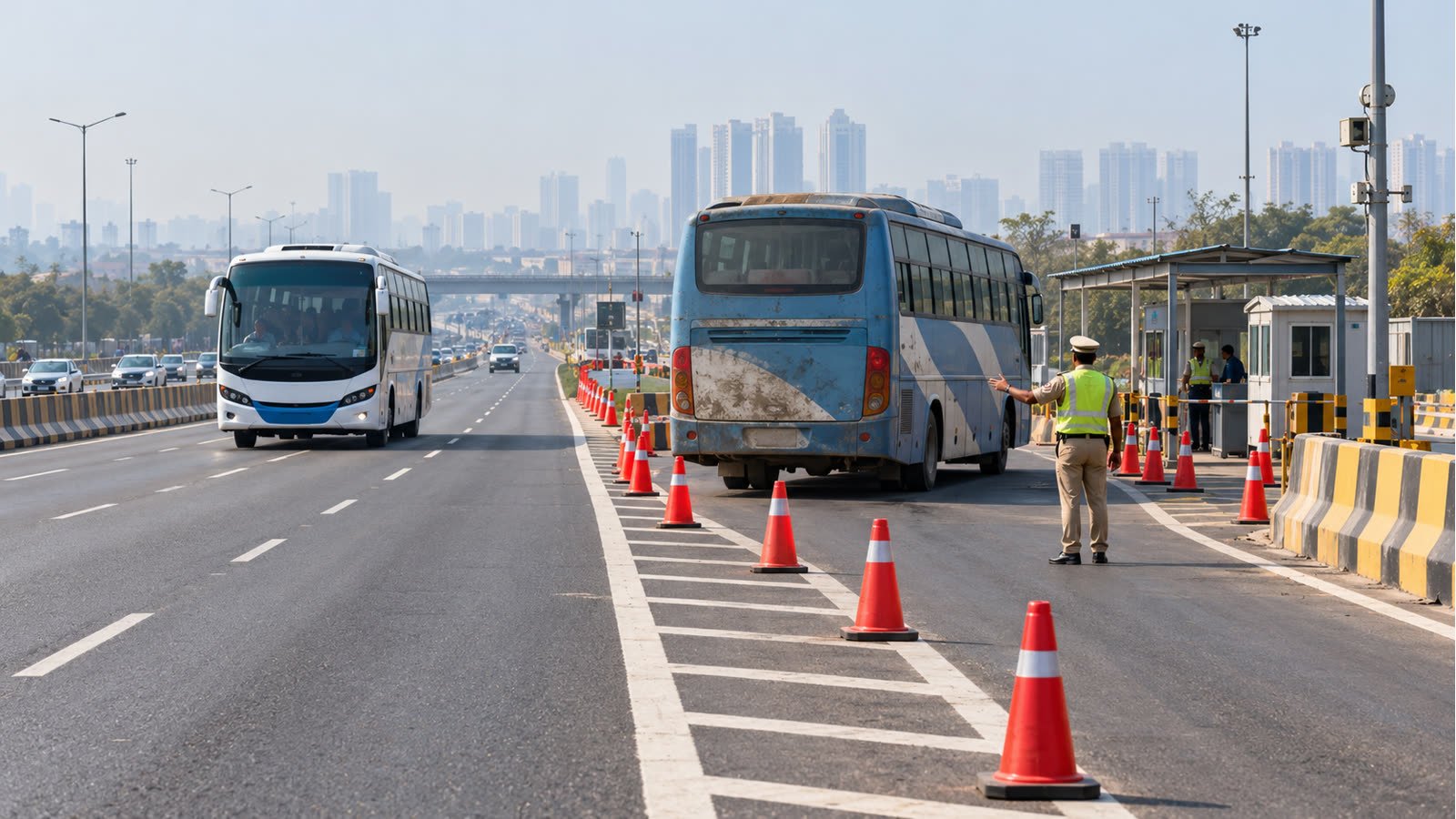
Delhi Traffic Police has said inter-city and inter-state buses that do not meet the cleaner-fuel criteria will be stopped and diverted at the capital's borders. The move is tied to a Commission for Air Quality Management (CAQM) direction taking effect on 1 November 2026, under which only CNG, electric or BS-VI diesel buses may enter Delhi; buses registered in Delhi are exempt under that order.
For passengers, operators and fleet planners, the practical issue is not a new bus fare or toll charge. It is the possibility of a border stop, a changed boarding point or extra time if a bus does not meet the permitted standard.
Key takeaways
- From 1 November 2026, CAQM Direction No. 93 bars buses other than CNG, electric and BS-VI diesel buses from entering Delhi.
- The rule covers inter-city and inter-state buses, including All India Tourist Permit, contract-carriage, institutional and school-bus services.
- Delhi Traffic Police said on 23 October 2026 that non-compliant buses will be stopped and diverted at borders rather than turned back after entering the city.
- The order exempts buses registered in Delhi, while separate winter restrictions apply to some other vehicles entering the capital.
What changes at Delhi borders
The primary rule is set out in CAQM Direction No. 93 dated 3 June 2025. It says that, from 1 November 2026, no bus other than a CNG, electric or BS-VI diesel bus may enter Delhi. The direction includes buses operating under the All India Tourist Permit and other service regimes, and says the restriction will not apply to buses registered in Delhi.
The implementation detail is new and important for road users. In a 23 October 2026 inter-state coordination meeting, Delhi Traffic Police said non-compliant inter-city and inter-state buses should be stopped and diverted at the border. The stated reason is to avoid the congestion and additional pollution that can result when a bus is allowed to enter and then turned around inside the city.
The same report said border authorities may use prominent display boards and joint enforcement teams. It did not publish a single list of every affected border, a common transfer point or a passenger-refund process. Those details may therefore vary by route and operator.
Which bus services are affected
The CAQM direction is wider than a rule aimed only at ordinary state-road buses. It specifically discusses inter-city services from NCR states and neighbouring states, and also covers All India Tourist Permit buses, contract-carriage services, institutional buses and school buses entering Delhi. The permitted categories are defined by the powertrain or emission standard: CNG, electric or BS-VI diesel.
The order reaches beyond scheduled public transport because it expressly covers tourist, contract, institutional and school-bus services. It does not publish a route-by-route list of where an ineligible bus would terminate, so operators will need to communicate their own arrangements.
What passengers should check before travelling
Passengers booking an inter-city or inter-state bus to Delhi can ask the operator whether the assigned bus is CNG, electric or BS-VI diesel and whether it is registered in Delhi. A booking confirmation alone may not explain what happens if the vehicle is changed before departure, so the operator's latest boarding and arrival instructions matter more as the enforcement date approaches.
If a journey crosses the capital's border and the operator changes the drop-off point, the road-trip planner can help compare the revised arrival route and time. The border measure does not itself set a new passenger fare, and it does not announce a blanket closure of Delhi's roads.
What fleet operators and trip planners should calculate
For a bus operator, a diversion affects more than arrival time. It can add distance, fuel use, crew hours and a possible passenger transfer. A route-level estimate can be checked with the fuel-cost calculator, using the actual bus fuel type and the revised distance rather than the original timetable.
The CAQM direction does not announce a toll revision. If a border diversion moves a vehicle onto a tolled expressway or National Highway, the operator can separately check the route's fee in the toll-charge calculator. The applicable amount will depend on the route and vehicle class, so it should not be inferred from the bus-entry order.
Do not confuse the bus order with other winter rules
The bus restriction is one part of a wider winter-pollution framework. The 23 October traffic-police update also reviewed restrictions on vehicles registered outside Delhi from 1 November 2026 to 31 January 2027, subject to notified exemptions. News On AIR's summary of Delhi's permanent Winter Pollution Master Plan says non-Delhi-registered vehicles below BS-VI standards will face entry restrictions during that period, with exemptions including CNG and electric vehicles, ambulances, fire services and other essential vehicles.
The wider plan also requires a valid Pollution Under Control Certificate for fuel supply at petrol pumps, CNG stations and LPG stations in Delhi, according to the same government-backed summary. That is separate from the bus-entry direction: a bus operator must consider both the vehicle's entry category and any applicable certificate or fuel-station compliance requirement.
Why enforcement is tightening now
Delhi Traffic Police linked the 23 October coordination meeting to Stage-I of the Graded Response Action Plan and CAQM directions. The timing combines the approaching 1 November deadline with the seasonal deterioration in Delhi-NCR air quality, which is why the operational focus is on screening buses at the border rather than managing turnarounds inside the city.
The policy's intended benefit is cleaner public transport entering the capital, while the operational test will be whether non-compliant buses are intercepted before they create an in-city turnaround. For travellers, the clearest near-term signal will be border signage and operator communication about where a bus will stop.
What to watch next
Delhi's Transport Department and Traffic Police are expected to clarify the border-screening process, the treatment of buses that arrive without the required standard and the notified exemptions for other vehicle categories. The CAQM direction mentions mechanisms such as automatic number-plate recognition and RFID at border entry points, but it does not provide a public route-by-route diversion map.
Until those operational details are published, the reader takeaway is simple: a bus entering Delhi after 1 November 2026 should fit the CNG, electric or BS-VI diesel categories unless it is registered in Delhi. Passengers and operators should confirm the vehicle and arrival point before travel, then price any detour in fuel, time and tolls separately.
Sources
- CAQM, “Direction No. 93: Migration of all buses entering into Delhi to cleaner modes”, 3 June 2025
- The New Indian Express, “Buses below BS-VI standards to be diverted at borders to curb pollution”, 23 October 2026
- News On AIR, “Delhi Govt notifies permanent Winter Pollution Master Plan to curb seasonal air pollution”, 2 July 2026; page updated 25 October 2026