Delhi Traffic Police has imposed traffic restrictions in Chittaranjan Park (CR Park) and Greater Kailash-II from 16 October to 20 October 2026, every day from 4 p.m. to midnight, for Durga Puja crowd management. Drivers crossing South Delhi during those hours should avoid the listed corridors, allow extra time and use the Metro or designated drop-off points where practical.
The advisory matters beyond visitors to the pandals: it covers through-traffic on major roads around the two neighbourhoods, where evening congestion can add time, idling and an unplanned detour to a city trip. The restrictions are temporary and event-linked, not a permanent closure or a new toll rule.
Key takeaways
- Traffic restrictions run from 16 to 20 October 2026, daily between 4 p.m. and midnight.
- Likely pressure points include the Outer Ring Road, Lala Lajpat Rai Marg, August Kranti Marg, Mehrauli-Badarpur Road and connecting South Delhi corridors.
- Visitors and devotees have been asked not to drive private vehicles into CR Park or park without authorisation near the pandals.
- Delhi Traffic Police has advised visitors to use the Metro, with Greater Kailash and Nehru Enclave identified as practical drop-off points.
What Delhi Traffic Police has changed
The police issued the advisory on 16 October after expecting a large evening footfall in CR Park and Greater Kailash-II. The pandals are located in residential colonies with limited road space and no visitor parking area, so the plan combines traffic restrictions, route management and parking enforcement during the busiest hours.
The restriction window is the same each day through 20 October. It does not mean every road in Delhi will be closed. It means traffic movement in and around the festival areas, and on feeder roads carrying traffic towards them, may be regulated or slowed as police respond to crowd conditions.
Routes likely to face delays
Drivers who do not need to enter the celebration areas should treat the following stretches as an avoid list during the evening window:
- Outer Ring Road between Vasant Vihar and Modi Mill Flyover.
- Lala Lajpat Rai Marg near CR Park and August Kranti Marg between Ring Road and Outer Ring Road.
- Mehrauli-Badarpur Road between Khanpur and Jamia Hamdard, plus Guru Ravidas Marg between DDA Flats, Kalkaji and Jamia Hamdard.
- Lal Bahadur Shastri Marg between Khanpur and Chirag Delhi Flyover, and Josip Broz Tito Marg between Chirag Delhi Flyover and Moolchand Flyover.
- Internal roads in CR Park and Greater Kailash-II, especially near the pandals and visitor approaches.
The route list is useful for both local commuters and commercial drivers. A vehicle travelling between south-east Delhi and the Vasant Vihar or Moolchand side may encounter spillover queues even if the final destination is outside CR Park. Police personnel may change the arrangement on the ground, so a mapped route should be treated as a plan rather than a guarantee.
How visitors can reduce delay
Delhi Traffic Police has asked visitors to use the Metro to reach the pandals. Greater Kailash and Nehru Enclave stations are the suggested drop-off points for taxi and auto passengers, after which visitors can walk towards the festival areas. Taxis and autos should not stop on main carriageways, and private vehicles should not be left on roads, footpaths or near pandal entrances.
For a necessary road journey, start earlier than usual, check the latest police advisory before leaving and keep the full restriction window in mind. If a detour changes the distance or expected driving time, compare the options in the road-trip planner before setting out.
What this means for trip cost
There is no reported change to fuel prices or toll charges in this advisory. The practical cost is the time and fuel consumed when traffic queues force a longer route or extended idling. A small detour can also alter where a driver needs to refuel, especially for delivery, taxi and two-wheeler users making several evening trips.
Use the fuel cost calculator to compare a planned route with an alternate distance, and check the latest fuel prices before budgeting a longer journey. These tools cannot predict event-day congestion, but they can make the cost difference between route options visible.
What to watch until 20 October
The current advisory covers the five-day Durga Puja period, but traffic personnel can adjust barricades, entry points and diversion arrangements as crowd levels change. Drivers should follow on-road instructions even when a navigation app suggests a shorter path through CR Park or Greater Kailash-II.
For residents, the main check is whether a daily commute crosses one of the listed corridors between 4 p.m. and midnight. For visitors, the lowest-friction plan is to park away from the restricted neighbourhoods only where parking is authorised, or use the Metro and walk from the suggested stations.
Frequently asked questions
Are all Delhi roads closed during Durga Puja?
No. The restrictions focus on CR Park, Greater Kailash-II and the identified connecting roads. Traffic police may regulate nearby corridors temporarily, but the advisory is not a city-wide road closure.
Can I take a taxi or auto to the pandals?
Visitors have been advised to use the Metro. Taxi and auto drop-offs should use the suggested Metro stations rather than stopping on main carriageways or near pandal entrances.
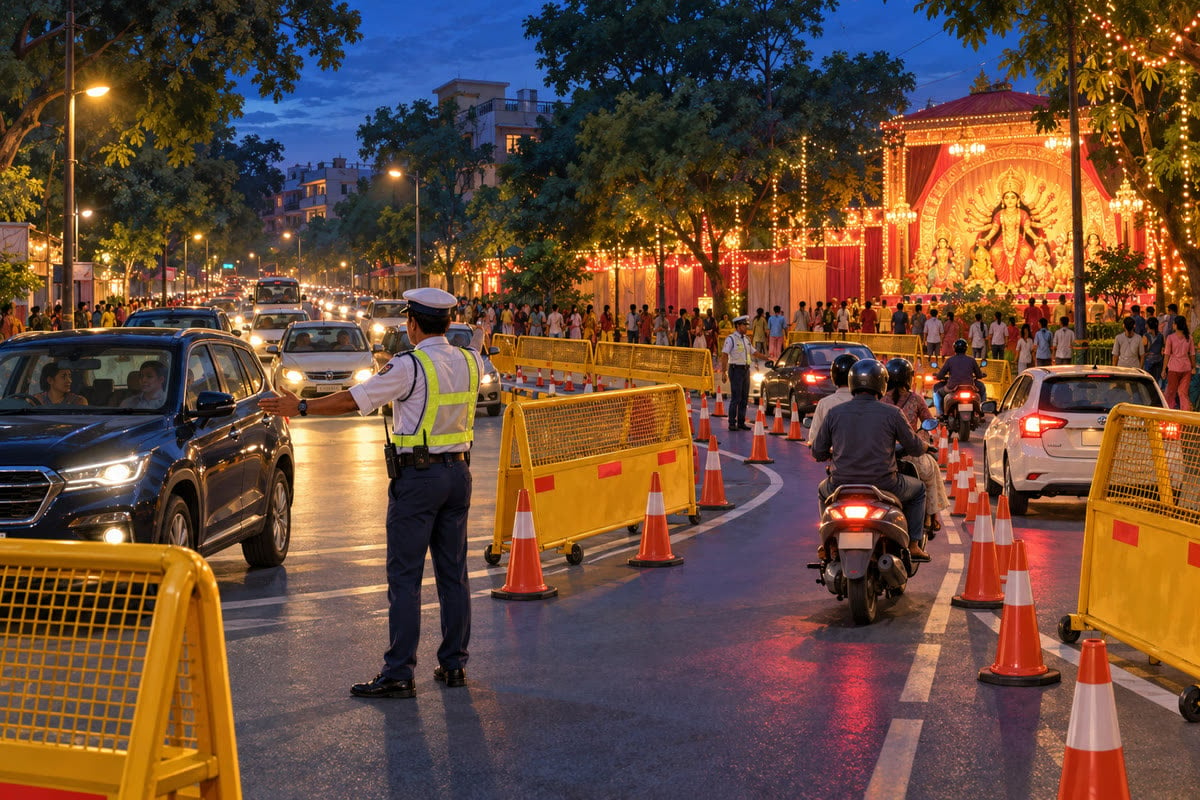
Illustrative visual: AI-generated traffic scene; not a photograph of the CR Park or Greater Kailash-II advisory location.
Sources
- Delhi Traffic Police: Traffic Advisory — Durga Puja Celebrations 2026 — 16 Oct 2026.
- Hindustan Times: Delhi traffic advisory: Restrictions imposed near CR Park, Greater Kailash-II from October 16 to 20; check affected routes — 16 Oct 2026.
- Business Today: Durga Puja 2026: Delhi Traffic Police issues advisory, lists roads to avoid from October 16-20 — 16 Oct 2026.