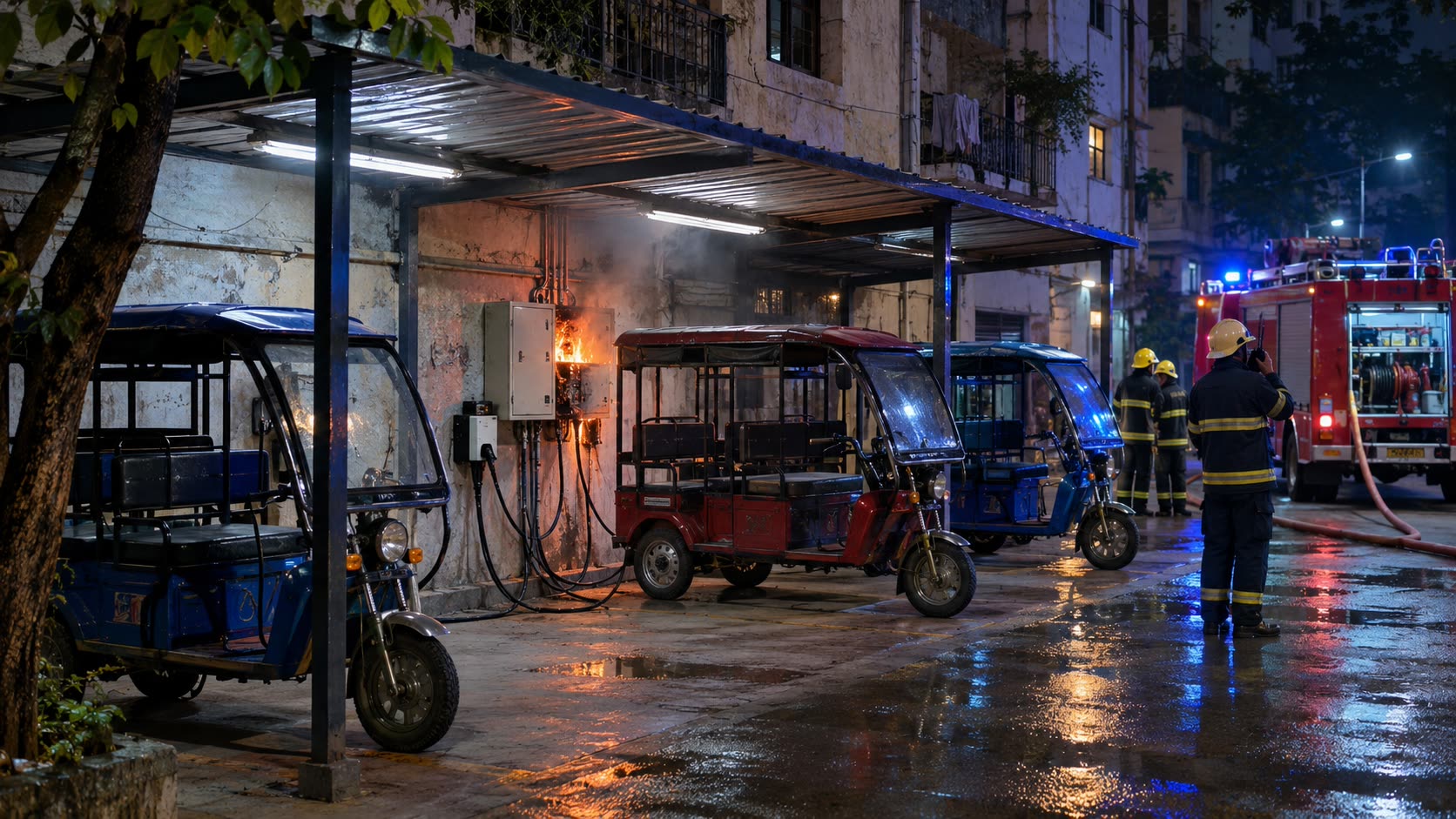
Four people died and two were injured in an early-morning fire on 29 Nov 2026 at a building in Delhi’s Vishwas Nagar where e-rickshaws were parked and charged, according to Delhi Police and fire officials cited by multiple reports. The cause has not been established; an electrical distribution board used for charging has been mentioned as a preliminary line of inquiry, so the immediate lesson for operators is to verify charging-site wiring, protective devices and fire access rather than assume the incident proves a general EV safety problem.
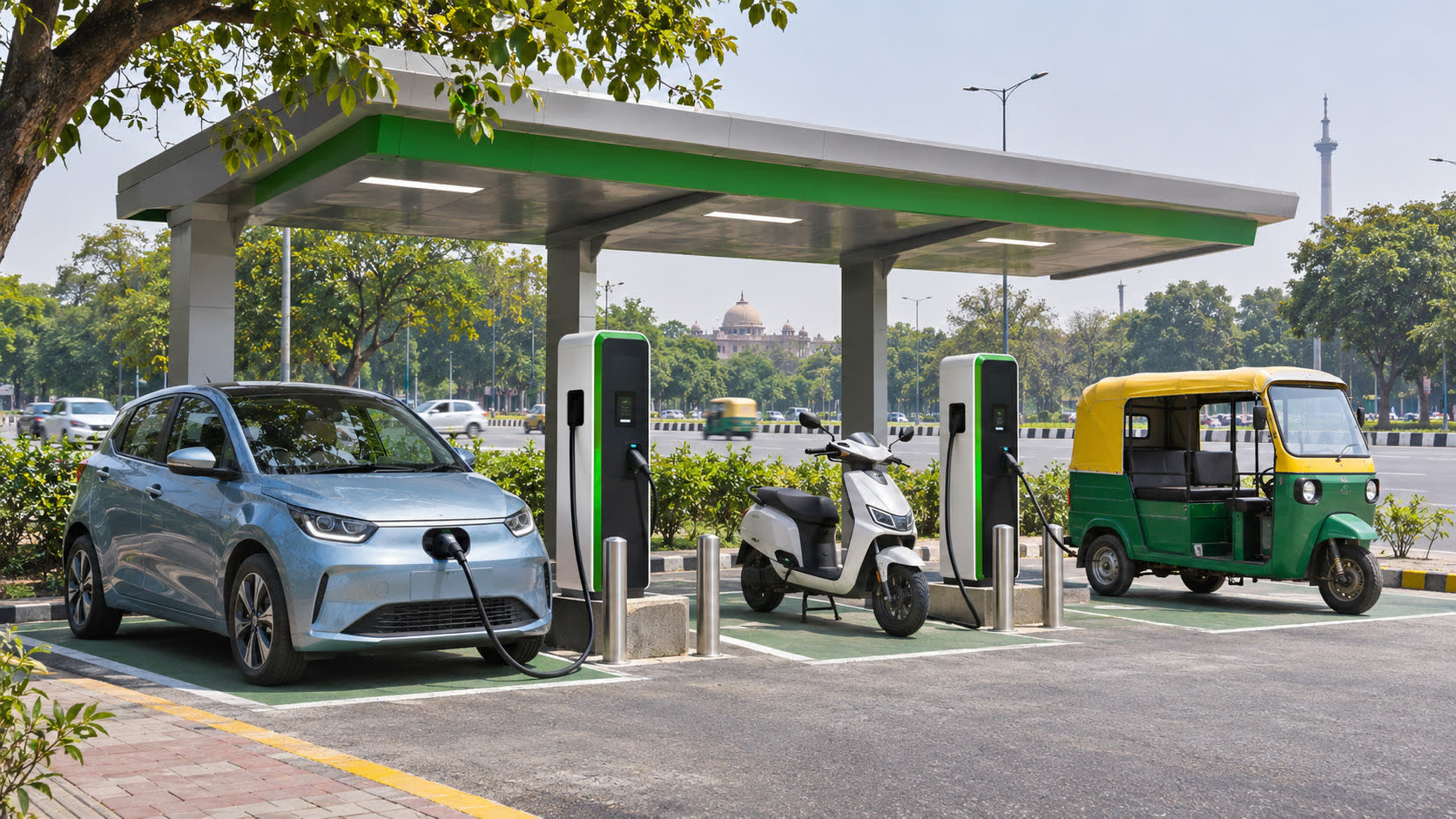
Illustration: A representative e-rickshaw charging area and fire-service response; this is not a photograph of the Vishwas Nagar incident.
Key takeaways
- Four people died and two were injured after the 29 Nov 2026 fire; the exact cause remains under investigation.
- Early reports agree that the ground floor was used for e-rickshaw parking and charging. Four e-rickshaws were reported burnt.
- The Central Electricity Authority’s EV-charging rules require dedicated electrical protection and prohibit improvised extension leads, adaptors and portable sockets.
- The Ministry of Power’s 2024 charging-infrastructure guidelines cover private, semi-restricted and public charging infrastructure, subject to applicable local approvals.
What happened in Vishwas Nagar
The fire was reported in Lane No. 11 near Unity One Mall in east Delhi’s Vishwas Nagar. Reports place it in the early hours of Sunday, 29 Nov 2026. Fire officials sent several tenders and brought the blaze under control, while police began checking the premises and the charging equipment. The reports agree on the casualties and on the use of the ground floor as an e-rickshaw charging and parking area, even though the initial accounts differ on the precise sequence of the emergency response.
Police and fire-service personnel found a four-storey building with e-rickshaws on the ground floor. The early reports said people on the premises were taken for treatment, with four deaths and two burn injuries. The Times of India and Deccan Chronicle reported that four e-rickshaws were gutted. These details are from the initial accounts dated 29 Nov 2026 and may be supplemented by the investigation.
What is confirmed, and what is preliminary
The confirmed part of the story is the fire, the deaths and injuries, the location, and the fact that charging equipment was present at the site. The Delhi Police and Delhi Fire Services have not announced a final technical cause in the reports reviewed for this article.
The Times of India quoted Shahdara DCP Rajendra Prasad Meena as saying that electrical distribution boards installed for e-rickshaw charging had caught fire. Deccan Chronicle’s PTI report described a short circuit in those boards as preliminary information, while Hindustan Times said the cause could not immediately be ascertained. Those statements should not be shortened into a definitive claim that a battery, charger or a particular e-rickshaw caused the fire. A final conclusion requires the relevant electrical and fire investigation.
That distinction matters for EV owners. A fire at one charging site does not establish that electric vehicles as a category are unsafe. It does show why charging facilities—especially those operating in mixed residential and commercial premises—need electrical protection, separation from sleeping areas and an unobstructed emergency exit plan.
Charging-safety checks for e-rickshaw operators
The Central Electricity Authority’s safety provisions for EV charging stations set technical requirements for charging points. The Ministry of Power’s 2024 charging-infrastructure guidelines apply to owners and operators of charging infrastructure in private parking spaces, semi-restricted locations and public places, as well as on highways and expressways. Operators should also check local fire, electrical and municipal requirements.
- Use a dedicated protected circuit. The CEA rules require each charging point to be supplied by an individual dedicated final sub-circuit with overcurrent protection. The charging supply also requires residual-current protection with a residual operating current of no more than 30 mA and earth-continuity monitoring.
- Do not improvise the connection. The rules prohibit a cord-extension set or second supply lead, an adaptor between the vehicle connector and inlet, and portable socket-outlets for EV charging. A damaged cable, loose socket or heat-discoloured distribution board should be taken out of service until inspected by a competent professional.
- Keep the point and vehicle layout compliant. The CEA provisions specify that the supply socket-outlet should be at least 800 mm above finished ground level and that the vehicle’s charging connection should be within 5 m of the charging point. Operators should keep cables protected from vehicle movement and keep access to electrical isolation points clear.
- Provide fire detection and maintain records. The CEA provisions require a firefighting system, fire detection, alarm and control arrangements, and compliant power-supply cables. A station must be tested and inspected before energisation; the owner must arrange inspection every year during the first 3 years and every 4 years thereafter, while retaining required records for at least 7 years.
- Separate charging from accommodation. Where a site also houses drivers or tenants, the charging bay should be treated as a separate risk zone rather than a sleeping area. Escape routes should remain open, and the operator should obtain a site assessment from qualified electrical and fire-safety personnel.
What this means for EV drivers and fleet owners
For drivers, the practical check is the condition of the site, not only the vehicle. Avoid using a charging point with exposed wiring, improvised multi-plug connections, visible burn marks or blocked access. If a site appears unsafe, report it to the operator and use another location. FuelPrice’s state-wise EV station directory can help drivers locate charging options, but availability and on-site compliance should be verified before a vehicle is connected.
Fleet owners can also build the safety check into route planning. The road-trip planner can help map stops, while the operator remains responsible for confirming that each charging location has suitable power protection, fire arrangements and enough space to separate vehicles from occupied rooms.
What to watch next
The next material update should come from the Delhi Police and Delhi Fire Services investigation: the final origin of the fire, the condition and approval status of the electrical installation, and any enforcement action affecting the premises. Until that evidence is released, reports should continue to describe the charging-equipment link as suspected or preliminary.
The reader takeaway is straightforward: e-rickshaw charging can support last-mile mobility, but a charging bay is an electrical installation and a fire-risk site at the same time. Dedicated circuits, proper protection, periodic inspection, fire controls and clear separation from sleeping or occupied areas are the checks that matter now.
Sources
- Hindustan Times — 4 killed as fire breaks out at e-rickshaw parking area inside house in Delhi — 29 Nov 2026
- The Times of India — 4 dead in Delhi house fire, cops suspect e-rickshaw charging point sparked blaze — 29 Nov 2026
- Deccan Chronicle / PTI — Four Killed, Two Severely Injured In Fire At Delhi E-Rickshaw Charging Facility — 29 Nov 2026
- Central Electricity Authority — Safety provisions for electric vehicle charging stations — 2019
- Ministry of Power — Guidelines for Installation and Operation of Electric Vehicle Charging Infrastructure-2024 — 17 Sep 2024