Delhi has approved 382 sites for electric-vehicle charging after a fresh review, according to Power Minister Ashish Sood's statement reported on 04 Oct 2026. The move matters to EV owners, e-rickshaw operators and commercial fleets because it creates a pipeline of new charging locations, although the sites are not live chargers yet.
The government is preparing to tender the first 160–180 high-readiness locations. That means the immediate milestone is the tender and subsequent commissioning, not an instant addition of 382 usable stations across Delhi.
Key takeaways
- Delhi says the Ministry of Heavy Industries has approved 382 charging sites after site-level reassessment.
- The first tender is expected to cover 160–180 high-readiness sites; a commissioning date has not been announced.
- The sites have been reviewed separately for two-wheelers, three-wheelers and four-wheelers.
- Delhi's policy permits only electric L5 three-wheelers in new registrations from 01 Jan 2027 and only electric two-wheelers from 01 Apr 2028.
- Drivers should treat the approval as an infrastructure pipeline and check charger availability, connector type and operating status before a trip.
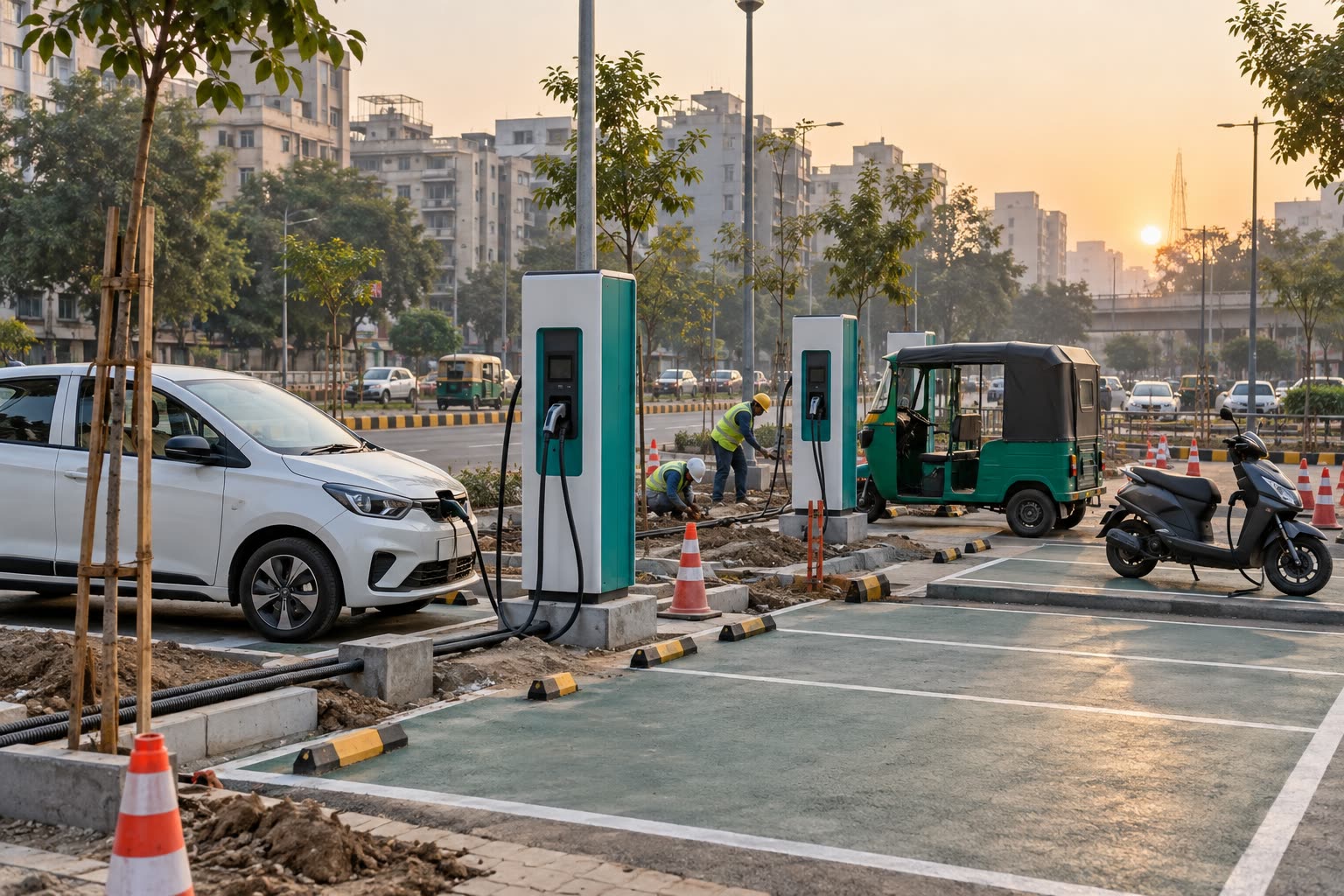
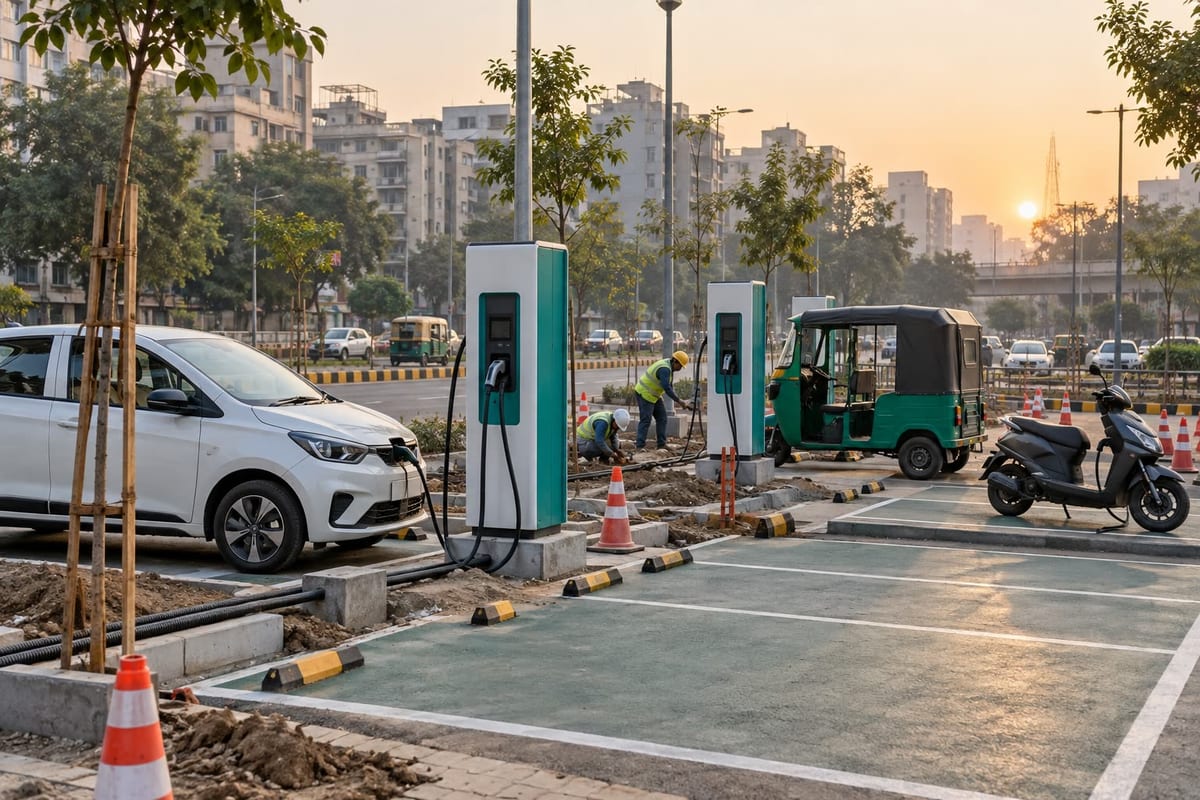 Illustrative generated image of a mixed-segment EV charging site rollout; it is not a photograph of an approved Delhi location. Credit: FuelPrice.
What Delhi has approved
Two independent reports agree on the core development: 382 EV charging sites have been approved and the first tranche of 160–180 high-readiness sites is to move towards tendering. The reports also say the sites were reassessed for segment-specific deployment, so the planned network is intended to account for different charging needs of electric cars, scooters, three-wheelers and light commercial vehicles.
There is one important data discrepancy. The Hindustan Times report published on 04 Oct 2026 says Delhi's Revenue Department and the Delhi Transport Corporation had identified 456 sites, of which 382 were approved. An Amar Ujala report dated 01 Oct 2026 says 505 sites were identified before the same 382-site approval. Both reports agree on the approved count and the first-tender range, but the baseline site count differs; it should therefore not be presented as a settled single figure without a fresh government notice.
The latest reporting also says the sites were reviewed over roughly three months and that KPMG has been brought in as the project management unit. The next concrete step is a tender for the high-readiness tranche. Until a tender is awarded and a site is commissioned, the approval should not be read as a live-station count.
Why the rollout matters to EV users
For a private EV owner, charger density affects how much time is spent searching, waiting or making an unplanned detour. A larger network can make city trips easier to plan, but the benefit will depend on whether each site has adequate power, compatible connectors, clear access and reliable uptime. Those operational details matter as much as the headline number of approved sites.
For e-rickshaw and other three-wheeler operators, segment-specific planning may be more useful than a network designed mainly around private cars. These vehicles often work long hours and need predictable charging access near operating areas. The official Delhi EV Policy 2026 assigns Delhi Transco Limited responsibility for planning, deploying and monitoring public charging and battery-swapping infrastructure, including grid-readiness and service benchmarks.
Delhi Transco's 01 Oct 2026 notice also shows that the public charging programme is moving through an offer-of-sites and stakeholder-input process. That is consistent with a phased rollout: locations have to be screened, power connections arranged, operators selected and chargers commissioned before motorists can rely on them.
What the policy dates mean
The charging decision is tied to Delhi's wider EV transition. Under the notified policy, only electric L5 three-wheelers are permitted for new registration in the National Capital Territory from 01 Jan 2027. From 01 Apr 2028, only electric two-wheelers are permitted for new registration. These are new-registration rules; they do not mean that every existing petrol or diesel vehicle must immediately leave the road.
For buyers and operators, the practical question is not only whether an EV qualifies under the policy. It is also whether the daily route has dependable charging close to work, home, depots or major stops. Before a longer journey, drivers can use the EV charging station directory to check available locations, then plan the road-trip route around realistic charging stops.
What changes now, and what to watch
Nothing in the announcement changes a driver's charging bill or creates an immediate 382-station network. The near-term change is administrative: Delhi has a larger pool of sites to take through tendering and implementation. The first tender will show which locations are genuinely ready, which operators are selected and how the sites are divided across vehicle segments.
Until that information is published, EV users should check the charger operator, connector standard, power rating, opening hours, payment method, parking conditions and current availability before setting out. If an EV trip is being compared with a petrol or diesel vehicle, the fuel-cost calculator can help separate the energy-cost comparison from the time and charging-stop question.
The reader takeaway is straightforward: 382 approved sites are a meaningful infrastructure signal, but not yet 382 operating chargers. The first 160–180-site tender, the final site list and commissioning updates will determine when the approval starts changing everyday travel in Delhi.
Sources
- Hindustan Times, “MHI approves 382 sites for EV charging infrastructure in Delhi” — 04 Oct 2026
- Amar Ujala, “Delhi EV Policy: Electric Two-Wheeler Registrations Surge 30% in First 3 Months; Govt Approves Charging Sites” — 01 Oct 2026
- Delhi Transco Limited, “Electrical Vehicle: stakeholder inputs for public EV charging and battery-swapping infrastructure” — 01 Oct 2026
- Government of the National Capital Territory of Delhi, “Delhi Electric Vehicle Policy 2026” — notified 30 Jun 2026