NDTV and Dainik Jagran reported on 11–12 Nov 2026 that the National Highways Authority of India (NHAI) has given in-principle clearance for the proposed Delhi–Panipat–Karnal Namo Bharat corridor along NH-44. For drivers and regular commuters, the immediate point is that this is a rail-and-road coordination step, not a new toll change or an opening announcement.
The status still needs to be read carefully. NCRTC’s current annual report says the revised Detailed Project Report (DPR) remains under approval by the Government of India, so the reported NHAI clearance should be treated as progress towards construction rather than confirmation that the corridor is sanctioned, operational or ready for passengers.
Key takeaways
- Recent reports say NHAI has approved the NH-44 alignment and land-use proposal in principle, subject to detailed drawings and further permissions.
- The proposed corridor would run about 136.3 km from Sarai Kale Khan in Delhi through Sonipat and Panipat to Karnal.
- Reported journey-time projections are around 60 minutes from Delhi to Panipat and 90 minutes from Delhi to Karnal once the line is operational.
- The revised project cost is listed at ₹33,051.15 crore in a Delhi government planning document; this is not a fare or toll estimate.
- No passenger fare, operating schedule or confirmed opening date has been announced.
What the reported NHAI clearance means
The latest media reports describe an in-principle approval for NCRTC to take the project forward along NH-44. Dainik Jagran reported that the clearance covers the proposed alignment and requires NCRTC to submit detailed drawings before work affecting the highway can proceed. NDTV similarly reported that NHAI has cleared the alignment and use of land needed for the elevated tracks, stations and utility work.
That distinction matters for road users. An in-principle clearance is not the same as a final central sanction or permission to start every part of construction. The conditions reported by Dainik Jagran include a comprehensive utility plan, a pre-condition survey of existing structures, structural-health monitoring, a traffic-management plan, and safeguards for the carriageway, service roads, bridges, drains and road furniture.
Confirmed, reported and still pending
The NCRTC annual report published in 2026 says the Delhi–Panipat–Karnal corridor’s revised DPR is under approval by the Government of India. It also says consultancy services and enabling works have been awarded and are under execution, which points to preparatory activity rather than a live passenger service.
The Delhi government’s 2026–27 planning document lists the revised project cost as ₹33,051.15 crore and says the Delhi–Karnal corridor is under consideration by the Centre, with preliminary activities being taken up. These official documents do not announce a passenger opening date.
That creates an important status line for readers: the NHAI step is reported and may remove a major coordination hurdle along the highway, but the final approval, construction permissions and operating plan still need to be tracked. The corridor should not yet be described as a confirmed alternative to today’s road journey.
Route, cost and projected travel time
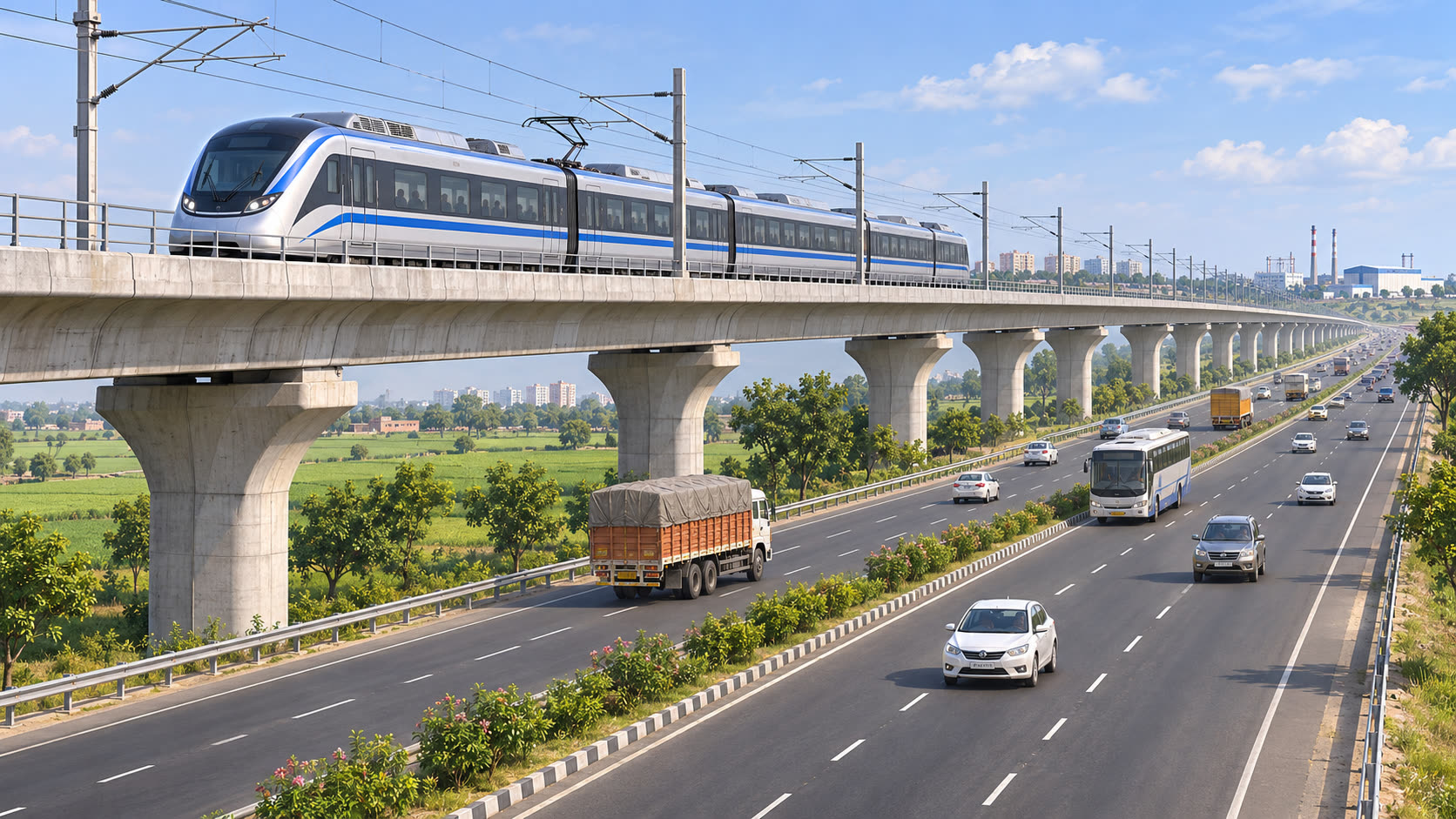
The planned 136.3-km route starts at Sarai Kale Khan in Delhi and heads north through Sonipat and Panipat before reaching Karnal. It is designed to run largely alongside NH-44, making it relevant to people who currently drive between Delhi, the industrial and education clusters around Sonipat, Panipat’s urban areas, and Karnal.
NDTV and Dainik Jagran report projected travel times of about 60 minutes from Delhi to Panipat and 90 minutes from Delhi to Karnal. These are future journey-time estimates, not a published timetable. Actual end-to-end travel will also depend on the station used, access time, interchange arrangements, service frequency and the final operating plan.
There is also a station-count caveat. Recent media reports describe 22 proposed stations, while NCRTC’s project-details page lists 17 main-line stations excluding Sarai Kale Khan. The difference may reflect whether interchange or future stations are counted, so the final station list should be taken from the sanctioned DPR rather than from an early project summary.
What changes for NH-44 drivers now?
For motorists, nothing in the reported clearance immediately changes the current road route, fuel price or toll amount. Dainik Jagran says NHAI’s conditions require traffic to remain safe and continuous during affected works, with barricading, signage, lighting and traffic regulation arranged before construction activity begins. It also reports that toll operations should remain uninterrupted.
That means a driver travelling on NH-44 should continue to plan with today’s road conditions. A future rail option could reduce some car and bus trips, but it cannot reduce a driver’s fuel or toll bill until a usable service actually opens. For a current trip, the fuel-cost calculator can estimate the petrol, diesel or CNG component from the route and vehicle details.
Toll rates and route charges should also be checked separately because the Namo Bharat proposal is not a toll revision. The toll-charge calculator hub is the relevant place to estimate the present road cost before leaving.
What to watch next
The next meaningful milestones are the submission and approval of detailed drawings, permissions for work within the highway right of way, utility shifting, construction traffic plans, final project sanction and a published passenger-service plan. These steps will determine whether works create temporary diversions or lane restrictions for NH-44 users and when the corridor can deliver its projected time savings.
Readers should also watch for a final fare structure, station-access arrangements and interchange details at Sarai Kale Khan. A fast line can shorten the rail portion of a trip while still requiring road travel to reach a station, so total travel time should be measured door to door rather than from station to station alone.
Reader takeaway
The Delhi–Panipat–Karnal Namo Bharat project has moved closer to implementation according to the latest media reports, but it is still a proposed future service in the official project record. NH-44 drivers should continue using current road, fuel and toll information, while watching official traffic advisories if construction permissions turn into active work.
When the final route and service details are published, commuters can compare the rail option with a road trip using distance, time, fuel and toll together. Until then, the road-trip planner can help compare the current road journey rather than assuming that the projected rail time is already available.
Sources
- NDTV — “New Namo Bharat Corridor: Delhi To Panipat In 1 Hour, Karnal In 90 Minutes” — 12 Nov 2026
- Dainik Jagran — “Delhi-Karnal Namo Bharat corridor: NHAI gives in-principle approval” — 11 Nov 2026
- NCRTC — “Annual Report 2025–26” — Nov 2026
- NCRTC — “Project Details: Delhi–Panipat–Karnal Corridor” — accessed 14 Nov 2026
- Delhi Planning Department — “Delhi–Panipat–Karnal Namo Bharat Corridor details” — 2026–27