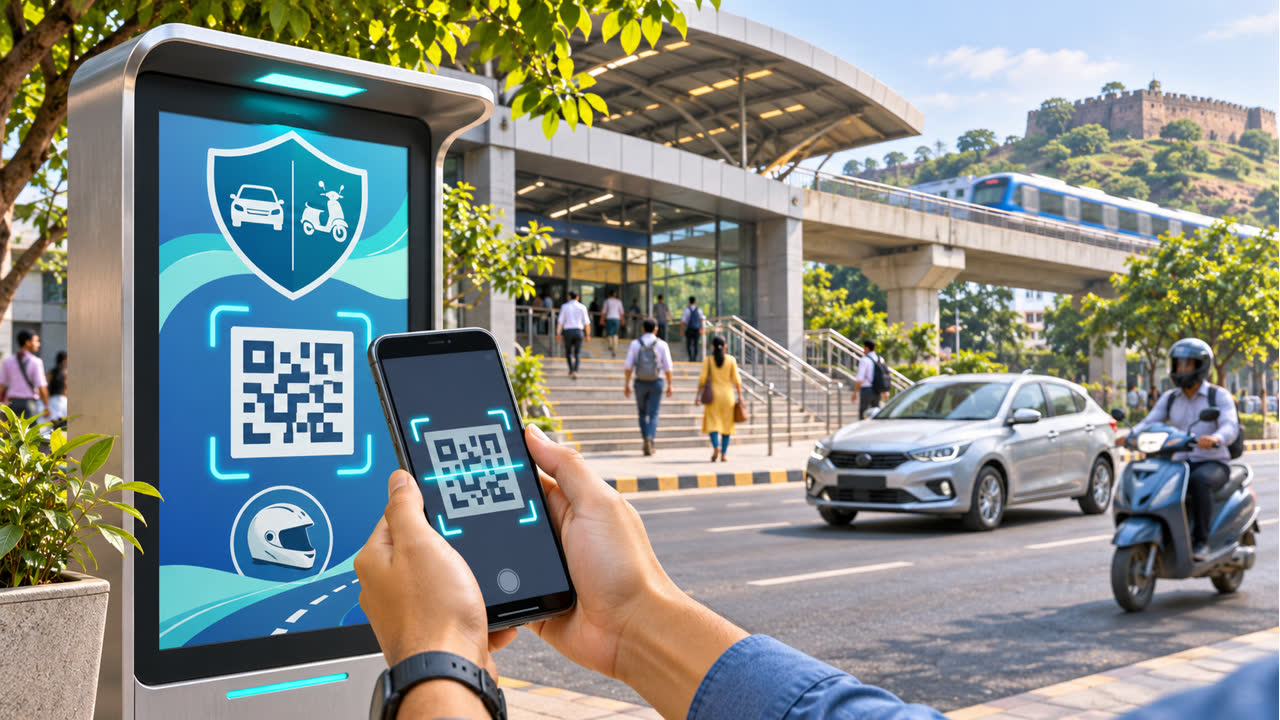
Bajaj General opens a digital insurance check point in Pune
Bajaj General Insurance says it inaugurated a digital branch at Yerwada Bajaj General Metro Station in Pune where commuters can scan a QR code to check whether a vehicle has active third-party motor insurance. The company announced the 10 November 2026 initiative with Pune Traffic Police as part of a wider road-safety campaign that also explains the PM-RAHAT and RAH-VEER government schemes.
The practical point for drivers is narrower than a new insurance rule: this is a company-run service at one Pune station. It gives vehicle owners a convenient place to verify third-party cover, but it does not replace a policy document, create a new nationwide checking system or automatically settle a claim.
Key takeaways
- The digital branch is at Yerwada Bajaj General Metro Station in Pune and is intended for commuters.
- Its QR flow is described as a way to check active third-party motor insurance and, if needed, buy a policy digitally.
- Third-party insurance remains the legally required minimum for vehicles used in public places; the Pune initiative does not change that rule.
- PM-RAHAT is a separate government cashless-treatment scheme for eligible road-accident victims, while RAH-VEER concerns assistance by Good Samaritans.
- Drivers elsewhere in India still need to check their own policy records and confirm what type of cover is active.
What the Pune digital branch does
The company’s release says the branch is designed to make motor-insurance information available during everyday commuter journeys. The QR process is meant to let a vehicle owner verify whether third-party cover is active. Metro India independently reported the same location, partnership with Pune Traffic Police and QR-based check, adding that the service can direct a visitor to a digital purchase if cover is not active.
That makes the branch a useful awareness and access point, but the offer should be read carefully. The reported service is tied to Bajaj General Insurance’s own digital branch. It is not evidence that every metro station, traffic-police office or insurer now provides the same facility. The company has not announced a nationwide rule requiring drivers to use a station QR code.
What a third-party policy check tells you
Section 146 of the Motor Vehicles Act, 1988 requires a policy meeting the Act’s requirements before a motor vehicle is used in a public place, subject to the Act’s stated exceptions. Third-party insurance is intended to cover liability to other people affected by the use of the vehicle. It is not the same as cover for damage to the policyholder’s own car or bike.
A positive validity result therefore answers only one question: whether the vehicle appears to have active third-party cover in the check being performed. It does not confirm that an accident will be payable, that every document is correct or that own-damage protection is included. Policyholders should compare the policy type, expiry date, insured vehicle details, exclusions and deductible in the policy schedule. FuelPrice’s guide to car insurance policy dates and renewal checks covers the record-keeping questions that a QR result cannot answer.
For a vehicle owner, the most useful follow-up is to keep the policy number, registration number, insurer contact details and expiry date together. If a check shows a mismatch or an unfamiliar document, do not assume that a digital screen is proof of authenticity. Use the insurer’s verified customer channel and, where relevant, the transport records available to you. Our explainer on checking a motor-insurance policy for signs of fraud explains why a low price or a forwarded PDF is not enough.
PM-RAHAT is separate from motor insurance
The campaign also highlights PM-RAHAT, the Prime Minister–Road Accident Victims’ Hospitalisation and Assured Treatment Scheme. In a 11 March 2026 reply, the Ministry of Road Transport and Highways said the scheme had been launched on 13 February 2026 and provides treatment cover up to ₹1.5 lakh per victim, subject to a maximum of seven days from the accident, at designated hospitals. The Ministry said it applies to victims of road accidents caused by motor vehicles on any category of road.
PM-RAHAT should not be described as a replacement for third-party insurance. The official description is a statutory, cashless-treatment workflow involving hospitals, police and the Motor Vehicle Accident Fund. It addresses immediate medical treatment; it does not turn a vehicle’s own-damage policy into third-party cover or remove the legal requirement for insurance.
The same government material says the scheme is connected to the 112 Emergency Response Support System, through which a victim or Good Samaritan can get information about a designated hospital or request an ambulance. Actual treatment and hospital processes remain subject to the scheme’s official workflow and designated facilities.
What RAH-VEER means for bystanders
RAH-VEER is the government’s protection and reward framework for Good Samaritans who voluntarily assist a road-accident victim or take the victim to hospital. The Ministry said in its 4 February 2026 Rajya Sabha reply that the reward had been increased to ₹25,000 from ₹5,000 under the revised guidelines.
That information belongs in the road-safety context, not in the insurance-policy section of a driver’s checklist. A bystander’s assistance, a victim’s cashless treatment and a vehicle owner’s third-party policy are related safeguards, but they are different mechanisms with different conditions.
What drivers should check now
- Confirm the policy’s expiry date and whether it is third-party-only, own-damage or comprehensive cover.
- Match the registration number, vehicle details and policyholder information with the policy schedule.
- Keep the insurer’s official contact route rather than relying only on a QR result, screenshot or forwarded document.
- If a policy or claim problem remains unresolved, use the insurer’s complaint process and consult FuelPrice’s guide to motor-insurance complaints and escalation options.
For motorists outside Pune, the immediate takeaway is that the verification habit matters more than the location of this particular branch. A local digital counter can make a check easier for commuters, but it does not change coverage, premium, renewal date or claim eligibility. Any wider rollout would need a separate announcement from the relevant insurer, transport authority or regulator.
Bottom line
Bajaj General’s Yerwada initiative puts a third-party insurance check in a busy commuter setting and links it with awareness of India’s accident-assistance schemes. Drivers can treat it as a prompt to verify their own documents, while keeping the boundaries clear: third-party insurance is the mandatory legal minimum, PM-RAHAT is a treatment scheme, and RAH-VEER is a Good Samaritan framework.
Sources
- Bajaj General Insurance, “Bajaj General Insurance Drives Public Awareness on Road Safety, Motor Insurance and Government Accident Assistance Schemes”, 10 Nov 2026
- Metro India, “Bajaj Insurance Drives Public Awareness on Road Safety”, 13 Nov 2026
- India Code, “The Motor Vehicles Act, 1988”, 14 Oct 1988
- Press Information Bureau / Ministry of Road Transport and Highways, “PM RAHAT-Cashless Treatment of Road Accident Victims”, 11 Mar 2026
- Press Information Bureau / Ministry of Road Transport and Highways, “Vehicle Scrappage Policy and Road Safety Initiatives”, 4 Feb 2026
This article is for general information only and is not financial, insurance or legal advice.