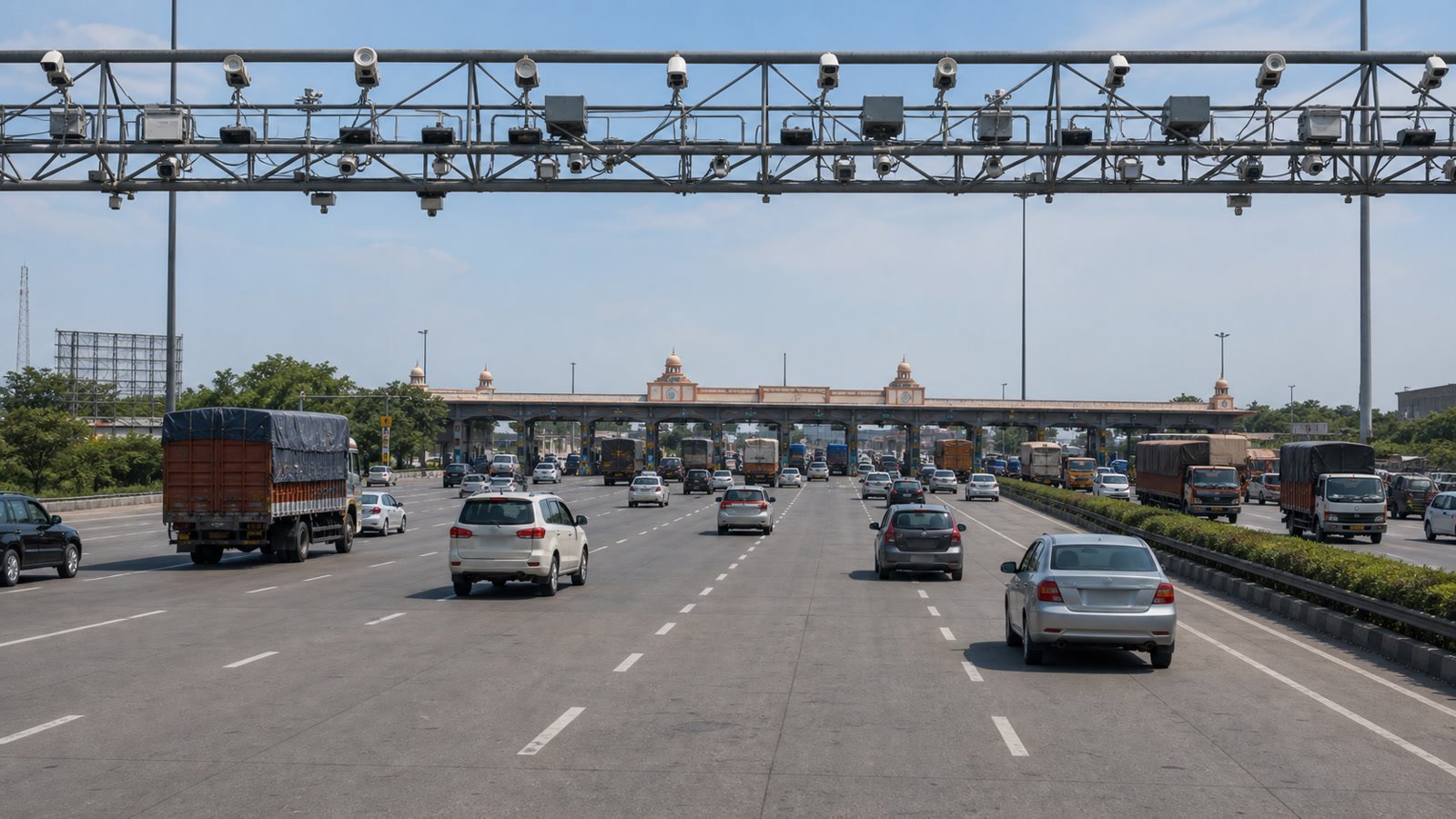
Delhi's border toll points may be headed for one of their biggest operational changes in years. The Municipal Corporation of Delhi plans to convert all 154 entry toll points into barrier-less multi-lane free-flow corridors by December 2026, according to a Times of India report published on June 12, 2026. The plan is aimed at commercial vehicles entering the capital, where toll checks, queueing and border congestion have long created delays for freight movement and extra idling fuel use.
For FuelPrice readers, the story is not only about toll technology. It is about how a daily border process affects diesel consumption, delivery schedules, logistics cost, emissions and the reliability of vehicle movement into India's largest urban market. If the system works as planned, trucks and other commercial vehicles should be able to pass through toll points without stopping at physical barriers, while tolls and related charges are processed through digital identification and enforcement systems.
What MCD is planning
The latest report says MCD wants all 154 entry toll points to become barrier-less MLFF corridors by December. MLFF, or multi-lane free-flow tolling, is designed to remove the traditional stop-pay-go toll experience. Instead of a vehicle stopping at a booth or boom barrier, overhead gantries, cameras and sensor systems identify the vehicle and allow payment or liability processing in the background.
Previous reporting on MCD's toll-modernisation plan gives more context. In November 2025, TOI reported that the civic body was working on a system using Automatic Number Plate Recognition cameras and RFID technology to enable seamless toll deduction without requiring vehicles to stop, similar in principle to FASTag on national highways. That report also referred to the need for a fresh toll agency framework and a minimum annual revenue expectation around Rs 900 crore, showing why the project is both a traffic-management issue and a municipal finance issue.
The plan has also been shaped by air-quality and court-linked pressure. A February 2026 TOI report said the Commission for Air Quality Management flagged congestion at MCD toll plazas as a significant concern and stressed the need for barrier-free MLFF systems integrated with RFID and ANPR technology to ease traffic snarls and reduce emissions. That context matters because Delhi border queues are not just inconvenient; slow-moving and idling commercial vehicles add to local fuel burn and pollution near already stressed corridors.
Why this matters for fuel users and freight
Commercial vehicles entering Delhi run on tight schedules. A truck delayed at an entry point does not only lose time at that border. The delay can affect unloading slots, return trips, driver working hours, cold-chain reliability and last-mile distribution. Even short stops across a large number of vehicles can translate into avoidable diesel burn when engines idle in queues or crawl through congested lanes.
Barrier-less tolling cannot reduce the posted toll amount by itself. What it can reduce is friction: stopping time, lane blockage, manual verification and traffic bunching. For transporters, that can mean more predictable route timing. For fuel users, it can mean lower wastage at a specific point in the journey. For the city, it can mean less spillback from toll plazas into approach roads, especially during peak freight windows.
The benefit will be most visible where toll queues are a routine operating problem rather than an occasional inconvenience. If a transporter plans routes into Delhi every day, the difference between a 2-minute pass-through and a 15-minute queue can change vehicle utilisation. Multiply that by multiple trips, multiple borders and a fleet of trucks, and the fuel-and-time value becomes more meaningful than it may appear in a single journey.
| Area | Current pain point | If MLFF works well |
|---|---|---|
| Commercial vehicles | Stop-start queues, manual checks and uncertain crossing time. | Smoother movement through toll points with fewer physical stops. |
| Fuel use | Diesel wasted in idling and low-speed crawling near borders. | Lower avoidable fuel burn at toll choke points, especially for regular freight routes. |
| Municipal revenue | Collection depends on accurate identification, enforcement and contractor performance. | More automated records, but only if tags, cameras and penalty systems are reliable. |
| Air quality | Congestion near toll plazas adds local emissions. | Less idling and queueing can support emission-reduction goals. |
What has to work for the plan to deliver
The technology has to do more than look modern. It must correctly identify vehicles, link them to valid payment or liability records, recognise number plates in difficult weather and lighting, handle unreadable or damaged plates, and create a clean process for disputes. A barrier-less toll point is only efficient if drivers trust that they will not face incorrect charges and if the authority can reliably pursue non-compliant vehicles.
RFID and ANPR each solve different parts of the problem. RFID-style tags can help identify enrolled vehicles quickly, while number-plate recognition provides a second verification layer and supports enforcement when a tag is missing, unreadable or misused. A commercial-vehicle system also needs accurate category classification because toll and environment-related charges can vary by vehicle type and load condition.
Revenue protection is equally important. A free-flow lane without strong back-end enforcement can create leakage. A system with too many false readings can create disputes and slow adoption. That is why MCD's tendering, agency selection, data integration, penalty rules and grievance process will decide whether the project becomes a genuine mobility upgrade or merely replaces one bottleneck with another administrative problem.
Why Delhi is a useful test case
Delhi already has recent exposure to no-stop tolling. In May 2026, barrier-less MLFF tolling was launched at the Mundka-Bakkarwala toll plaza on Urban Extension Road-II, with reports describing the use of FASTag and ANPR technology to let vehicles pass without stopping. That project is on a highway corridor, while MCD's entry toll plan focuses on municipal border toll points for commercial traffic. The operating conditions are different, but the principle is similar: remove physical stopping, capture vehicle identity digitally and reduce the queue.
The MCD plan is arguably more complex because it deals with a dense urban border ecosystem, different commercial-vehicle categories, municipal toll arrangements and environment-linked charges. It also has to work at scale across 154 points, not just at a single showcase location. The operational challenge is therefore not the concept of MLFF; it is whether the system can be deployed consistently across many entry points where traffic conditions, lane discipline and enforcement realities vary.
Who is affected
- Fleet operators: They should watch whether onboarding, tags, account mapping and dispute resolution are simple enough for multi-vehicle fleets.
- Truck and goods-vehicle drivers: They gain most if crossing time becomes predictable, but they will also need clarity on compliance requirements.
- Retailers and warehouses: Faster entries can improve delivery windows and reduce uncertainty in city distribution.
- MCD and toll contractors: They must protect revenue while reducing congestion, which requires strong data and enforcement discipline.
- Delhi road users: Even vehicles not paying the commercial entry toll may benefit if fewer toll queues spill back into shared approach roads.
What to watch before December 2026
The next signals will be the tender structure, technology vendor selection, rollout schedule, pilot locations, enforcement rules and how existing commercial-vehicle users are migrated into the new system. Transporters should watch for clear instructions on tags, account balances, vehicle-category mapping, number-plate standards and penalties for non-compliance. The public should watch whether MCD releases performance targets such as queue-time reduction, detection accuracy, revenue assurance and grievance timelines.
There is also a practical transition question. During installation, some toll points may operate with temporary lane changes or hybrid systems. If that transition is poorly managed, congestion could rise before it falls. A phased rollout with clear communication would reduce the risk of confusion for drivers and fleet managers.
The reader takeaway is straightforward: MCD's barrier-less toll plan is a high-impact mobility story because it sits at the intersection of fuel waste, freight timing, municipal revenue and Delhi's air-quality pressure. The promise is smoother commercial-vehicle movement at 154 entry toll points by December 2026. The test will be execution. If RFID, ANPR, enforcement and grievance handling work reliably, the plan can cut avoidable idling and make Delhi freight movement more predictable. If those pieces fail, barrier-less tolling could become another digital layer on top of the same border congestion problem.
Sources: Times of India current report, Times of India toll-system background, Times of India CAQM congestion context, Economic Times MLFF context.