Three Gujarat packages on the Delhi–Mumbai Expressway remain in fresh tendering, and a Times of India report says a continuous Delhi–Mumbai drive may not be possible until December 2029. That date is a reported project expectation rather than a new official completion notification; NHAI tender records confirm that balance work is still being procured on two of the affected packages.
For drivers, the practical message is simple: the corridor is not yet a guaranteed, uninterrupted Delhi–Mumbai route. Trip times, fuel use, toll exposure and diversion planning will continue to depend on which sections are open when a journey begins.
Key takeaways
- The delayed work covers three Gujarat packages on the Vadodara–Mumbai side of the corridor, spanning about 90 km according to the latest report.
- NHAI’s official tender records describe balance work for package VIII between km 154.6 and km 190.0 and for package IX between km 128.0 and km 154.6.
- The December 2029 date is the latest media-reported estimate. An earlier ministerial timeline had targeted the three Gujarat packages for financial year 2027–28.
- Until the missing links open, travellers should plan the actual route, tolls and fuel cost from current road conditions rather than the expressway’s eventual 12-hour promise.
What has changed on the expressway
The Delhi–Mumbai Expressway is being built as a 1,386-km corridor connecting Delhi, Haryana, Rajasthan, Madhya Pradesh, Gujarat and Maharashtra. The Union government told the Rajya Sabha in July 2024 that the revised scheduled completion date for the project was October 2025. That schedule was not met.
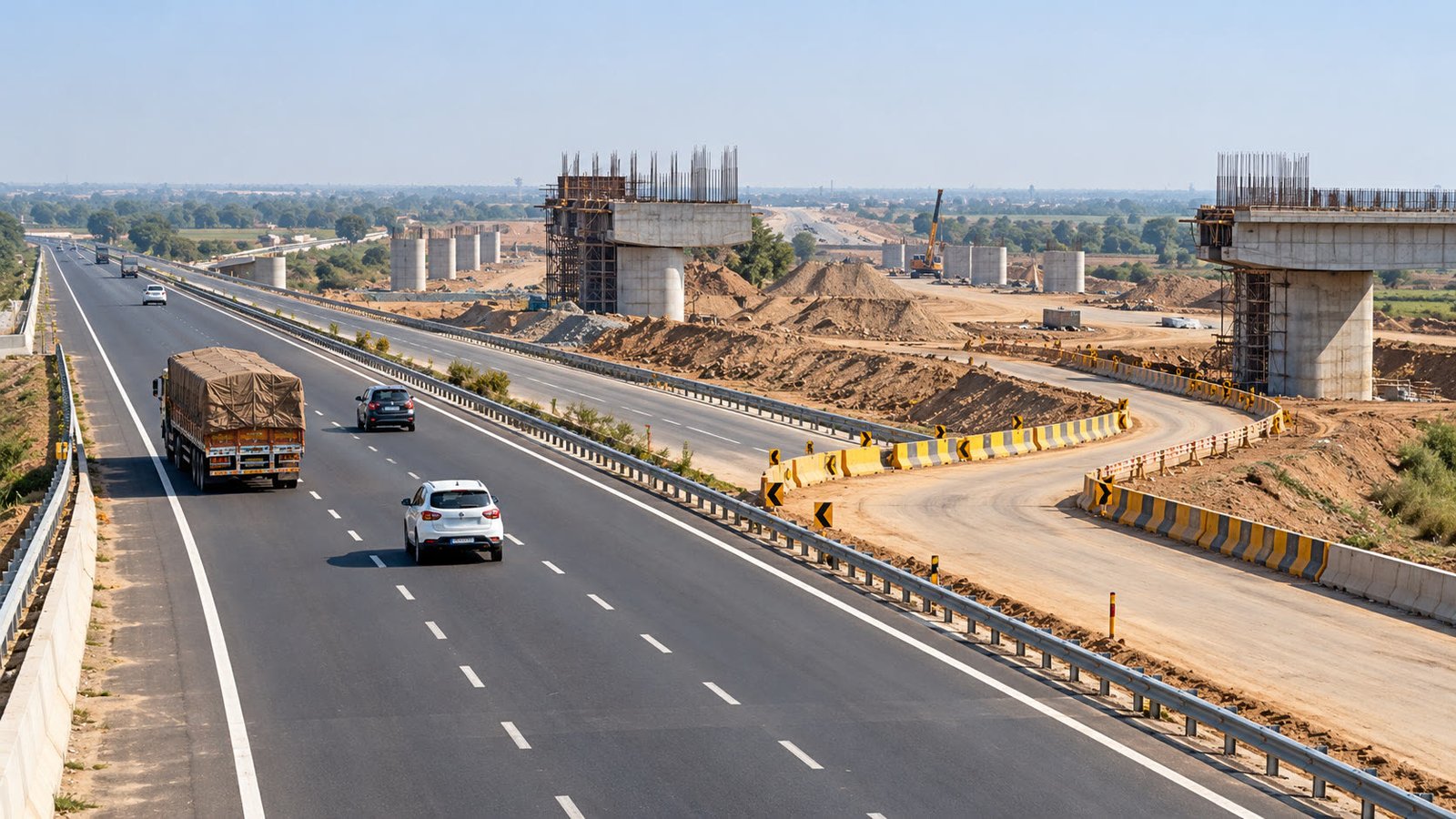
The latest development concerns three packages in Gujarat: package 8, Jujuwa–Gandeva; package 9, Karvad–Jujuwa; and package 10, Talsari–Karvad. The Times of India reported on 18 October 2026 that contracts for the stretches had been terminated after the original contractor failed to meet milestones, and that NHAI was processing fresh bids or a replacement appointment. The report puts the combined unfinished distance at around 90 km.
NHAI’s own procurement records provide the primary check on the status of the work. Its second-call tender for package VIII is for balance construction from km 154.6 to km 190.0 on the Vadodara–Mumbai Expressway. A separate NHAI tender for package IX describes balance construction from km 128.0 to km 154.6. These records show that the work is still being contracted; a tender record is not, by itself, an opening date for traffic.
Why the completion date needs careful wording
The timelines in circulation refer to different stages of the project and should not be treated as one confirmed deadline. The July 2024 government reply gave October 2025 as the revised corridor-wide schedule. In February 2026, NDTV Profit reported that Road Transport and Highways Minister Nitin Gadkari had told the Lok Sabha that the three delayed Gujarat packages were targeted for completion in financial year 2027–28.
The 18 October 2026 Times of India report is newer and says people involved in the project expect the three stretches to be ready by December 2029 after work starts. It also reports that construction could take about two years. That is useful for planning, but it remains an attributed estimate. A final opening date will require a current official schedule, completed works, safety checks and a traffic-opening notification from the relevant authority.
The difference matters because a driver may read “2029” as a firm promise or assume that a newly awarded package is already usable. Neither conclusion is supported by the sources. The confirmed point is that key Gujarat links remain under balance-work procurement, while the latest reported completion expectation has moved beyond earlier government targets.
What the delay means for drivers and transporters
The expressway was intended to cut travel time between Delhi and Mumbai to roughly 12 hours once the full corridor is operational. That benefit applies to a continuous route, not automatically to a journey that still has to leave the access-controlled road and use ordinary highways or local diversions around an incomplete package.
For a private car, a detour changes the trip budget in two ways: extra kilometres consume more fuel, while slower roads can add idling and stop-start running. Estimate the added fuel from the actual diversion length and the vehicle’s real-world mileage, then apply the current pump price; the result depends on traffic, load, weather and the diversion in force on the travel date.
Freight operators face a wider exposure. A route change can affect fuel consumption, toll payments, driver-hour planning, delivery slots and the reliability of a return journey. The fact that one package is being tendered does not mean every adjacent section has the same operating status, so a dispatch plan should treat the corridor package by package.
Toll assumptions also need care. Future charges for a fully connected route cannot be inferred from a single open plaza or from a proposed completion date. Travellers can compare the current route using the toll-charge calculator hub, then recheck the route before departure if a section or diversion changes.
What to check before a Delhi–Mumbai road trip
Start with the road actually available on the travel date, not the eventual project map. The road-trip planner can help organise the route and stops, but local diversion notices and authority updates remain important near construction zones.
Next, calculate the fuel effect of the selected route with the fuel cost calculator. Enter the vehicle’s real-world mileage and the current fuel price rather than using the expressway’s promised travel time as a proxy for cost. For a commercial trip, add a time buffer for non-expressway sections and retain the toll receipts needed for reconciliation.
Finally, watch for three concrete signals: NHAI’s award or contract notices for the balance packages, progress updates that identify an actual completed stretch, and an official traffic-opening announcement. Until those appear, December 2029 should be read as the latest reported expectation, not as a confirmed date that drivers can book around.
Reader takeaway
The Delhi–Mumbai Expressway is already useful on open sections, but the Gujarat gaps still determine whether the journey can be made continuously on the planned corridor. For now, check the live route, estimate fuel and tolls for the sections you will actually use, and treat future completion dates as subject to change.
Sources
- The Times of India — “Nonstop Delhi-Mumbai drive may have to wait until December 2029” — 18 Oct 2026
- NHAI / Government eProcurement System — “Balance work for Construction of 8-lane access-controlled expressway, Jujuwa to Gandeva section, Pkg VIII, 2nd Call” — 14 Sep 2026
- NHAI / Government eProcurement System — “Balance work for Construction of 8-lane access-controlled expressway, Karvad to Jujuwa section, Pkg IX” — 28 May 2026
- Press Information Bureau / Ministry of Road Transport and Highways — “Delhi-Mumbai Expressway” — 31 Jul 2024
- NDTV Profit — “Gadkari Revises Delhi-Mumbai Expressway Timeline: Full Stretch To Open by June 2026” — 13 Feb 2026