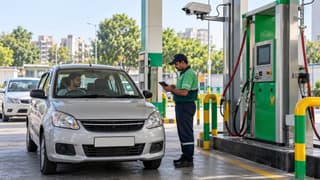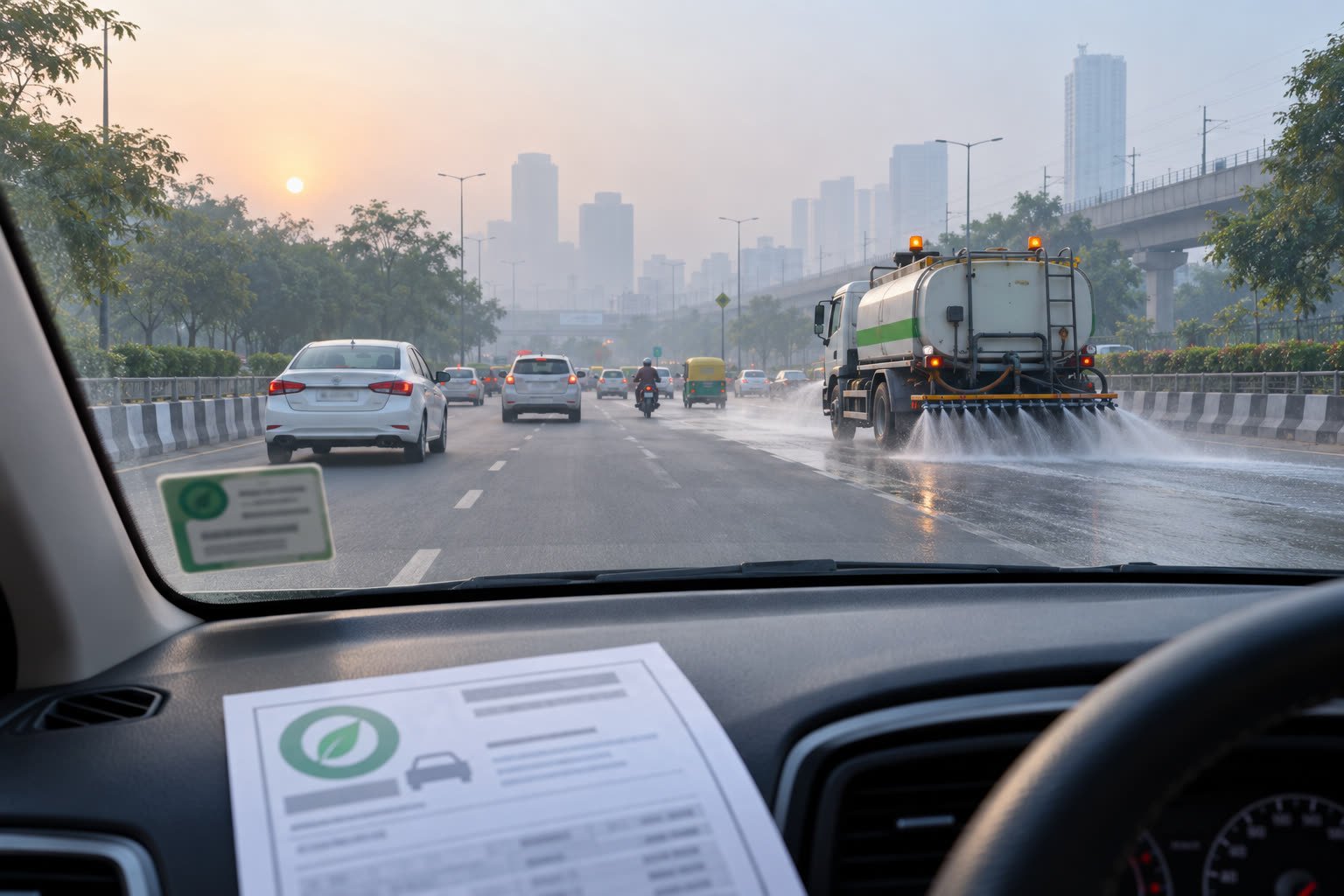
CAQM has invoked Stage-I of the Graded Response Action Plan (GRAP) across Delhi-NCR with immediate effect on 21 Oct 2026 after Delhi’s Air Quality Index (AQI) reached 244 at 2 pm, the ‘poor’ band. For road users, the immediate change is stricter enforcement of PUC, overage-vehicle and visible-emission rules, alongside tighter road and bus-management measures—not a blanket ban on every private car.
Key takeaways
- Stage-I GRAP now applies across the entire NCR from 21 Oct 2026.
- Delhi’s AQI was 244 at 2 pm, up from 179 on 20 Oct, according to reporting on the CAQM order.
- Transport and traffic authorities must intensify PUC checks and action against visibly polluting or overage vehicles.
- Road sweeping, water sprinkling, construction dust controls and cleaner-bus requirements will affect traffic operations.
- Stage-I does not itself impose a blanket ban on all private cars; tougher car restrictions are linked to higher GRAP stages.
What CAQM changed on 21 October
The GRAP sub-committee reviewed Delhi’s air quality and forecasts from the India Meteorological Department and the Indian Institute of Tropical Meteorology before invoking all Stage-I actions across the NCR. News On AIR reported that the order took effect immediately and that agencies must implement, monitor and review the measures to prevent further deterioration.
Delhi’s AQI moved from 179 in the ‘moderate’ category on 20 Oct to 244 at 2 pm on 21 Oct. The revised GRAP framework places AQI readings from 201 to 300 in Stage-I, or the ‘poor’ category. The CAQM’s revised GRAP schedule sets the next stages at 301–400 for Stage-II, 401–450 for Stage-III and above 450 for Stage-IV.
The direction covers Delhi and the NCR areas administered by the participating state agencies. It is an operational pollution-control order, not a new nationwide vehicle rule, so a driver outside the NCR is not affected merely because the vehicle is registered in another state.
What drivers and riders should check
Keep PUC and emission compliance current
Stage-I requires transport departments and traffic police to strictly enforce pollution-under-control norms and take action against visibly polluting vehicles. That means a valid PUC certificate and a vehicle that is not visibly emitting excessive smoke become more important during roadside checks. The order also calls for enforcement of existing court directions on overage petrol and diesel vehicles. Drivers should verify their vehicle’s age category and local operating restrictions rather than assume that a current registration or insurance policy overrides an emissions rule.
This is different from saying every private car is prohibited. The CAQM schedule shown on its website places restrictions on BS-III petrol cars and BS-IV diesel cars in Stage-III, not Stage-I. The exact restriction can also depend on the applicable order and vehicle category, so owners should wait for an official escalation notice before treating a higher-stage rule as active.
Expect operational changes on busy roads
Agencies have been directed to intensify mechanised sweeping and water sprinkling on roads, control dust from road repair and construction, synchronise traffic signals and deploy personnel at identified bottlenecks. These steps are intended to reduce dust, but sweeping, sprinkling, diversions and enforcement activity can temporarily change lane speeds and journey times.
For a simple illustration, a car that returns 15 km per litre would use about 0.67 litre for an additional 10-km diversion, before accounting for idling. That is an example, not an official estimate. Drivers can compare the likely fuel effect of a changed route with the fuel cost calculator and use the road-trip planner when a cross-NCR journey needs a different departure time or route.
What changes for buses, freight and public transport
The Stage-I schedule also affects larger road movements. Indian Express reported that inter-city and interstate buses entering Delhi from specified cities and towns in neighbouring states must meet the schedule’s cleaner-mode conditions—electric, CNG or BS-VI diesel, subject to the covered routes and categories. Authorities have also been told to divert non-destined truck traffic away from Delhi through the Eastern and Western Peripheral Expressways.
For commuters, the same schedule calls for additional CNG and electric-bus services, Metro and RRTS capacity, and traffic management at congested corridors. The immediate practical effect may therefore be uneven: a cleaner bus fleet and more road-dust control in some corridors, but diversions or slower movement for some freight and inter-city traffic.
Other Stage-I actions beyond vehicles
GRAP is broader than a vehicle checkpoint. The measures include tighter dust mitigation at construction and demolition sites, including restrictions on unregistered or non-compliant projects that do not meet dust-control requirements; a ban on coal and firewood in tandoors at hotels, restaurants and open eateries; strict enforcement against open burning; and regular lifting and disposal of municipal, construction and industrial waste.
Schools and offices continue to function normally under Stage-I, Indian Express reported. The focus is on preventing a further slide in air quality while agencies monitor the forecast. If Delhi’s AQI moves into Stage-II, the framework adds measures such as staggered timings for public offices, tighter diesel-generator controls and higher parking charges. Stage-III brings more severe construction and vehicle restrictions.
What to watch before your next trip
- Check your PUC validity and confirm that the vehicle is not covered by an existing overage-vehicle restriction.
- Allow time for dust-control work, traffic checks, bus diversions or truck-route changes on NCR corridors.
- For an inter-city bus or commercial vehicle, confirm the applicable fuel and emission standard for entry into Delhi.
- Monitor the AQI and official CAQM updates before treating any Stage-II or Stage-III measure as active.
- Use the live fuel prices page if a longer route or additional idling changes the trip budget.
The useful distinction is simple: Stage-I is active across Delhi-NCR, but it is primarily a pollution-control and enforcement step. A valid PUC, awareness of existing age-based restrictions and a little extra route planning are more relevant to most private-car users today than a blanket vehicle ban.
Sources
- Commission for Air Quality Management, “Revised Graded Response Action Plan (GRAP) for NCR, September 2026” — 29 Sep 2026.
- News On AIR, “CAQM Invokes Stage-I GRAP Across NCR as Delhi AQI Enters Poor Category” — 21 Oct 2026.
- The Indian Express, “GRAP-1 imposed in Delhi as air turns ‘poor’, schools and offices unaffected” — 21 Oct 2026.
- Mint, “Delhi’s worsening air quality triggers Stage-I GRAP across NCR” — 21 Oct 2026.