The Union Cabinet has approved a Rs 9,585 crore scheme to help replace old trucks and buses registered in Delhi-NCR, aiming to move the region's commercial fleet from BS-IV or older vehicles to BS-VI, stricter-emission or electric alternatives. For fleet owners, this is not only an air-quality policy. It is a financing, fuel-cost and vehicle-replacement decision that could change how trucks and buses operate in the National Capital Region.
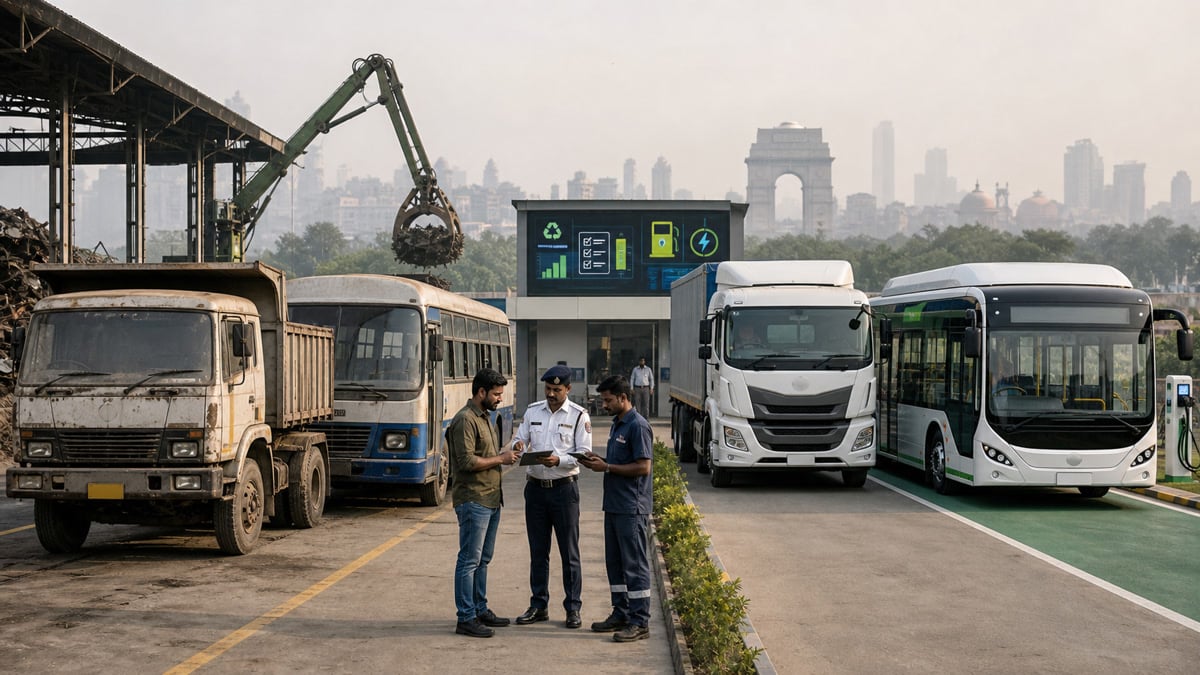
Editorial visual showing Delhi-NCR fleet replacement from older trucks and buses to cleaner commercial vehicles.What happened
The Cabinet approved a two-year scheme to support the National Capital Region Planning Board for replacing old trucks and buses in Delhi-NCR. According to the Press Information Bureau, the programme will be funded through NCRPB under the Ministry of Housing and Urban Affairs and implemented by the Ministry of Road Transport and Highways and the Ministry of Petroleum and Natural Gas, in collaboration with Delhi, Haryana, Rajasthan and Uttar Pradesh.
The scheme targets trucks and buses registered in Delhi-NCR that comply with BS-IV or earlier emission norms. Eligible owners will be incentivised to replace those vehicles with BS-VI or stricter emission-compliant vehicles, or electric vehicles. The total financial outlay is Rs 9,585 crore, including Rs 5,041 crore from the Centre and an estimated Rs 1,601 crore in tax concessions from participating states.
Why this is a serious mobility policy
Delhi-NCR's air pollution problem is not caused by one source, but commercial transport is a high-impact category. PIB cited an ARAI-TERI source-apportionment study showing that the transport sector contributes 14 percent of PM2.5, 40 percent of carbon monoxide and 63 percent of nitrogen oxide emissions in the region. Within transport, trucks and buses account for 36 percent of PM2.5 emissions while making up only about 3 percent of the total fleet.
That is why the scheme is focused on heavy and commercial vehicles rather than only private cars. Older heavy-duty vehicles can have a disproportionate pollution impact. PIB said a single pre-BS heavy-duty vehicle can emit as much as 14 BS-VI compliant vehicles, while even a BS-IV vehicle emits 2.7 times more than a BS-VI counterpart. This makes fleet replacement one of the more targeted ways to reduce emissions without waiting for the entire vehicle population to turn over naturally.
Who is affected
The scheme is expected to benefit about 2.07 lakh owners in Delhi-NCR, including around 1.91 lakh truck owners and 16,329 bus owners. The affected region covers Delhi and the NCR areas of Haryana, Rajasthan and Uttar Pradesh. This means small transporters, bus operators, logistics fleets, intra-city goods carriers and regional commercial vehicle owners will all have to examine whether they qualify and whether the incentives make replacement financially workable.
Government vehicles are excluded. For private owners, the rules differ by vehicle category and emission stage. BS-III or older vehicles must be scrapped at Registered Vehicle Scrapping Facilities. BS-IV vehicles can either be scrapped or sold outside NCR in non-NCAP cities or towns. Owners must then purchase and register a BS-VI or stricter norms compliant vehicle, or an electric vehicle, within NCR.
What benefits are available?
| Support item | What it means | Fleet impact |
|---|---|---|
| Loan support | 5 percent interest subvention on loans for five years. | Can reduce the financing burden for replacement trucks and buses. |
| Fuel vouchers | Monthly fuel vouchers worth up to Rs 4,800 depending on vehicle category. | Directly lowers operating cost during the support period. |
| Tax and fee relief | Registration fee waiver and motor vehicle tax concessions from states. | Improves replacement economics for fleet owners. |
| OEM discount | Participating vehicle makers will offer 8 percent discount on ex-showroom price. | Can make new BS-VI, CNG or EV purchases more reachable. |
Delhi rules are stricter for some categories
The scheme includes specific conditions for Delhi. Light goods vehicles purchased under the scheme in Delhi must be electric. Buses in Delhi must be BS-VI CNG or electric only. This matters because it pushes Delhi's urban fleet replacement more directly toward clean fuel or zero-tailpipe-emission options, while the wider NCR framework still allows BS-VI or stricter-compliant choices depending on category and location.
For operators, this creates a practical decision tree. A fleet owner needs to know the registration location, current emission norm, whether the vehicle is BS-III or older, whether it can be sold outside NCR, whether EV charging or CNG access is workable, and whether the financing plus vouchers offset the purchase cost of a newer vehicle.
Fuel and logistics impact
The fuel impact will vary by replacement choice. A BS-VI diesel truck may continue to use diesel but emit substantially less than an older truck. A BS-VI CNG bus can reduce diesel dependence for passenger movement. Electric light goods vehicles or e-buses can remove tailpipe emissions and shift operating economics toward electricity and charging infrastructure. For fleet owners, the scheme is therefore not only about compliance. It is about total cost of ownership: fuel or energy cost, maintenance, financing, downtime, permits and resale value.
Logistics firms may also see operational pressure. If old vehicles become less attractive in NCR and replacement incentives are time-bound, operators may accelerate fleet planning. Smaller owners could benefit from subsidies but may still face cash-flow pressure because a new truck or bus is a large purchase. The digital portal promised by the government will matter because delays in eligibility checks, loan claims, fuel voucher credits or certificate processing could affect trust in the scheme.
What changes now
The Cabinet approval sets the policy framework, but implementation will decide the real outcome. PIB said the scheme will run through an integrated digital portal with real-time eligibility checks, automated interest subvention claims, monthly fuel voucher credits and monitoring of pollution-reduction outcomes. Central benefits will continue for five years from the registration date of the new vehicle, even though the enrolment window is two years.
The scheme will be monitored by an Empowered Committee chaired by the Cabinet Secretary, while district-level implementation will be handled by District Collectors or District Magistrates. That structure suggests the government wants the programme to be more than a paper subsidy, but execution across four jurisdictions will still be complex.
What to watch next
- When the digital portal opens and how quickly eligibility checks are processed.
- Which OEMs participate and whether the 8 percent ex-showroom discount is applied smoothly.
- How banks price loans after the 5 percent interest subvention.
- Whether enough registered scrapping facilities can handle BS-III and older vehicles.
- How quickly charging and CNG infrastructure supports electric and CNG replacement choices.
Final takeaway
The Delhi-NCR truck and bus replacement scheme is a major clean-fleet intervention because it targets a small but high-emitting slice of the vehicle population. For transporters, the policy offers real financial support, but it also pushes a hard business decision: retire or move older vehicles and invest in cleaner replacements. If the portal, finance, OEM discounts and scrappage system work smoothly, the scheme could reduce emissions while modernising a large part of NCR's commercial transport fleet.
Sources: Press Information Bureau, Hindustan Times, NDTV, NDTV Auto and ETAuto.