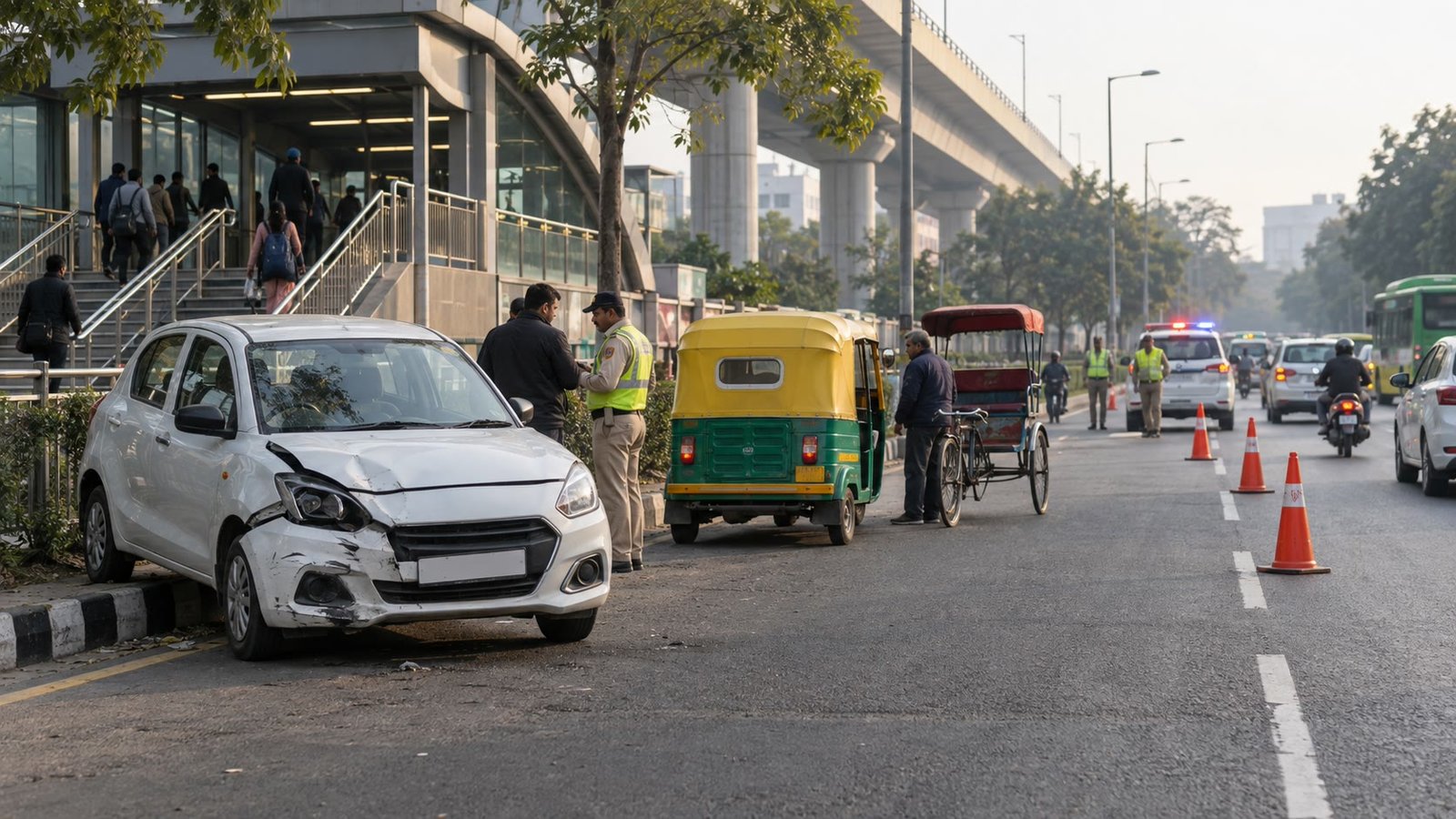
A 45-year-old auto-rickshaw driver was killed and another man was injured after a car hit two vehicles near Delhi’s Sukhdev Vihar Metro station on 26 Sep 2026, police said. The incident is under investigation, but it also shows why drivers need extra attention on busy metro approaches where cars, autos, cycle rickshaws, buses and pedestrians share limited space.
For motorists travelling through South Delhi or planning a longer drive, the practical takeaway is simple: slow down before signals and station access roads, leave room for vulnerable road users, and do not treat an open lane as an invitation to accelerate.
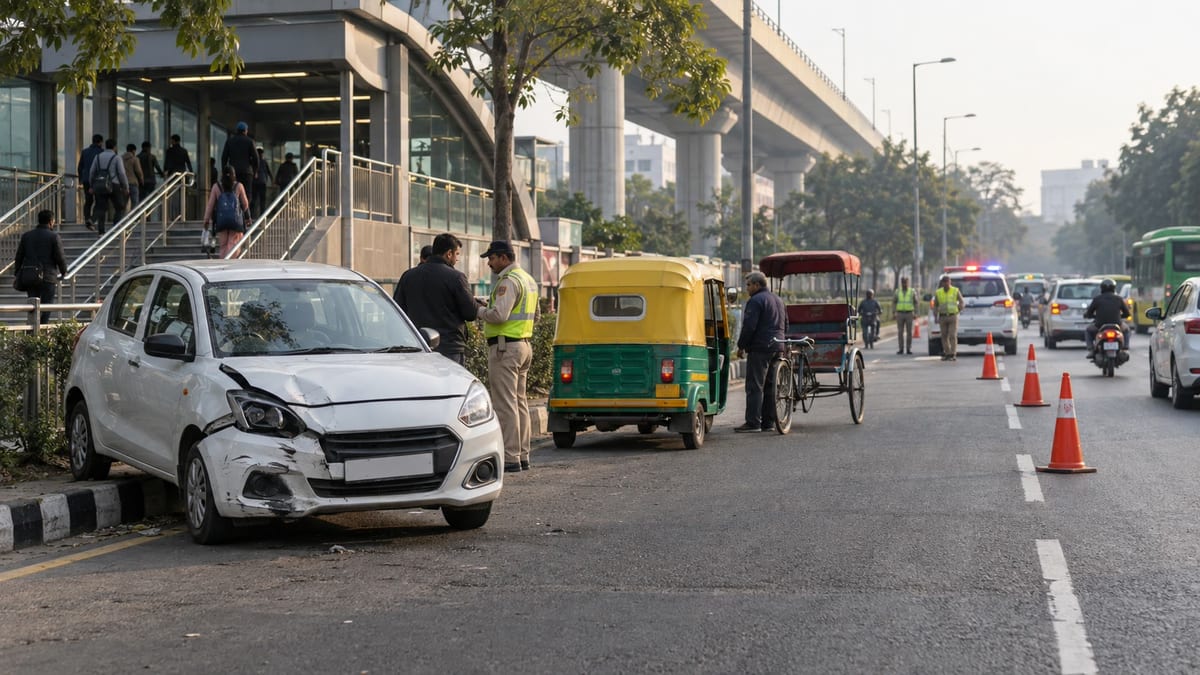 Credit: FuelPrice/OpenAI-generated editorial illustration. Representative road-safety scene, not a photograph of the Sukhdev Vihar crash.
Key takeaways
- The crash happened on the morning of 26 Sep 2026 near Sukhdev Vihar Metro station in southeast Delhi.
- Police reporting said a Hyundai i20 and an auto-rickshaw were found damaged; a cycle rickshaw was also involved.
- The auto-rickshaw driver died and another man was injured. A case has been registered and the investigation is continuing.
- Witness claims that two cars were racing have not been established as a final finding. Drivers should avoid speeding, racing and abrupt manoeuvres around mixed-traffic junctions.
What happened near Sukhdev Vihar
Hindustan Times reported that the New Friends Colony police station received information about the crash at 7:15 a.m. A police team found a white Hyundai i20 and an auto-rickshaw in a damaged condition, while the injured man was taken for treatment. The report quoted southeast Delhi deputy commissioner of police Vineet Kumar as saying the deceased was identified as Mohammad Kalam and the injured man as Mohammad Bablu.
A separate PTI report carried by The Tribune said the collision took place at about 7 a.m. and that the car allegedly hit the auto-rickshaw before striking a cycle rickshaw. The report said both the car and auto were found at the spot and that a crime team inspected the scene. Police told the outlet that the investigation was in progress.
Witnesses told multiple outlets that two cars may have been racing and that people in the white car left in another vehicle. That account is an allegation, not a confirmed conclusion. The cause of the crash, the identity of the driver and any charges will depend on the police investigation and evidence collected from the scene.
Why metro approaches need more caution
Station roads are not ordinary stretches of uninterrupted highway. People may cross outside a marked crossing, autos may pull in for passengers, cycle rickshaws can move slowly near the kerb, and buses or delivery vehicles can block a driver’s view. A car travelling too quickly has less time to respond when one of these movements happens unexpectedly.
The same risk appears on roads connecting metro stations to markets, offices and residential lanes. Drivers who know the route can become overconfident, especially during a quiet early-morning period. Familiarity does not remove the need to scan mirrors, watch side roads and prepare for a sudden stop.
What Delhi drivers should check now
- Reduce speed before the conflict point. Ease off before a signal, station entrance, bus stop or merge instead of braking late after traffic has already tightened.
- Keep a visible escape space. Do not follow an auto, cycle rickshaw or two-wheeler so closely that a small change of direction leaves no room to react.
- Expect movement from the kerb. Watch for passengers stepping out, autos rejoining the lane and pedestrians moving around parked vehicles. Use indicators early and check mirrors before changing lanes.
- Keep attention inside the car. Put the phone away, avoid racing another vehicle and do not allow passengers or entertainment screens to distract from the road.
- Respond safely to a crash scene. Slow down without staring, follow cones or police instructions, leave a clear path for emergency vehicles and avoid stopping in a live lane to record video.
If you are planning a drive through Delhi or the NCR, use the road-trip planner to think through the route, timing and stops before leaving. The fuel-cost calculator can help estimate the trip budget, but no saving in time or fuel is worth accelerating through a crowded junction.
What happens next
Police said a case was registered, forensic and crime-scene teams examined the vehicles and the deceased was sent for post-mortem examination. Reporting from Hindustan Times and NDTV said officers were working to trace the driver after the car was left at the spot. Until the investigation establishes the sequence of events, descriptions such as “racing” or “hit-and-run” should be treated as reported allegations rather than final findings.
For commuters, the immediate action is not to speculate about the case but to make the next trip more defensive: reduce speed near station roads, protect space around autos and rickshaws, and be prepared for people to enter the carriageway. Those habits are useful well beyond Sukhdev Vihar, particularly on busy city routes where different kinds of road users meet within a few metres.
Sources
- Hindustan Times — “Auto driver killed, homeless man injured in collision near Delhi’s Sukhdev Vihar Metro” — 26 Sep 2026.
- The Tribune/PTI — “Racing car rams into 2 vehicles in southeast Delhi, kills auto-rickshaw driver” — 26 Sep 2026.
- NDTV — “Speeding i20 Hits Auto, Rickshaw Near Delhi Metro Station, 1 Killed” — 26 Sep 2026.