East Delhi is set to get three planned foot overbridges on the Delhi-Saharanpur-Dehradun Expressway (NH-709B), with two foundation stones laid on 23 Sep 2026 and a third bridge approved nearby. The facilities are intended to give pedestrians safer, lift-accessible crossings while keeping people out of the expressway traffic stream; however, the government has not announced an opening date yet.
- Two foot overbridges have received foundation stones at Geeta Colony/Gandhi Nagar and Ramesh Park in Laxmi Nagar.
- A third crossing is approved near Bhajanpura-Garhi Mendu at Km 10+800.
- The two foundation-stone bridges are planned with lift facilities; the combined estimate for all three is ₹12.8 crore.
- Parking, EV charging points, toilets and solar panels are also part of the wider Delhi-section improvement plan.
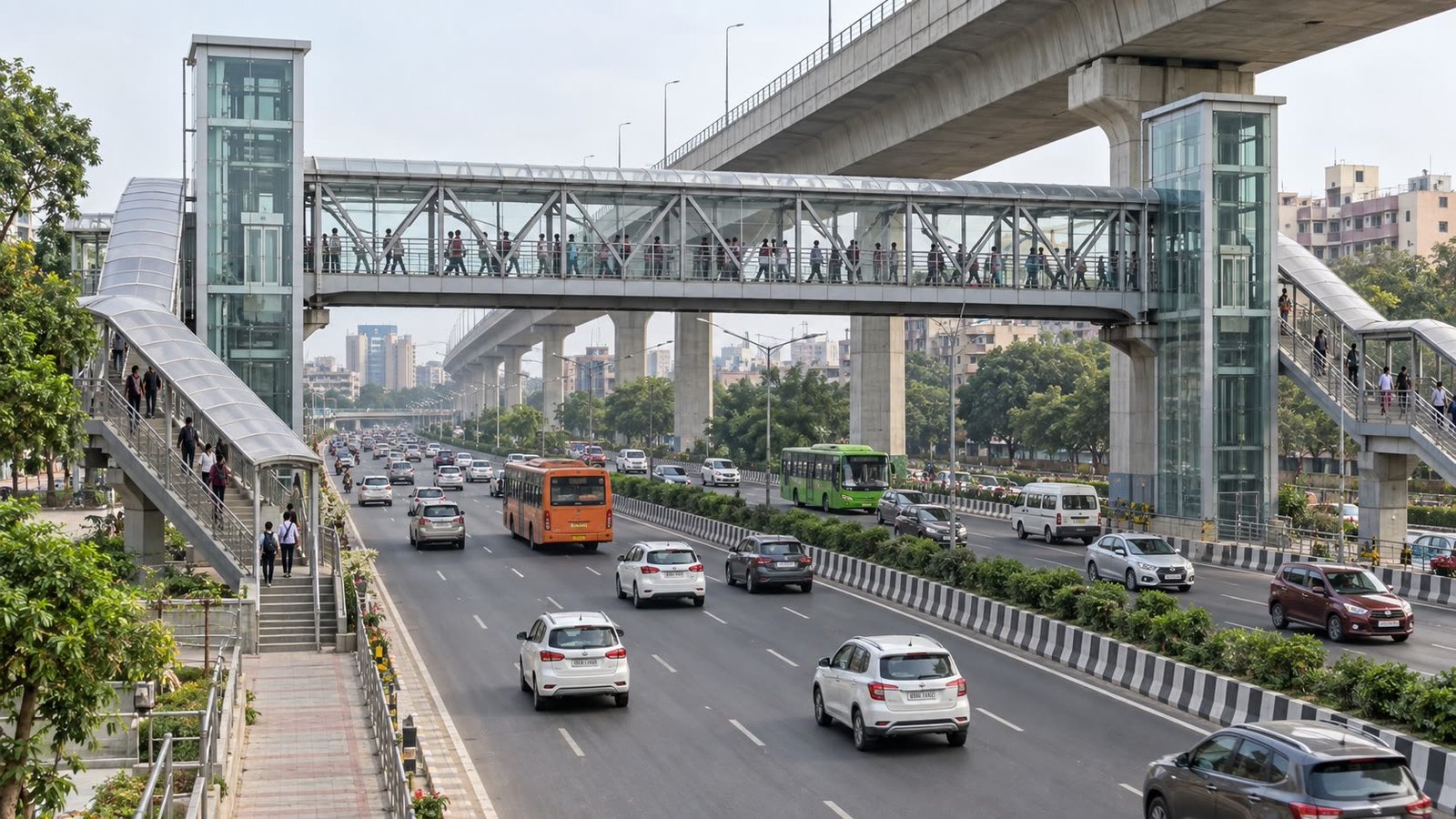
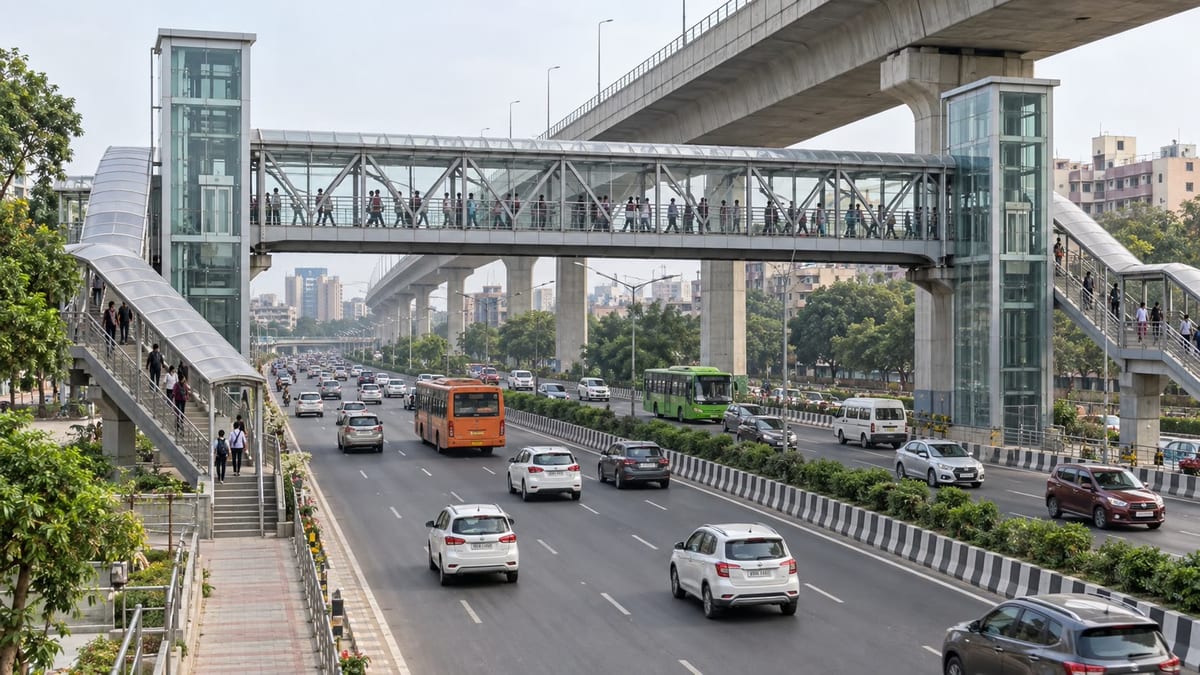 AI-generated editorial illustration of an accessible foot overbridge over a busy urban expressway. Credit: FuelPrice.
What was announced on 23 Sep
Minister of State for Corporate Affairs and Road Transport and Highways Harsh Malhotra laid the foundation stones for two foot overbridges on the Delhi section of NH-709B, according to the Press Information Bureau. The first is planned at Geeta Colony/Gandhi Nagar at Km 5+100 and the second at Ramesh Park, Laxmi Nagar at Km 2+800.
The same PIB release approved one more foot overbridge at Km 10+800 near Bhajanpura and Garhi Mendu. It put the combined cost of the three facilities at ₹12.8 crore. The Tribune's report published on 24 Sep also said the bridges are intended to provide safer pedestrian movement while allowing vehicle traffic to continue on the busy corridor.
For drivers, this is a planned safety and access upgrade rather than a new toll announcement. The project details released so far do not set a completion date, announce a route closure or change a toll rate. People planning a longer Delhi-NCR trip can still use the road-trip planner to compare the corridor with alternate routes.
Why the crossings matter to drivers and pedestrians
The Delhi section of the expressway passes through dense residential and commercial areas, where local movement and high-speed through traffic share a constrained urban setting. A dedicated crossing can reduce the need for pedestrians to cross at road level, lowering the chance of sudden conflicts between people and moving vehicles.
The benefit is not limited to people walking between neighbourhoods. Students, workers, shoppers, bus passengers and residents approaching the corridor all stand to gain a defined crossing point. For motorists, the intended benefit is more predictable traffic movement: fewer informal crossings and less need for drivers to brake suddenly near busy access points. That is an expected operational benefit, not a measured time or fuel saving announced by the government.
The Financial Express reported that the two foundation-stone sites are the Geeta Colony/Gandhi Nagar and Ramesh Park-Laxmi Nagar locations, while the third site is near Bhajanpura-Garhi Mendu. The report also noted that the bridges will have lifts, a detail that matters on an elevated corridor where stairs alone can exclude older people and people with mobility challenges.
Lifts are part of the access design
Lift facilities are planned at the two foundation-stone sites and are part of the wider three-bridge announcement. The PIB said they are meant to improve access for senior citizens, people with mobility challenges, students, workers and other pedestrians. Their usefulness will depend on construction quality, maintenance and whether the approaches connect cleanly with footpaths, bus stops and nearby lanes.
Parking, charging and solar work under the elevated section
The footbridges are one part of a broader plan for the Delhi stretch of the expressway. The PIB said parking facilities beneath the elevated section have started, while a beautification plan for NH-709B Phase-I is in progress. The space below the corridor is also intended to include public amenities such as EV charging points and toilets.
That combination could make the corridor more useful for people who stop locally, rather than treating the expressway only as a through route. EV owners can check nearby options in FuelPrice's state-wise EV charging directory as facilities are added; the announcement itself does not provide an operational date or charger count for these planned amenities.
Solar panels are also being installed along the elevated stretch, according to the PIB and the Financial Express. The stated purpose is to support highway-related power requirements and reduce reliance on conventional sources. No generation figure or emissions estimate was included in the announcement, so the impact should be assessed after the installation becomes operational.
What changes now for corridor users
There is no immediate change to the published route, toll or vehicle-document requirements in the announcement. The immediate development is the start of project implementation through foundation works. As construction progresses, drivers may see work zones or local traffic management around the sites; the authorities have not yet published a construction timetable or specific diversion plan in the sources reviewed for this report.
Pedestrians should look for official signs and use designated crossings when they are opened rather than assuming that a foundation ceremony means the bridge is ready for use. Drivers who regularly use Geeta Colony, Gandhi Nagar, Laxmi Nagar or Bhajanpura should watch local traffic advisories before peak-hour trips, especially when civil works begin around ramps and footpaths.
For a trip that includes the Delhi-Dehradun corridor, the fuel cost calculator can help separate the expected fuel spend from any parking or toll costs. A route-level estimate can then be checked against the toll charge calculator, because the new footbridges themselves do not change the toll information reported by the government.
What to watch next
The next useful update for readers will be an official construction and completion schedule for each bridge. It should also clarify temporary traffic arrangements, lift commissioning, footpath connections and the operating details of any EV charging or public facilities under the elevated section.
Until those details are published, the practical takeaway is limited but clear: East Delhi's NH-709B corridor is receiving planned pedestrian infrastructure at three identified locations, with accessibility built into the design. The project may improve safety and traffic predictability after completion, but the announced facilities are not yet open and no immediate toll or route change has been notified.
Sources
- Press Information Bureau: Minister of State for Corporate Affairs and Road Transport & Highways Lays Foundation Stones for Two Foot Over Bridges on Delhi-Saharanpur-Dehradun Expressway in East Delhi — 23 Sep 2026
- The Tribune: Delhi-Dehradun expressway to get two foot over bridges in East Delhi — 24 Sep 2026
- Financial Express: Delhi-Dehradun Expressway to get 3 new foot over bridges in East Delhi area — 23 Sep 2026