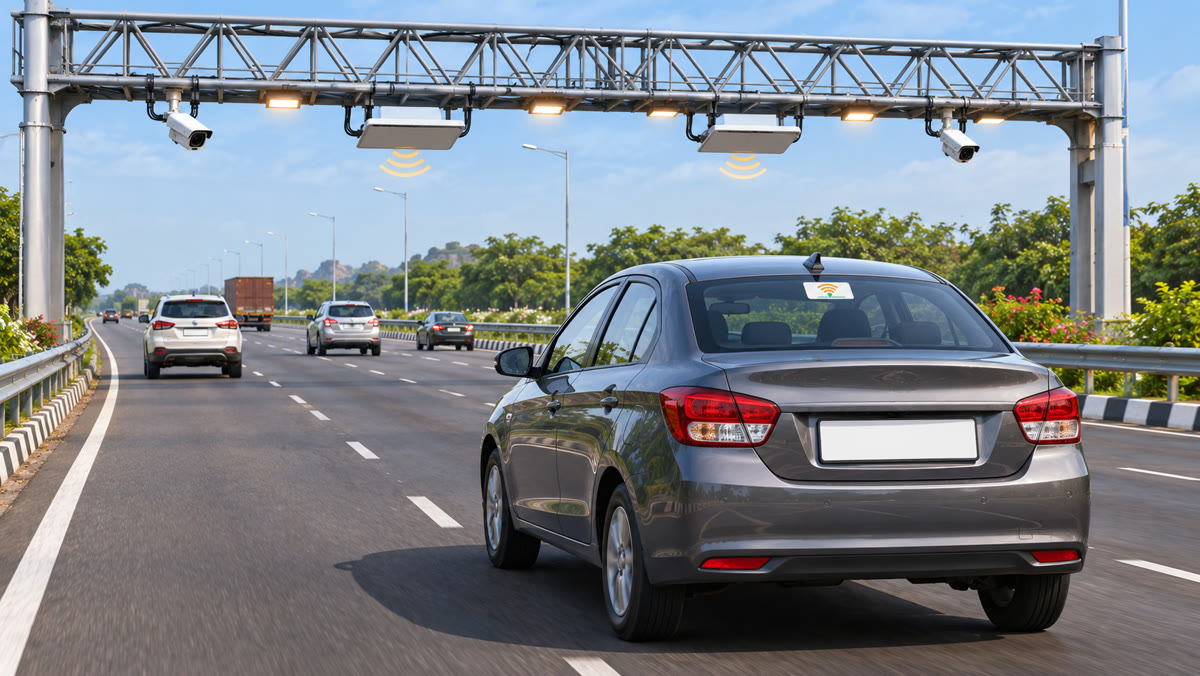
The Ministry of Road Transport and Highways (MoRTH) has proposed a penalty equal to five times the applicable user fee for deliberate number-plate masking, tampering or FASTag non-affixation at Multi-Lane Free Flow (MLFF) toll plazas. Because the original toll would still be recovered, the total amount can reach six times the normal fee when intent to evade is established.
This is a new enforcement step for barrier-free tolling, not a new charge on every vehicle that passes an MLFF gantry. The ministry says the action is aimed at deliberate evasion, and the announcement does not specify a separate start date. It says the penalty is proposed for existing MLFF locations and for future locations where the system is introduced.
Key takeaways
- The additional penalty is five times the applicable user fee, over and above the original toll.
- The total exposure can therefore be six times the normal toll when deliberate evasion is proven.
- The proposal covers number plates that are masked, concealed or tampered with, as well as FASTag non-affixation when used to avoid payment.
- Detection will use the MLFF system's FASTag readers, Automatic Number Plate Recognition (ANPR) cameras and other technology-driven checks.
- Drivers should keep both registration plates clearly visible and make sure the FASTag is properly affixed before using a barrier-free toll location.
What MoRTH has proposed
In the announcement reported on 27 Nov 2026, MoRTH said a vehicle user who deliberately masks, tampers with or conceals the registration number on the front, rear or both sides could face the additional charge. The same proposal covers cases in which a FASTag is not affixed to the vehicle as part of an attempt to avoid the user fee.
The wording matters because the ministry has tied the penalty to intent. Its statement does not say that every missed read automatically attracts the charge; the conduct must be established as an attempt to avoid payment.
The financial effect is straightforward. If the applicable user fee is ₹100, the proposed five-times penalty would add ₹500, while the original ₹100 would remain payable, taking the total to ₹600. This is an illustration of the announced formula, not a fixed toll rate: the actual amount would depend on the user fee at the concerned plaza.
Where the MLFF rule applies
MLFF is a barrier-free tolling system in which overhead gantries use FASTag readers and ANPR cameras to identify a vehicle and facilitate electronic deduction without a conventional toll barrier. The system is intended to reduce stopping, queues, travel time, fuel use and emissions on the covered highway sections.
The network is expanding, but it is not the same as every toll plaza in India. The Indian Express reported on 27 Nov that MLFF was live at nine fee plazas, while a 23 Nov PIB release described the system as operating at Choryasi in Gujarat plus eight other plazas. The practical scope for a driver therefore depends on whether the route uses an operational MLFF location, rather than a conventional barrier-based plaza.
The same PIB release said the seven plazas included in its comparison had recorded a 19.84% increase in net revenue against the corresponding pre-MLFF baseline as of 31 Oct 2026. That background explains why enforcement is being tightened: the authority is trying to keep the faster, barrier-free system from creating an easy route for unidentified vehicles to avoid payment.
What drivers should check now
- Registration plates: keep the front and rear plates clean, readable and unobstructed. Do not use covers, films, folds or other changes that make the number difficult for a camera to read.
- FASTag placement: make sure the tag is affixed as required and is associated with the vehicle using it. The proposal specifically covers non-affixation when it is used to avoid payment.
- Trip route: check whether the road includes an MLFF toll location and estimate the ordinary charge with the toll-charge calculator before the journey.
- Notices and deductions: review any toll message or e-notice against the vehicle, route and date before treating it as an error or ignoring it. The PIB has said NHAI is using electronic notices and technology-enabled recovery for unpaid user fees.
How ANPR and vehicle matching fit in
Under MLFF, the FASTag read and the linked registration number work together to identify the vehicle. If a number plate is deliberately hidden or altered and the tag cannot be detected, the ministry says the vehicle can be traced through a technology-driven process. The wider enforcement system includes ANPR cameras and, according to the PIB's 23 Nov account, NHAI's use of vehicle-fingerprinting tools and VAHAN integration to trace registered owners.
This development follows NHAI's earlier move to use AI-based vehicle fingerprinting for toll-evasion cases. FuelPrice's earlier coverage of that detection system explains why a vehicle that is not identified at the gantry may still be pursued later through linked records and notices. The new proposal adds a specific financial consequence to that identification effort.
What changes for ordinary toll users
For a driver using a properly affixed FASTag and a clearly visible registration plate, the announcement does not create a new six-times toll. It is targeted at conduct that is found to be deliberate evasion. The key change is that the possible recovery is now substantially higher when the enforcement process establishes that a plate or tag was deliberately made difficult to detect.
MoRTH has not stated a separate effective date in the 27 Nov announcement. It has said the proposal is intended to apply wherever MLFF is already in use and at each new location introduced in future. Road users should therefore watch for location-level implementation details, the notice and recovery process, and any official clarification on how intent will be recorded and challenged.
People planning longer highway journeys can use FuelPrice's road-trip planner to map the route and identify toll-related stops. For a complete trip budget, the fuel-cost calculator can be combined with the toll estimate; both costs vary with the selected route, vehicle and current rates.
Reader takeaway
The safest interpretation of the announcement is precise: do not obstruct or alter a vehicle's registration number, do not remove the FASTag to avoid a toll, and do not assume that a barrier-free lane means a vehicle cannot be identified later. The proposed five-times penalty is in addition to the normal user fee, so a proven evasion case can make the total six times the applicable toll. For everyone else, the immediate task is simply to keep the plate visible, the tag affixed and toll records available for checking.
Sources
- News On AIR — Government announces fivefold penalty for toll fee evasion under MLFF — 27 Nov 2026.
- The Indian Express — Number plate tampering to evade toll at barrier-less plaza to attract five times penalty — 27 Nov 2026.
- India Today — MLFF toll evasion penalty: Masked number plates, missing FASTags to attract sixfold charge — 27 Nov 2026.
- Press Information Bureau, Ministry of Road Transport and Highways — NHAI's Barrier-less MLFF Tolling System Boosts Net Toll Revenue by 19.84% Across Operational Fee Plazas — 23 Nov 2026.