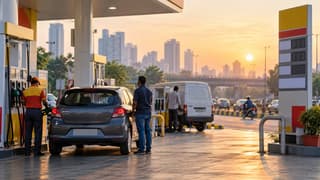
Ethanol blending with petrol at record 19.6% in January 2025

Around 82.1 crore litres of ethanol was utilised in the blending programme last month and during November 2024-January 2025, the blending volume stood at 222.9 crore litres

		
				Ethanol blending with petrol at record 19.6% in January 2025

The year 2025 commenced on a positive note for the Ministry of Petroleum & Natural Gas (MoPNG) as ethanol blending with petrol achieved a rate of 19.6 per cent in January—the highest so far.

This is the second consecutive month when ethanol blending hit a record.

In December last year, the blending rate stood at a high of 18.2 per cent.

Sponsored

The Ministry of Petroleum & Natural Gas (MoPNG) is promoting ethanol blending in petrol under the Ethanol Blended Petrol (EBP) programme.

Under the National Policy on Biofuels, it aims to achieve the target of 20 per cent blending in Ethanol Supply Year (ESY) 2025-26.

Around 82.1 crore litres of ethanol was utilised in the blending programme last month.

During November 2024-January 2025, the blending volume stood at 222.9 crore litres.

State-run Oil Marketing Companies (OMCs) cumulatively procured 91.7 crore litres of ethanol during January and 200.8 crore litres in November-January of ESY 2024-25 (November 2024 to October 2025).

“Ethanol blending in Petrol was 19.6 per cent during January 2025 and cumulative ethanol blending during November 2024-January 2025 was 17.4 per cent,” MoPNG said.

India’s ethanol production capacity is around 1,683 crore litres, which is more than sufficient to meet the 20 per cent blending mandate till October 2026.

To achieve a blending for 20 per cent ethanol with petrol in the ESY 2024-25, around 990 crore litres of ethanol will be required.

According to the International Energy Agency (IEA), ethanol demand in India tripled between 2017 and 2021.

In 2017 blending stood at 2 per cent, but by the summer of 2021 it touched 8 per cent.

Public sector OMCs achieved the target of 10 per cent ethanol blending in petrol in June, 2022, which was five months ahead of the target during ESY 2021-22. Blending of ethanol further increased to 12.06 per cent in ESY 2022-23 and around 14.6 per ent during ESY 2023-24.

During the last ten years, the EBP programme helped in payment of around ₹92,409 crore to farmers as of September 2024.

During the same period, EBP programme also resulted in savings of more than ₹1,08,655 crore of foreign exchange, crude oil substitution of 185 lakh tonnes and net CO2 reduction of about 557 lakh tonnes.

It is anticipated that 20 per cent ethanol blending in petrol is likely to result in payment of more than ₹35,000 crore annually to farmers.

comment Comments

Related Fuel News

More updates you might want to read next.

Tata Motors Plans Rs 40,000 Crore FY31 Investment: Why Its EV And CNG Push Matters For Buyers

Tata Motors Passenger Vehicles is planning to invest Rs 37,500-40,000 crore over the next five years, up to FY31, as it targets a bigger production base, more models and annual sales of over 1.2 million units. ET also reported that the company wants revenue to cross Rs 6 lakh crore by FY31 with a 10 percent EBIT margin, with EVs and CNG models doing much of the heavy lifting. For buyers, the story is less about balance-sheet ambition and more about what kind of cars Tata wants to sell next.

Petrol, Diesel Rates May Ease As Cheaper Crude Arrives: What Hardeep Puri’s Signal Means For India

Union Petroleum Minister Hardeep Singh Puri says petrol and diesel rates in India may ease once recently bought cheaper crude reaches refiners, after global oil prices cooled and Brent slipped below $80 a barrel. The signal matters because India imports most of its crude, so any sustained fall can filter through to motorists, freight users and inflation. But the relief is unlikely to be immediate, because fuel prices depend on inventory cycles, logistics and how quickly oil companies pass on lower input costs.

Petrol, Diesel Rates May Ease As Cheaper Crude Arrives: What Hardeep Puri’s Signal Means For India

Union Petroleum Minister Hardeep Singh Puri says petrol and diesel rates in India may ease once recently bought cheaper crude reaches refiners, after global oil prices cooled and Brent slipped below $80 a barrel. The signal matters because India imports most of its crude, so any sustained fall can filter through to motorists, freight users and inflation. But the relief is unlikely to be immediate, because fuel prices depend on inventory cycles, logistics and how quickly oil companies pass on lower input costs.

Toyota Ebella Deliveries Begin In India: Why The ₹23.6 Lakh E3 Matters For EV Buyers

Toyota has started deliveries of the Urban Cruiser Ebella electric SUV in India, turning the model from launch headline into a real-world ownership story. The top-spec E3 is priced at Rs 23.60 lakh ex-showroom, while Toyota is also offering a Battery-as-a-Service route that lowers the entry price to Rs 15.25 lakh and charges Rs 4.99 per km for battery use. For EV buyers, this is the point where Toyota’s first mass-market electric SUV begins proving itself on the road.