India’s EV battery-swapping debate is increasingly tilting toward electric two- and three-wheelers rather than passenger cars, according to a 29 November 2026 analysis by ThePrint. For Indian drivers, the distinction matters because battery weight, parking access, station compatibility and the payment model can change whether an EV is practical for daily trips or commercial work.
Key takeaways
- Battery swapping is a charging alternative, not a new national mandate for EV owners.
- India’s Ministry of Power guidelines support swapping stations and battery-as-a-service, but do not require manufacturers to adopt one common system.
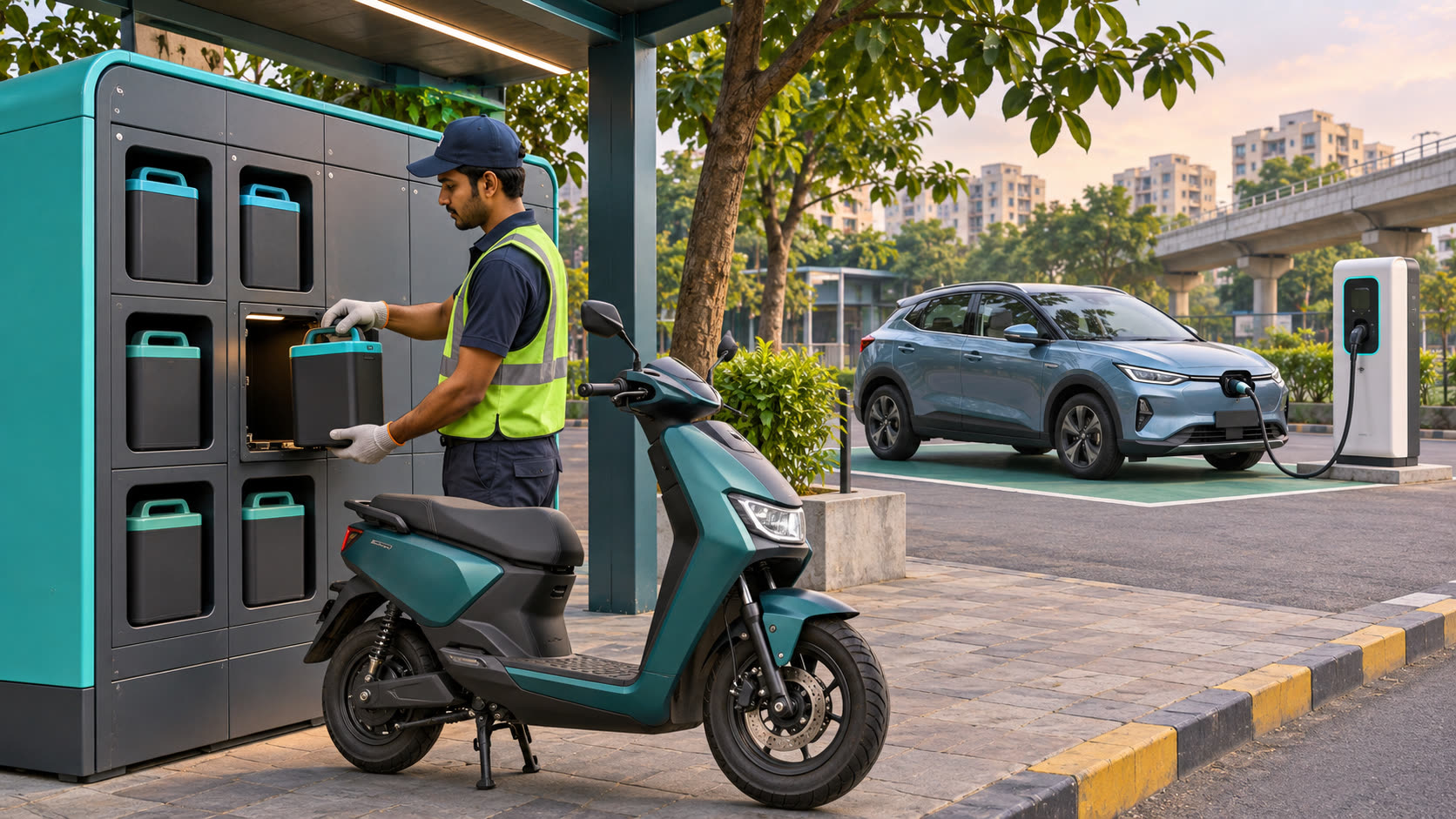
- Two- and three-wheelers can make a stronger near-term case where riders lack fixed parking or commercial operators value short stops.
- Passenger-car swapping faces tougher questions around battery size, handling, station equipment, spare inventory and interoperability.
- Fixed charging is still expanding; Ather says its network had more than 6,100 fast-charging points in over 370 Indian cities as of 25 August 2026.
What the new analysis says
ThePrint’s 29 November analysis frames India’s debate as a choice between fixed batteries with plug-in charging and removable batteries exchanged at a station. It reports that manufacturers are pursuing different routes: VinFast is preparing an electric-scooter strategy centred on swappable batteries, while Ather has built its case around fixed batteries and a fast-charging network. These are company approaches reported by the publication, not a government decision that settles the market.
What India’s rules already allow
India already has an official framework for the infrastructure behind swapping. In guidelines dated 10 January 2025, the Ministry of Power described swappable batteries as an alternative way to power EVs and set objectives that include promoting battery-as-a-service and developing a battery-swapping ecosystem. The guidelines apply to battery providers and operators of battery charging or swapping stations.
The same document defines battery-as-a-service as a model in which a manufacturer or third-party provider owns and manages batteries, leasing or renting them to EV owners or fleet operators. It also allows station operators to use an existing electricity connection, subject to the applicable provisions, and recognises liquid-cooled swappable batteries for larger vehicles such as trucks and buses.
That framework enables the model; it does not mean every battery will fit every vehicle. NITI Aayog’s e-AMRIT material identifies low standardisation, unsuitable battery-pack design, higher cost over an EV’s life and shorter commercial battery life as adoption challenges. Its battery-swapping material also points to the need for common form factors, interoperable connections, battery-management communication and network-management standards.
Why two-wheelers and three-wheelers may move first
Parking and daily access
For many urban two-wheeler users, the first charging problem is not range but where the vehicle can be parked overnight. ThePrint’s account quotes VinFast’s two-wheeler leadership making that point ahead of its reported India scooter plans. A compact removable pack can be carried to a charging point, or exchanged at a nearby station, although the pack’s weight and handling still matter for the user.
Swapping can also be useful for delivery riders, e-rickshaw operators and other high-utilisation fleets where waiting for a vehicle to charge reduces earning or operating time. NITI Aayog’s e-AMRIT material describes swapping as a potential option for the commercial segment. The benefit is therefore closely tied to route density and station availability, not just the vehicle’s advertised range.
For people checking whether a local network exists, the EV station directory is a useful starting point. Availability, operating hours and network coverage should be checked for the actual commute rather than inferred from a national headline.
Why passenger cars are a harder fit
A passenger-car battery is generally more difficult to remove, transport and exchange than a scooter battery. A car-swapping network would also need specialised equipment, a large pool of compatible charged batteries and a way to manage battery condition across vehicles. ThePrint notes that robotic car swapping is technically possible in other markets, but that equipment, security and inventory make the model more complicated.
Interoperability is another hurdle. A driver cannot assume that a station operated by one company will accept a battery from another company. NITI Aayog’s public material says Indian standards work is addressing battery form factors, interoperable connections and communication between the battery-management system, vehicle and station. Until those systems are widely aligned, a car buyer may be tied to one manufacturer or network.
This does not rule out car swapping. Fleet operators with predictable routes, controlled parking and high utilisation could make the economics work more easily than private owners. It does mean that a technically impressive demonstration is not the same as a nationwide service for family-car drivers.
Fixed charging is still competing for the same users
Swapping is not developing in an empty market. Ather’s official 25 August 2026 update said its fast-charging grid had more than 6,100 points across over 370 cities and towns; ThePrint cited the same network while describing the fixed-battery approach. Those figures are company-reported and apply to Ather’s network, but they show the alternative being built alongside swap stations.
What EV users should check now
- Battery handling: Check whether the pack is removable, how it is lifted and whether the vehicle’s warranty covers the battery separately.
- Network fit: Confirm the locations, hours, live status and vehicle compatibility of swap or charging stations on the regular route.
- Payment model: Read whether the battery is owned, leased or covered by a per-swap or distance-based plan, and identify taxes, deposits and renewal terms.
- Fallback charging: Check whether the vehicle can be charged at home or through a compatible public connector if a station is closed or out of stock.
- Long-trip planning: Use the road-trip planner to map stops and allow for the actual charging or swapping network rather than assuming continuous coverage.
For a conventional vehicle comparison, the fuel-cost calculator can show the petrol or diesel baseline for a planned trip. That comparison should be kept separate from the EV’s charging or battery-service bill, because tariffs and subscription terms vary by network and vehicle.
What to watch next
The next meaningful developments will be practical: wider interoperability standards, more stations in dense urban and commercial corridors, transparent battery-service contracts and evidence that swapped batteries can be tracked safely through their life. Fleet pilots may move faster than private-car adoption because vehicles return to known depots and can use predictable routes.
For now, the fresh debate changes the questions buyers and operators should ask, not the rules they must follow. Battery swapping may become an important part of India’s EV infrastructure, but its usefulness will depend on the vehicle segment, local parking reality, station density and the total cost of the chosen service.
Frequently asked questions
Is battery swapping a new national rule?
No. The Ministry of Power’s 10 January 2025 guidelines support and regulate the infrastructure model. They do not require EV owners or manufacturers to use swappable batteries.
Will one swap station work with every EV?
Not automatically. Battery shape, connectors, communication systems and network rules must match. Interoperability standards are still an important part of the ecosystem’s development.
Does swapping automatically reduce the cost of an EV?
It can separate the battery from the vehicle’s upfront purchase price in a battery-as-a-service model, but the owner still needs to compare lease, per-swap or distance-based charges over the expected ownership period. The actual cost depends on usage and contract terms.
Sources
- ThePrint — EV battery swapping might not work for cars. It could take off in 2-wheelers — 29 Nov 2026
- Bureau of Energy Efficiency, Ministry of Power — Guidelines for Installation and Operation of Battery Swapping and Charging Stations — 10 Jan 2025
- NITI Aayog e-AMRIT — FAQs, including battery-swapping viability and adoption barriers — accessed 29 Nov 2026
- NITI Aayog e-AMRIT — BIS standards for EV charging and battery swapping — accessed 29 Nov 2026
- Ather Energy — How Fast Charging Technology Works for Ather Electric Scooters — 25 Aug 2026