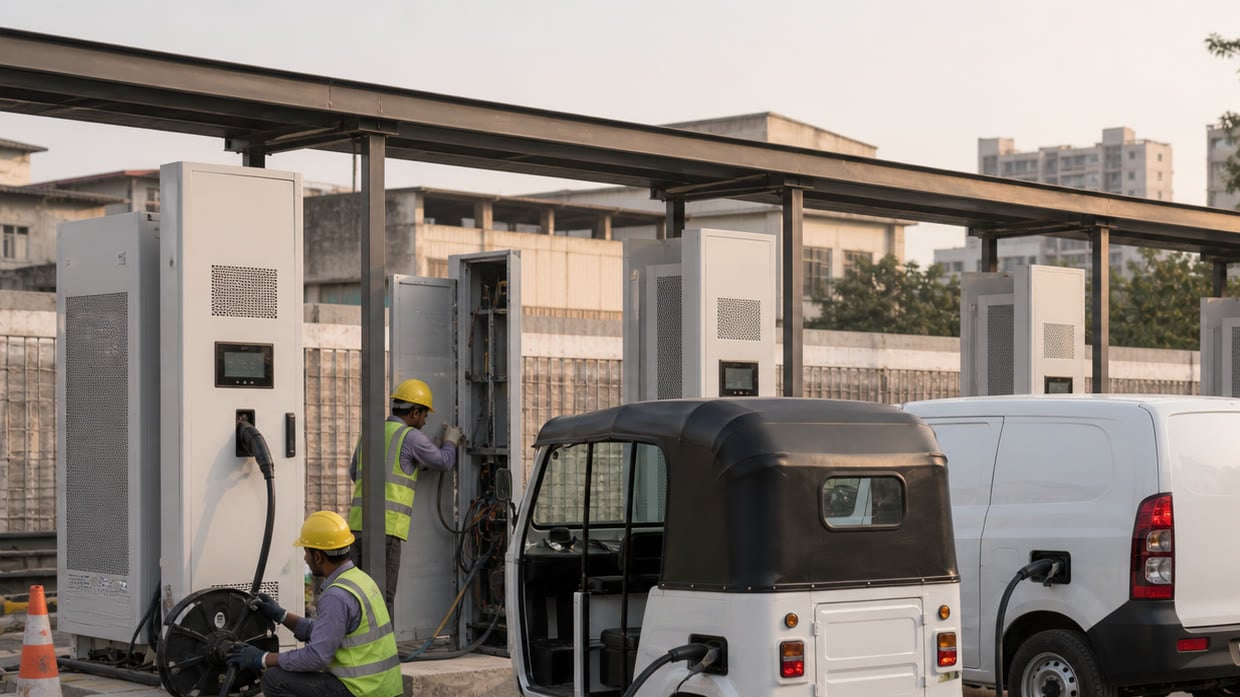
Bengaluru-based Exponent Energy has secured Rs 200 crore, about $21.1 million, in a fresh funding round co-led by 360 ONE Asset and TDK Ventures. The company says the capital will support expansion of its rapid-charging network, deeper vehicle partnerships, and continued development of its battery and charging technology for commercial electric vehicles.
This is not a routine startup fundraise for the auto sector. Exponent's focus is the part of the EV market where charging time directly affects income: three-wheelers, delivery vehicles, buses and other high-utilisation fleet vehicles. For a private car owner, waiting longer at a charger may be inconvenient. For a transporter, driver, route operator or delivery fleet, every idle hour can reduce trips, earnings and asset productivity.
What happened
According to ETtech and Times of India coverage, the Rs 200 crore round was backed by 360 ONE Asset, TDK Ventures, Hitachi Ventures, Eight Roads Ventures, Lightspeed, 3one4 Capital, AdvantEdge VC and YourNest. ETtech also reported that the latest fundraise takes Exponent Energy's total capital raised to about $65.7 million.
The company is best known for its rapid-charging approach that combines its own battery pack and charging system. Exponent's website positions the platform around a 15-minute charge, longer battery-cycle life, and a charging network designed for commercial EV use. Its public numbers also list more than 2,000 vehicles on road and 162-plus charging stations, while the latest ETtech report says the network is already near the 200-station mark across key operating markets.
The fresh capital is expected to help Exponent move beyond early clusters and add depth to its network. That is important because commercial EV adoption does not only depend on vehicle price. It also depends on whether a driver can recharge quickly, reliably and near the route where the vehicle earns money.
Why this matters for fuel users and fleets
India's commercial transport market still depends heavily on petrol, diesel and CNG for last-mile movement, passenger three-wheelers, cargo vans, buses and light logistics vehicles. Electric alternatives can lower running cost, but only when charging access matches route demand. A vehicle that charges slowly may look economical on paper but can become difficult for a fleet owner if it misses peak operating windows.
That is why rapid charging is a fuel-economics story, not only a technology story. If more commercial EVs can charge in minutes rather than hours, fleet operators get a practical substitute for fuel-station-style turnaround. Drivers can complete more daily trips, logistics companies can schedule routes with less buffer time, and vehicle owners can recover the higher upfront cost of an EV faster.
The impact will be most visible in high-use segments. Electric three-wheelers running passenger or cargo routes, e-commerce delivery vehicles, school or staff transport fleets, and intra-city commercial vans all have predictable daily patterns. If chargers are placed near depots, loading points, mobility hubs and dense urban corridors, operators may be more willing to move away from petrol, diesel or CNG vehicles.
The bigger shift: uptime over headline range
Many EV buying decisions in India still focus on range. For commercial EVs, uptime can be even more important. A 120 km to 150 km real-world range may be enough for many city routes if the vehicle can top up quickly during a break. A much longer-range vehicle can still be inefficient for a fleet if charging forces long downtime or if the charger network is too thin.
Exponent has also been expanding its commercial approach beyond new vehicles. In earlier coverage, ET reported that the company entered the retrofit market with a technology package aimed at converting CNG and LPG passenger autos into rapid-charging electric vehicles. That strategy matters because India already has a large installed base of three-wheelers. Retrofitting, if executed with reliable warranties, financing and service support, can potentially accelerate the shift without waiting for every operator to buy a brand-new EV.
The company has also launched financing support for commercial EV buyers, another relevant piece of the fuel transition puzzle. Charging speed can solve uptime, but monthly instalments, battery confidence and route-level charger access still decide whether small fleet owners and independent drivers make the switch.
Who is affected
- Fleet operators: Faster charging can improve vehicle utilisation and reduce downtime compared with slow depot charging.
- Delivery and logistics companies: More rapid-charging hubs can make electric cargo routes easier to plan across dense city clusters.
- Auto-rickshaw and three-wheeler owners: Retrofit and rapid-charge options may give existing fuel users another path into electric mobility.
- Fuel retailers and CNG networks: Commercial EV charging hubs are still small compared with conventional fuel networks, but they are starting to compete on turnaround time.
- Vehicle manufacturers: More dependable charging infrastructure can help OEMs sell commercial EVs with stronger operating-cost logic.
What to watch next
The next test is not just how much money Exponent has raised. The real test is execution. Watch how quickly the company adds charging stations outside its strongest existing hubs, which vehicle makers sign deeper partnerships, and whether commercial users report stable real-world battery life after repeated fast charging.
Charging tariffs will also matter. A 15-minute charge is valuable, but the per-km cost must stay clearly competitive against petrol, diesel or CNG for fleet owners to shift in large numbers. Grid reliability, charger uptime, site permissions, battery warranty terms and after-sales support will all decide whether rapid charging becomes a mainstream fleet solution or remains a premium network for select operators.
For FuelPrice readers, the takeaway is clear: this funding round is a signal that India's EV transition is moving from product launches to operating infrastructure. If Exponent and similar players can scale dense rapid-charging hubs, commercial EVs could become more practical for daily high-mileage users, reducing fuel dependence in last-mile mobility and city logistics over time.
Sources: ETtech, Times of India, Exponent Energy, ET Energy/Renewables, ETtech financing context.