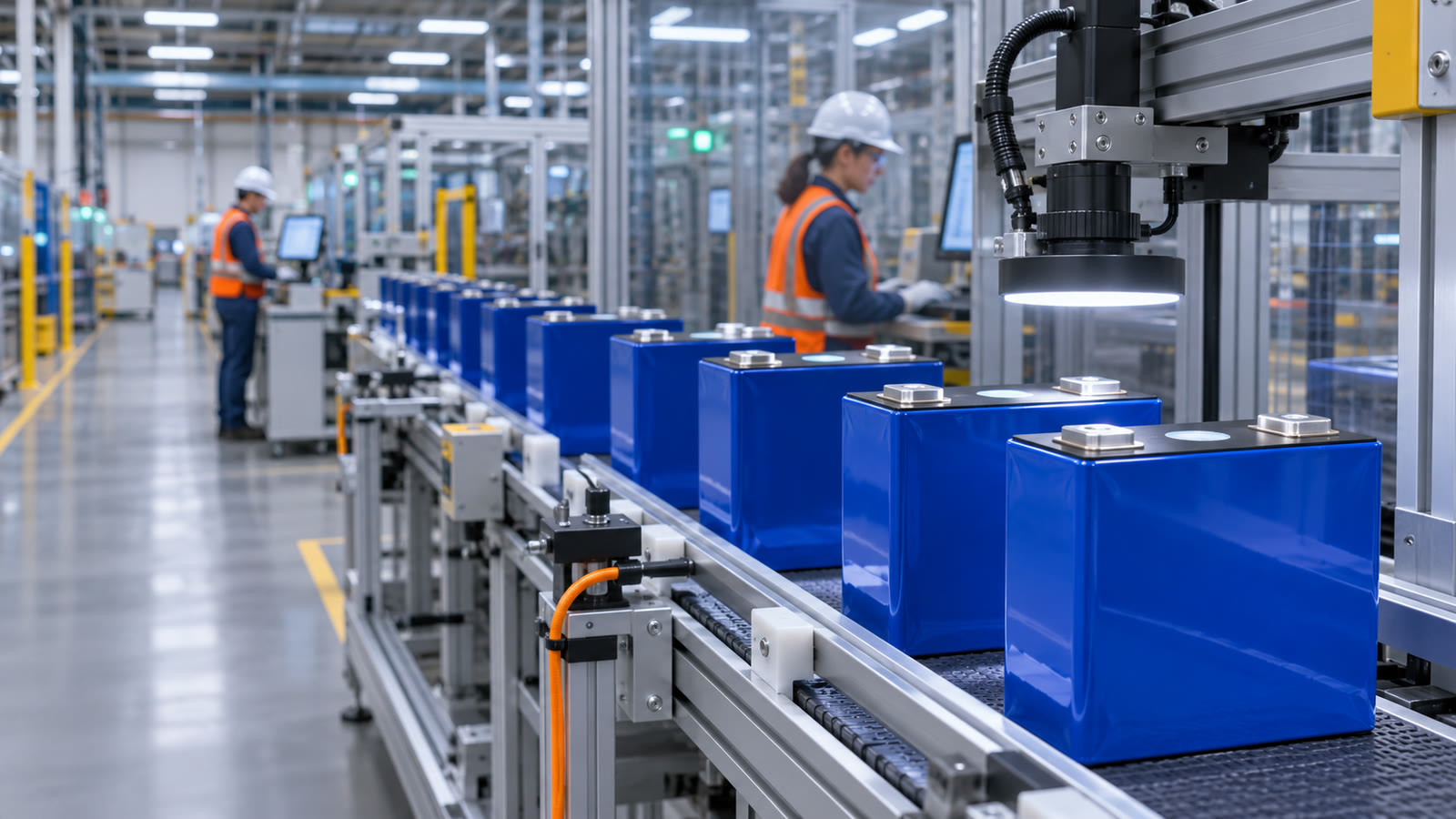
Ford has started shipping its first lithium-iron-phosphate (LFP) prismatic battery cells from the BlueOval Battery Park Michigan plant to Louisville, Kentucky, for Fathom electric-pickup prototypes. The 18 Nov 2026 milestone gives the US automaker an in-house route to lower-cost EV batteries while keeping licensed CATL technology inside a Ford-owned production operation.
Key takeaways
- Ford says the first LFP prismatic cells are moving from its Michigan plant to Louisville for Fathom prototypes.
- The plant is owned and operated by Ford, but the battery technology is licensed from Chinese battery maker CATL.
- Ford says the production line can deliver 40 cells per minute; that is a cell-line pace, not a vehicle-production forecast.
- LFP avoids nickel and cobalt in the cathode chemistry and is being pursued as a lower-cost, durable battery route.
- The Fathom is still a development programme, with series production reported for 2027 and export markets not yet specified.
What Ford has confirmed
In an announcement dated 18 Nov 2026, Ford said the first LFP prismatic cells were rolling off the line at BlueOval Battery Park Michigan in Marshall and were headed to Louisville Assembly Plant. The cells will initially power Fathom prototypes, so this is a manufacturing milestone rather than confirmation that customer vehicles are ready for delivery.
Reuters independently reported the same development on 18 Nov, describing the cells as a lower-cost battery option for Ford's forthcoming Fathom midsize electric truck. Electrive's report on 19 Nov said the first cells marked the end of the pilot phase. Taken together, the reporting confirms that Ford has moved from planned production into early in-house cell output, while the vehicle programme remains ahead of series manufacturing.
Ford says the Michigan assembly line can deliver 40 cells per minute. That figure describes the pace of cell assembly; it does not translate directly into the number of battery packs or vehicles that can be completed because cells must still pass quality checks, be assembled into packs and integrated into a vehicle.
Why LFP matters to EV costs
LFP is becoming important because battery chemistry affects the material mix, manufacturing process and eventual cost of an electric vehicle. Ford says its LFP chemistry uses no nickel or cobalt. Reuters reported that several automakers are moving toward LFP because it costs less than nickel-based batteries and is considered more durable.
That does not mean every LFP vehicle will automatically be cheaper at the showroom. The final price also depends on the size of the pack, factory utilisation, labour, software, electronics, logistics, tariffs and the automaker's pricing strategy. A lower-cost cell creates room for a more accessible EV, but it is only one part of the cost stack.
For drivers, the useful question is total running cost rather than battery chemistry alone. A petrol or diesel baseline can be modelled with the fuel cost calculator, while an EV comparison also needs the owner's electricity tariff, charging losses, driving pattern and maintenance assumptions. The result will vary by vehicle and route; a battery milestone is not a promise of a particular saving.
Charging access is the next practical constraint. An EV with a lower-cost battery still needs dependable charging where it is driven and parked. Readers planning electric travel can check the EV charging directory for available stations, then verify connector compatibility, operating hours and payment access before treating a route as fully covered.
The CATL link is the wider supply-chain story
Ford owns the Michigan factory, but Reuters and Electrive reported that the technology is licensed from CATL, the Chinese battery company. That makes the announcement relevant beyond Ford's own product plan: it shows how battery manufacturing can be localised while the underlying process knowledge still crosses borders.
In practical terms, this is not a complete break from Chinese battery expertise. Ford is bringing cell production into a US-owned facility, but it is using a technology relationship with one of the world's largest battery specialists. The arrangement allows Ford to build internal manufacturing capability while relying on an established LFP process rather than starting with an entirely new chemistry and production system.
The cross-border structure also explains why the milestone has drawn policy attention. Reuters reported that US officials had questioned Ford's reliance on licensed CATL technology, while Ford defended the arrangement and said the partnership was the fastest route to learning how to produce LFP cells for more affordable EVs. The dispute is about supply-chain control and industrial policy; it does not change the technical fact that Ford's first cells are now being made in Michigan.
Fathom remains a prototype-stage programme
The cells are travelling to Louisville for prototypes, which is an important distinction for readers following the vehicle itself. Electrive reported that the Fathom is scheduled to enter series production in 2027, while Ford said its battery-pack plant in Marshall is planned to be running ahead of launch. Neither source confirms which export markets will receive the vehicle, so the announcement should not be read as a global sales launch.
For now, the development answers a manufacturing question: can Ford produce its own LFP cells at a US facility and use them in a new vehicle platform? It does not yet answer the consumer questions about final range, charging speed, long-term warranty terms or availability outside the US. Those details will matter more than the first-cell announcement when the production vehicle is formally launched.
What the milestone means for drivers and fleets
- Near term: there is no immediate change to the vehicles currently on sale because the cells are going into prototypes.
- Battery affordability: LFP could help automakers target lower-cost EVs, but pack design and vehicle pricing will determine whether that benefit reaches buyers.
- Fleet planning: operators will need real-world information on duty cycle, charging time, battery warranty, payload effect and electricity cost before comparing an EV with a diesel vehicle.
- Supply-chain resilience: a Ford-owned US plant adds local production capability, but the CATL licence shows that technology and manufacturing know-how remain international.
For a conventional vehicle comparison, readers can also check live fuel prices before estimating a petrol or diesel route. The useful comparison is always vehicle-specific: fuel or electricity rate, efficiency, distance, charging or refuelling access and time spent on the road.
What to watch next
The next evidence will come from the development-to-production handoff. Watch for confirmation that the battery-pack line is operating, additional details on the Fathom's production specification, and a clearer statement on export markets. It will also be useful to see whether Ford expands LFP beyond the Fathom and stationary storage, or whether it keeps different chemistries for different vehicle segments.
Quality and scale will matter as much as the first shipment. A line that can assemble cells quickly still has to maintain consistency, safety and pack-level performance over years of use. That is why the prototype phase is important: it gives Ford time to validate the cells, pack integration and vehicle controls before customer production begins.
The reader takeaway is straightforward. Ford's first LFP cells from Michigan are a genuine step toward US-made, lower-cost EV battery production, but they are not yet a retail-vehicle launch or a guarantee of cheaper ownership. The bigger global story is the combination of local manufacturing and international battery technology: the EV supply chain is being rebuilt across borders, not inside one country.
Sources
- Ford — “Ford Ships First Battery Cells from Michigan Plant for Fathom Electric Truck; Key Milestone for Ford Energy” — 18 Nov 2026
- Reuters — “Ford ships first battery cells using CATL technology” — 18 Nov 2026
- electrive — “Ford delivers first LFP batteries for test fitting in Fathom prototypes” — 19 Nov 2026