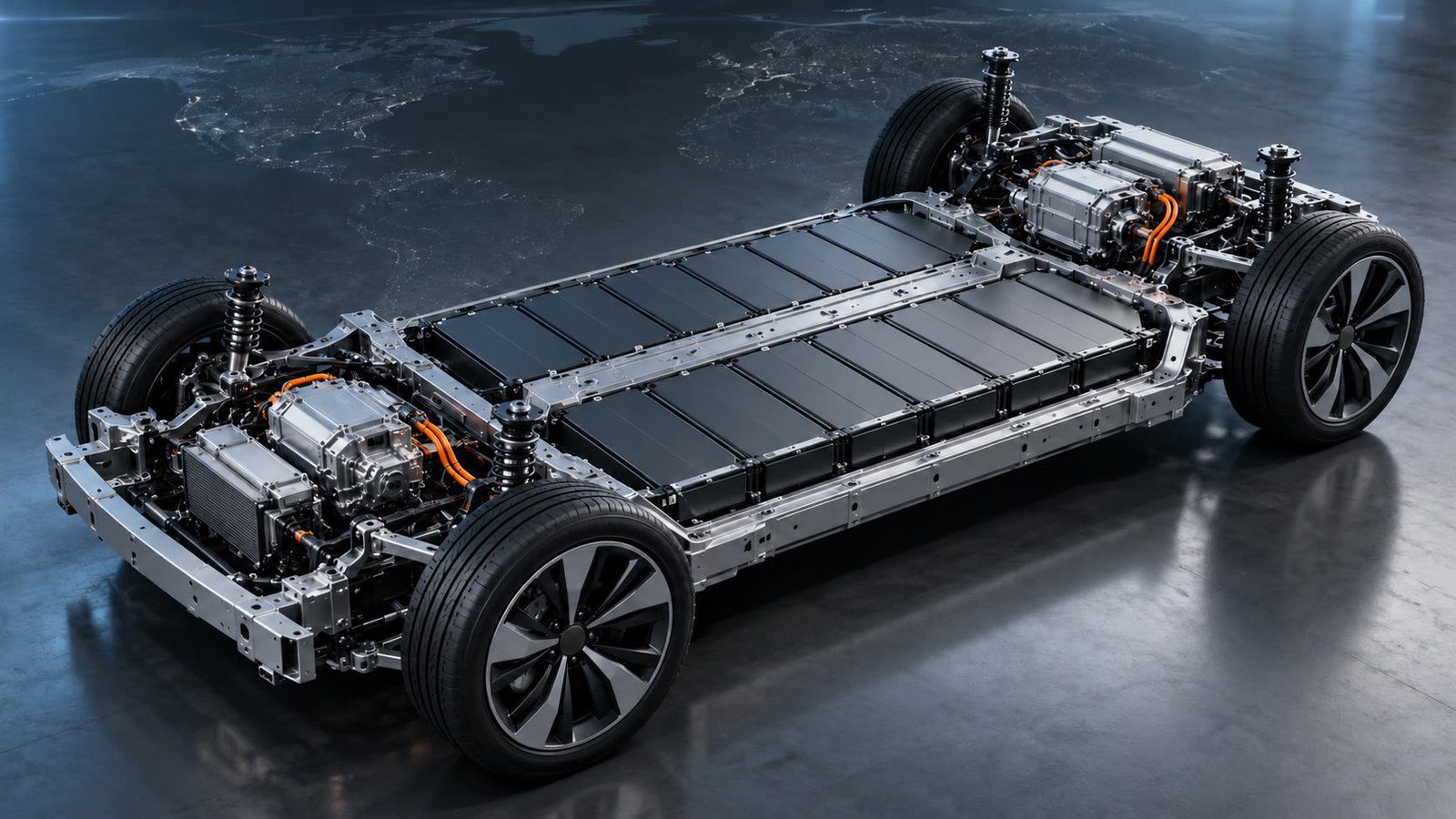
General Motors has outlined a fourth-generation EV platform that it says could deliver roughly 20% more driving range per kilowatt-hour. The company says the architecture combines lithium-manganese-rich batteries, simpler drive units and centralized computing to target more efficient, potentially lower-cost electric vehicles for high-volume segments.
The announcement, made on 21 Oct 2026, is a technology roadmap rather than a vehicle launch. GM has not yet published a production model name, retail price, final range figure or market-by-market launch schedule for the platform.
Key takeaways
- GM says its fourth-generation platform could deliver about 20% more range per kilowatt-hour than its current EVs.
- Its lithium-manganese-rich, or LMR, battery chemistry is designed to provide 33% more energy density than lithium iron phosphate, or LFP, at a comparable cost.
- GM says redesigned electric drive units will use 40% fewer internal parts, while centralized computing is intended to support software updates and energy management.
- The claimed gains are targets from development work; production-vehicle range, charging time, price and durability remain to be demonstrated.
What GM announced
GM’s fourth-generation architecture is being developed for the larger, higher-volume parts of the EV market. The company is combining battery chemistry, electric propulsion, aerodynamics, vehicle electronics and factory processes in one programme instead of treating each area as a separate hand-off.
That system-level approach matters because efficiency is not determined by the battery alone. A lighter pack, smaller motor, lower electrical losses and better aerodynamics can all reduce the energy needed to move the vehicle. GM says its early work points to roughly 20% more driving range from each kilowatt-hour of battery capacity; GM Authority reported the same company target in its independent account of the announcement.
LMR battery is the central change
GM says the platform will use prismatic cells with lithium-manganese-rich chemistry, manufactured by its Ultium Cells joint venture with LG Energy Solution in Spring Hill, Tennessee. The company describes LMR as a way to increase energy density without moving away from the cost position of widely used LFP batteries.
In GM’s stated comparison, LMR is designed to offer 33% more energy density than LFP at a comparable cost. GM Authority also reported that claim, while The Elec separately described GM’s plan to adopt LMR in the next-generation platform. Energy density is only one part of the ownership picture: it does not, by itself, establish charging speed, usable capacity, warranty life, thermal performance or the price of a finished vehicle.
Why the efficiency target matters
For an EV driver, the useful metric is not just the largest advertised range. Energy consumption per distance affects how much electricity is needed for a trip, how large a battery must be fitted for a given range, and how much weight the vehicle carries. If GM’s target is achieved in a production vehicle, the same trip capability could potentially come from a smaller pack, or a similar pack could deliver more distance. The actual result will depend on vehicle size, weight, tyres, software, temperature, speed and driving conditions.
That distinction is important for fleets and long-distance users as well as private owners. A more efficient vehicle can reduce the energy required between charging stops, but the business case still depends on local electricity tariffs, charging fees, vehicle price and utilisation. Until GM publishes those figures for a production model, the 20% claim should be treated as a development target rather than a guaranteed saving.
Drivers comparing an electric route with a petrol or diesel alternative can use the fuel cost calculator for the combustion-vehicle baseline. EV costs will need the vehicle’s consumption figure and the electricity price at the charging points used.
Software and manufacturing are part of the plan
GM is also changing the electrical and electronic architecture. The company says the platform will use centralized computing with 40 times more processing power for AI-enabled features, and that the new architecture will support future software updates, energy-management improvements and driver-assistance functions. The Elec also reported the move to a centralized computing structure.
On the production side, GM says its new development process overlaps design, engineering and manufacturing work and could cut a traditional five-year vehicle-development cycle in half. GM Authority reported the same target. The company also says its PlantBrAIn factory system is being used to speed battery-pack assembly, but that internal result should not be read as a production guarantee for every future plant.
The change could be significant if it allows GM to refresh high-volume vehicles more quickly across different markets. It could also make manufacturing efficiency a larger part of the EV cost contest, alongside battery materials, labour, shipping and regional trade rules.
What remains to be proved
The announcement leaves several questions open. GM has not identified the first production vehicle to use the platform, provided a final battery capacity or range figure, or stated when customers will be able to buy one. It has also not published independent road-test results for the LMR cells or a detailed comparison of charging performance against LFP.
The most useful evidence will arrive when a production vehicle is specified. Readers and fleet operators will then be able to compare consumption in kWh per 100 km or miles per kWh, usable battery capacity, charging-curve behaviour, cold-weather performance, warranty terms and price. Those details will show whether the platform’s efficiency translates into a practical advantage rather than only a laboratory or engineering claim.
Charging access remains the other half of the ownership equation. The EV charging station directory can help locate infrastructure while the platform moves from development into actual vehicles, but station availability and charging prices vary by country and route.
Bottom line for global EV buyers
GM has announced a broad technology direction, not a finished consumer product. Its LMR battery, more compact propulsion hardware and centralized software architecture could improve range and production economics if the company’s targets survive real-world validation.
For now, the practical takeaway is to watch the first production application and its independently measured efficiency. A future EV that uses less energy per kilometre may matter more to trip cost and charging frequency than a larger headline range alone. FuelPrice’s road-trip planner can support route planning as those vehicle and charging details become available.
Image note: The hero is an illustrative editorial rendering of a conceptual EV skateboard platform, not an official photograph of a specific GM vehicle.