Tesla reported a lower profit for the quarter ended 30 Sep 2026, even as free cash flow turned positive at $1.531 billion. The electric-vehicle maker also cut its full-year 2026 capital-expenditure outlook to about $20 billion from more than $25 billion, making the result relevant to global EV buyers, fleet operators and the wider battery industry.
The company’s official Q3 update, filed on 21 Oct 2026, shows a business in transition: vehicle deliveries were lower year on year, while Tesla continues to fund energy storage, software, robotics and new production capacity. The figures do not announce an immediate change to vehicle prices or charging access, but they give readers a clearer view of the investment choices that may shape future products and services.
Key takeaways
- Net income attributable to common stockholders was $787 million in Q3 2026, down from $1.373 billion in Q3 2025.
- Total revenue was $28.046 billion, broadly flat against $28.095 billion a year earlier.
- Vehicle deliveries were 486,532, about 2% below the 497,099 delivered in Q3 2025.
- Free cash flow was $1.531 billion, while the full-year 2026 capital-spending outlook was reduced to about $20 billion.
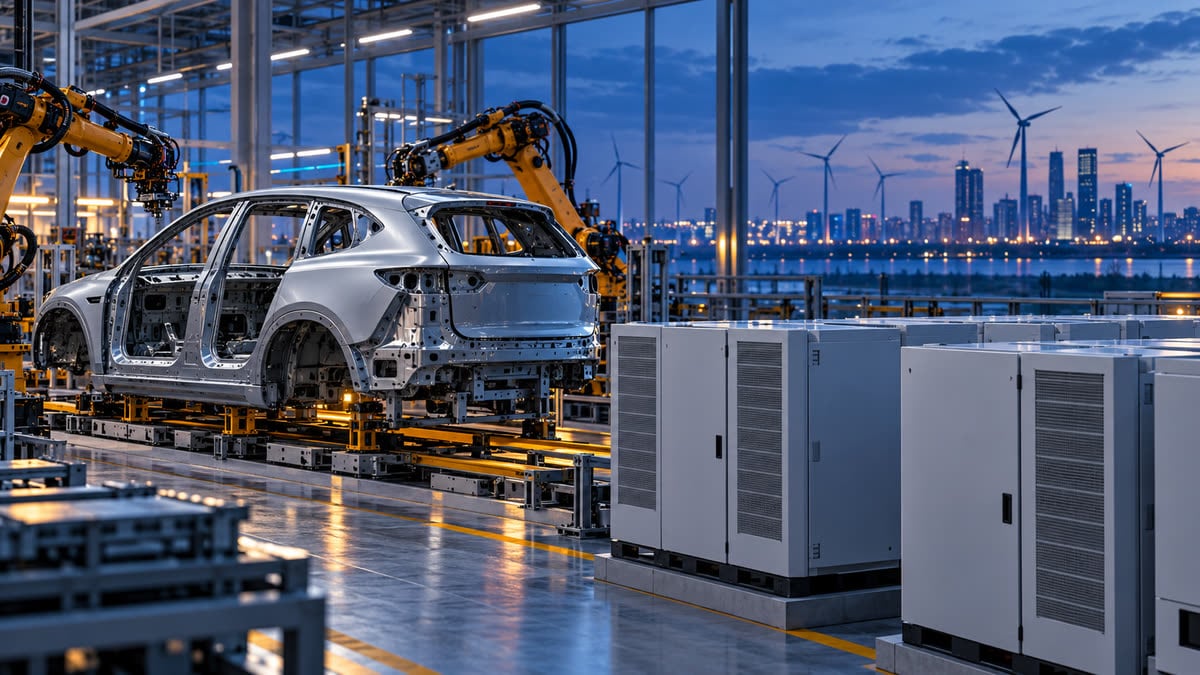
Illustrative editorial rendering of EV manufacturing and grid battery storage; it is not an official Tesla product photograph.
What Tesla reported on 21 October
Tesla’s update and its related US Securities and Exchange Commission filing provide the underlying figures. The Associated Press and Reuters independently described the same mixed quarter: lower profit and roughly flat revenue, alongside positive cash generation and a lower capital-spending plan.
| Measure | Q3 2026 | Comparison | Why it matters |
|---|---|---|---|
| Total revenue | $28.046 billion | $28.095 billion in Q3 2025 | Sales were broadly flat year on year. |
| Net income attributable to common stockholders | $787 million | $1.373 billion in Q3 2025 | Profitability weakened despite stable revenue. |
| Vehicle deliveries | 486,532 | 497,099 in Q3 2025 | Deliveries slipped about 2% year on year. |
| Free cash flow | $1.531 billion | $1.092 billion outflow in Q2 2026 | Cash generation improved quarter on quarter. |
| 2026 capital-spending outlook | About $20 billion | More than $25 billion previously | The planned pace of investment is lower. |
The profit decline is best described as about 43% using Tesla’s reported figures: $787 million compared with $1.373 billion is a 42.7% fall. AP rounded the same decline to 44%. That is a rounding difference, not a disagreement about the direction of travel. The more important point for readers is that revenue held broadly steady while profit fell sharply.
Why the cash-flow improvement is not the whole story
Free cash flow measures cash generated after the spending needed to operate and build the business. Tesla generated $1.531 billion in Q3, even though it spent $4.732 billion on capital projects during the quarter. AP called the positive cash flow a standout, while Reuters reported that spending on AI and robotics was lower than analysts had expected.
That distinction matters. Positive cash flow can strengthen a company’s balance sheet, but it does not by itself prove that demand, margins or long-term growth have improved. In Tesla’s case, the official update reported an automotive gross margin excluding regulatory credits of 18.1% in Q3, compared with 16.3% in Q2 2026. The margin recovery is useful context, but actual results can change with vehicle mix, discounts, tariffs, currency movements and factory costs.
For a driver comparing an electric trip with a petrol or diesel route, the practical question is still energy cost in the relevant market. A fuel-cost calculation for a trip can make that comparison in route terms, while local electricity tariffs and charging fees remain separate inputs.
What the report says about Tesla’s global EV push
Tesla’s update says battery availability limited the number of vehicles it could build in the quarter. It also says energy-storage demand remained strong and that the company is prioritising higher use of existing factories before adding new production lines. Those are management statements, not independent forecasts, but they show the operational trade-off behind the earnings figures: the same broad investment programme has to support vehicles, battery supply, software and grid-storage products.
That trade-off is global even though Tesla reports from a US-listed company. Tesla operates production and sales networks across North America, Europe and Asia, while its competitors are bringing newer and often lower-priced EVs to multiple markets. A lower capex outlook could simply reflect better sequencing of projects, or it could signal a more selective pace for expansion; the company did not specify every programme that would receive less spending. The next quarters will be needed to tell those possibilities apart.
Battery supply and charging availability are also part of the ownership equation. Readers assessing an EV can check the EV charging directory for available locations, while conventional fuel users can compare current market references through live fuel-price tools. Neither tool changes the company’s earnings, but both connect the financial story to the running-cost and trip-planning questions that matter at road level.
What changes now, and what to watch next
There is no immediate consumer price or charging-policy change in Tesla’s Q3 filing. The near-term signals are operational: whether production catches up with demand, whether battery availability eases, and how quickly the company converts its energy-storage backlog into reported deployments and revenue.
Investors and industry observers will also watch what the lower capital-spending outlook means in practice. Reuters reported that Tesla did not say which spending areas would be reduced. Tesla’s own outlook says production has begun for the Semi and that multi-year infrastructure work across computing, batteries and manufacturing is underway. Those plans are forward-looking statements and are not guarantees of timing, volume or profitability.
For vehicle buyers and fleet managers, the useful takeaway is limited but concrete: this quarter does not change a vehicle’s quoted price, range or local charging tariff. It does show that a major EV maker is managing a tighter link between product demand, battery supply and investment discipline. Those factors can influence future availability and service rollout, but they should be checked against local specifications and costs rather than inferred from one quarterly result.
Frequently asked questions
Does the Q3 result mean Tesla vehicles will become cheaper?
No. Tesla’s results did not announce a global vehicle-price change. Prices, taxes, incentives, financing and delivery costs vary by market and model.
How could free cash flow be positive while profit fell?
Profit and cash flow measure different things. Free cash flow reflects operating cash after capital spending, so lower-than-expected investment can improve the quarter’s cash position even when accounting profit is weaker.
Does the report change EV charging access today?
No. Charging access depends on the local network, site availability, tariffs and vehicle compatibility. The report is a company earnings update, not a charging-network rule change.
Sources
- Tesla, Tesla Third Quarter 2026 Update and Form 8-K exhibit, 21 Oct 2026.
- The Associated Press, Tesla’s Q3 profit drops as it prepares for possible merger with Musk’s other public company, SpaceX, 21 Oct 2026.
- Reuters, Tesla cuts spending before potential SpaceX deal even as Musk bets future on AI, robots, 21 Oct 2026.
This article is for general information only and is not financial, insurance or legal advice.