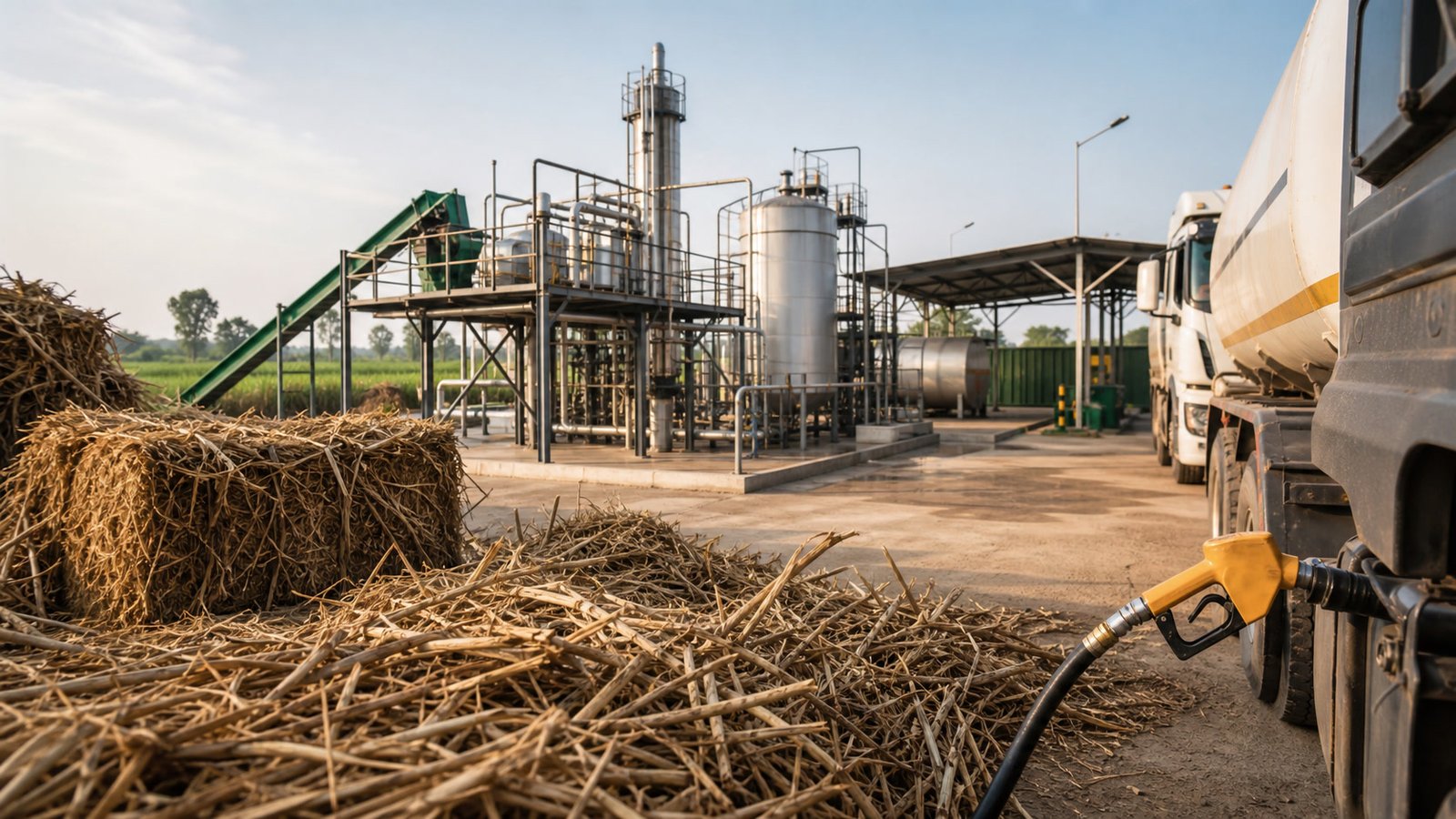
India's clean-fuel push has moved into a more practical lane: diesel substitution for real transport and industrial use. On 5 June 2026, the Technology Development Board under the Department of Science and Technology announced support for Pune-based Greenjoules Private Limited to commercialise an indigenous second-generation diesel-equivalent biofuel technology. For fuel users, the important part is not only that the fuel is renewable. It is that the project is aimed at a drop-in route, using waste feedstock to produce fuel that can work with existing diesel-linked demand rather than waiting for every fleet, generator and industrial user to electrify.
Second-generation biofuels are designed to turn waste biomass into usable transport fuel, reducing pressure on crude imports and diesel-linked logistics over time.What has been announced?
The PIB release says TDB-DST is supporting Greenjoules for the commercialisation of an indigenous second-generation biofuel technology. The technology is built around converting agricultural residue, municipal waste and other non-food, non-feed renewable inputs into fuel substitutes for petrol and diesel. Greenjoules describes its fuel platform as a way to produce renewable gasoline and diesel-range fuels from waste streams, with a focus on compatibility with existing engines, storage and distribution systems.
That distinction matters. India already has a large ethanol blending programme for petrol, a fast-growing EV ecosystem, and a developing compressed biogas and biodiesel market. But diesel remains deeply embedded in freight, tractors, buses, backup power, construction equipment and long-distance logistics. A clean-fuel technology that can enter the diesel-use chain without asking every user to replace equipment at once is strategically different from a vehicle-only transition story.
Why diesel-equivalent biofuel is a high-impact niche
India's fuel bill is highly exposed to crude oil imports. PPAC import-export data and recent energy-market reporting show that India still depends on imported crude for the overwhelming majority of its requirements. When crude prices rise or shipping routes become risky, pump prices, oil marketing company margins, freight charges and inflation expectations all become more sensitive. Biofuels cannot remove that exposure overnight, but they can create domestic liquid-fuel molecules from material that is otherwise underused, burned, dumped or treated as low-value waste.
For transporters, the most useful clean-fuel option is often the one that does not break operations. Electric trucks and buses are improving, but high payload routes, long-haul schedules, charging access and upfront cost remain real constraints. CNG and LNG work where networks exist, but they do not cover every route. A diesel-equivalent biofuel can potentially fit into a more familiar supply chain: depots, tanks, dispensing equipment and diesel engines. That is why the Greenjoules project deserves attention from fleet operators, logistics planners and fuel retailers, not only from climate-policy readers.
The user impact: not a pump-price cut today, but a supply option tomorrow
This announcement should not be read as an immediate petrol or diesel price cut for consumers. Commercialisation support is not the same as nationwide fuel availability. The near-term impact is more about technology validation, scale-up, feedstock supply, financing confidence and possible future offtake. If the project proves commercially repeatable, it can add another domestic option to India's liquid-fuel mix.
The affected users are broad. Truck operators may eventually look at such fuels as a way to reduce emissions without buying a new vehicle immediately. Industrial units and generator users may get a cleaner liquid fuel pathway if specifications, warranties and economics line up. Farmers and waste aggregators could see new value in crop residue and organic waste streams. Oil marketing companies and fuel distributors may gain an additional blending or specialty-fuel option if volumes grow and policy support remains stable.
Key details FuelPrice readers should note
- The technology route is second-generation. That means the feedstock focus is waste biomass and non-food renewable material, not food crops directly competing with consumption.
- The fuel angle is drop-in compatibility. Greenjoules says its renewable fuels are designed for existing fuel infrastructure and engines, which is critical for diesel-heavy users.
- The policy fit is clear. India's National Policy on Biofuels and later amendments support advanced biofuels and broader feedstock use to reduce import dependence and manage waste.
- The business test is scale. Lab success is not enough; the real benchmark will be whether feedstock aggregation, conversion yield, fuel quality and delivery economics work at commercial volumes.
- The logistics relevance is strong. Diesel powers a large share of freight movement, agriculture and industrial backup demand, making diesel-equivalent alternatives more immediately relevant than many niche clean-fuel pilots.
Why government support matters
Advanced biofuel projects face a classic scale-up gap. The science may work, but lenders, buyers and industrial partners often wait for proof that the process can produce consistent fuel at predictable cost. TDB support can help bridge that gap by signalling that the technology has passed a credibility threshold. It can also make it easier for the company to attract follow-on capital, equipment partners, feedstock partnerships and offtake discussions.
For India, the timing is important. The country is trying to cut oil-import vulnerability while keeping fuel available for a fast-growing economy. EVs will reduce petrol and diesel demand in some segments, but liquid fuels will remain important for freight, agriculture, aviation, construction and backup power for years. A domestic renewable diesel pathway gives policymakers another lever: not just replacing vehicles, but replacing a part of the fuel molecule itself.
What changes now?
For ordinary fuel buyers, nothing changes at the pump this week. The article is not about a new retail price, a new nationwide fuel grade or an immediate diesel blend mandate. The change is upstream: a backed commercialisation effort for a technology that could create future diesel-equivalent renewable fuel supply in India.
The next phase will be about execution. Watch whether Greenjoules discloses production milestones, commercial customers, fuel certification, feedstock contracts, refinery or OMC partnerships, and repeatable economics. The most important signal will be whether the technology can move from a promising funded project to a fuel that fleet operators and industrial users can buy with confidence.
Final takeaway
The Greenjoules-TDB-DST update is a serious fuel-market story because it targets one of India's hardest-to-replace fuels: diesel. It does not solve diesel dependence immediately, but it strengthens a practical pathway where waste biomass, domestic technology and existing fuel infrastructure can meet. For FuelPrice readers, the takeaway is simple: if second-generation diesel-equivalent biofuel scales, it could become a useful bridge between today's diesel economy and tomorrow's lower-carbon transport system.
Sources: PIB TDB-DST Greenjoules release; Greenjoules official website; India Science, Technology and Innovation portal on Abhilasha biofuel; PIB on National Policy on Biofuels amendments; PPAC import-export data; Indian Express background on crude import dependence.