Hero MotoCorp has moved flex-fuel technology from policy discussion into India's mass commuter motorcycle market by unveiling ethanol-compatible versions of the Splendor+ and HF Deluxe. The update is important because these are not premium showcase products; they belong to the everyday segment used by office commuters, rural buyers, small traders and high-mileage two-wheeler users.
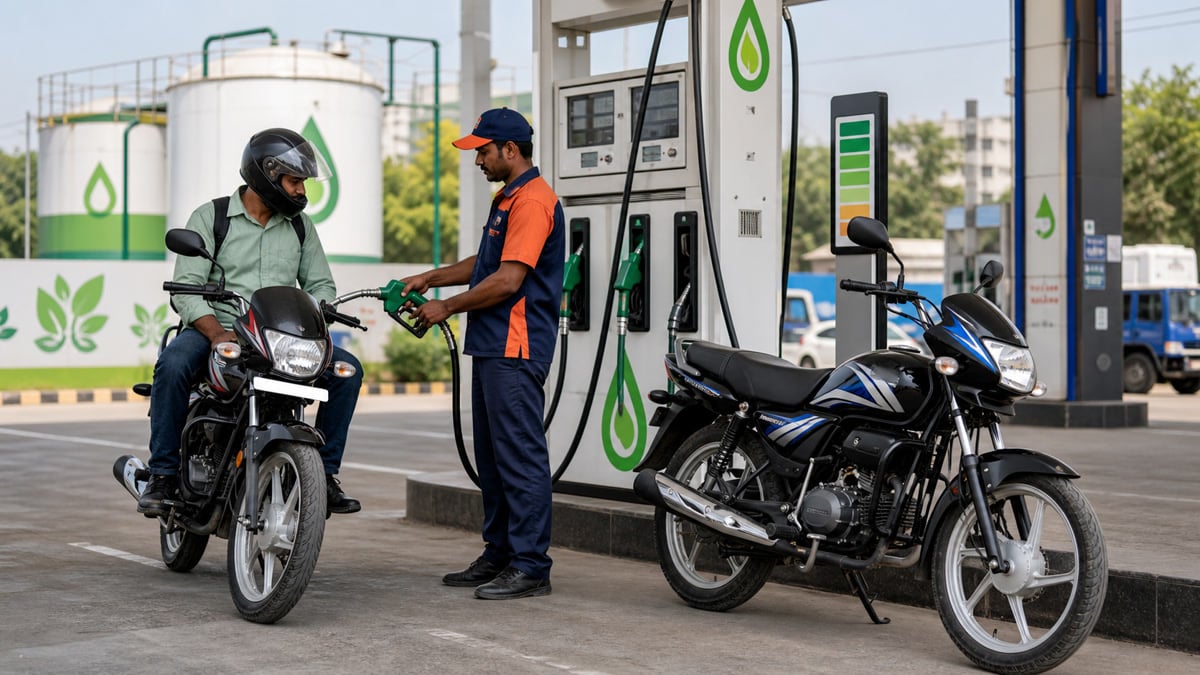
Editorial visual showing ethanol-compatible commuter motorcycles at a fuel station.What happened
Hero MotoCorp unveiled its first two flex-fuel motorcycles, based on the Splendor+ and HF Deluxe nameplates, on 3 June 2026. Business Standard reported that the models were shown in the presence of Road Transport and Highways Minister Nitin Gadkari and Petroleum and Natural Gas Minister Hardeep Singh Puri. The company expects customer deliveries to begin from July, while a wider rollout across Hero's motorcycle portfolio could happen over the next two years if fuel availability and pricing support adoption.
The company has 12 motorcycle models in its portfolio. According to the Business Standard report, Hero's CEO Harshavardhan Chitale said the ability to make flex-fuel motorcycles is not the main constraint. The larger questions are whether E85-E100 fuel becomes available widely enough, whether it is priced attractively against E20 petrol, and whether customers understand the running-cost trade-off.
Why this matters for fuel users
India's current petrol market has already moved deep into ethanol blending through E20 adoption. The next phase is more complicated. E85 contains at least 85 percent ethanol, while E100 is pure ethanol. A flex-fuel two-wheeler can run on a much higher ethanol blend than a regular E20-compatible petrol motorcycle, but the pump network, storage infrastructure and retail pricing have to keep up.
That is why this launch is a fuel-policy story as much as a vehicle story. The Splendor and HF Deluxe families are associated with high-volume, cost-sensitive buyers. If flex-fuel technology reaches this segment, the discussion shifts from niche technology to practical daily mobility: where will the fuel be available, how much will it cost per kilometre, and will the motorcycle remain usable when high-ethanol fuel is not available nearby?
The buyer economics: price, mileage and per-km cost
The biggest question for a commuter buyer is not whether ethanol sounds cleaner. It is whether the daily running cost works. Ethanol has lower energy density than petrol, which means a litre of high-ethanol fuel can deliver lower range than a litre of conventional petrol. To make the buyer whole, E85 or E100 needs to be cheaper enough to offset that range loss.
Business Standard reported that Hero's CEO pointed to fuel economics as a critical factor and noted that SIAM has suggested E85 should be priced about 25-30 percent below standard E20 petrol. The logic is simple: if the rider has to refuel more often but pays substantially less per litre, the per-kilometre cost can remain attractive or even improve. Without that discount, the technology may remain future-ready on paper but less compelling for price-sensitive users.
The additional purchase cost is also expected to matter. The report indicated that the extra cost of buying a flex-fuel motorcycle over a standard motorcycle is relatively small, around 4-5 percent. That is manageable for some buyers, but in India's entry-level two-wheeler market even a small increase needs to be justified through lower running cost, future fuel compatibility, or better resale confidence.
What changes from a normal petrol commuter bike?
| Area | Regular commuter motorcycle | Flex-fuel commuter motorcycle |
|---|---|---|
| Fuel compatibility | Typically built around petrol/E20 use. | Designed to handle much higher ethanol blends such as E85, with fallback use on E20 where high-ethanol fuel is unavailable. |
| User decision | Mostly depends on petrol price, mileage and service cost. | Adds ethanol pump access and E85/E100 pricing to the ownership calculation. |
| Policy relevance | Compatible with India's E20 phase. | Supports the next phase of higher ethanol blending and reduced petrol dependence. |
Why Splendor+ and HF Deluxe are the right test bed
The choice of commuter nameplates matters. High-end flex-fuel motorcycles can prove technology, but they do not prove mass adoption. The Splendor+ and HF Deluxe sit closer to the core Indian two-wheeler buyer. These users are sensitive to fuel prices, maintenance cost, service reach and resale value. If a flex-fuel solution works for them, it has a better chance of becoming relevant beyond a government showcase or auto-expo concept.
The models also help address a common concern around ethanol blending: older or standard vehicles are not automatically compatible with every higher blend. A factory-developed flex-fuel motorcycle gives buyers a clearer compatibility path, provided fuel pumps and service networks are prepared.
Fuel station readiness remains the real bottleneck
India has been expanding ethanol blending through policy, production incentives and fuel standards. PIB has documented government steps to support the Ethanol Blended Petrol programme, including feedstock allocation and measures for ethanol production. Separately, BIS has notified standards for petrol blends beyond E20, including E22, E25, E27 and E30, creating a technical framework for the next stage of blending.
But a flex-fuel motorcycle needs more than a standard on paper. Retail outlets require appropriate storage, dispensing and supply-chain handling for higher ethanol blends. If the fuel is available only in limited cities or pilot corridors, buyers may treat flex-fuel capability as future insurance rather than a daily operating advantage. If availability expands with a meaningful price gap, commuter buyers may start calculating ethanol as a running-cost tool.
What to watch next
- Whether July deliveries happen as planned and in which markets the bikes are first offered.
- How Hero prices the flex-fuel variants against regular Splendor+ and HF Deluxe models.
- Whether oil marketing companies announce E85 or E100 availability at selected pumps.
- Whether E85/E100 fuel is priced low enough to offset lower energy density and protect per-km cost.
- How quickly Hero expands flex-fuel options beyond these two commuter motorcycles.
Final takeaway
Hero's flex-fuel Splendor+ and HF Deluxe mark a practical step in India's ethanol mobility roadmap. They put higher-blend fuel compatibility into the country's most price-sensitive two-wheeler segment, where fuel cost decisions are real and frequent. The bikes can make sense for buyers only if E85-E100 fuel becomes available, clearly priced and easy to understand. Until then, the launch is best read as a future-ready bridge between today's E20 petrol market and India's planned higher-ethanol fuel ecosystem.
Sources: Business Standard, BikeDekho, Press Information Bureau and Mint.