Hero MotoCorp’s launch of the Splendor+ Flex Fuel and HF Deluxe Flex Fuel is more than a product update. It is a signal that India’s ethanol policy is moving out of the policy deck and into the commuter-bike showroom. For a country where two-wheelers are the daily mobility backbone, that matters a lot more than a flashy premium launch because any change in this segment can influence fuel demand, running costs and the pace of alternative-fuel adoption at scale.
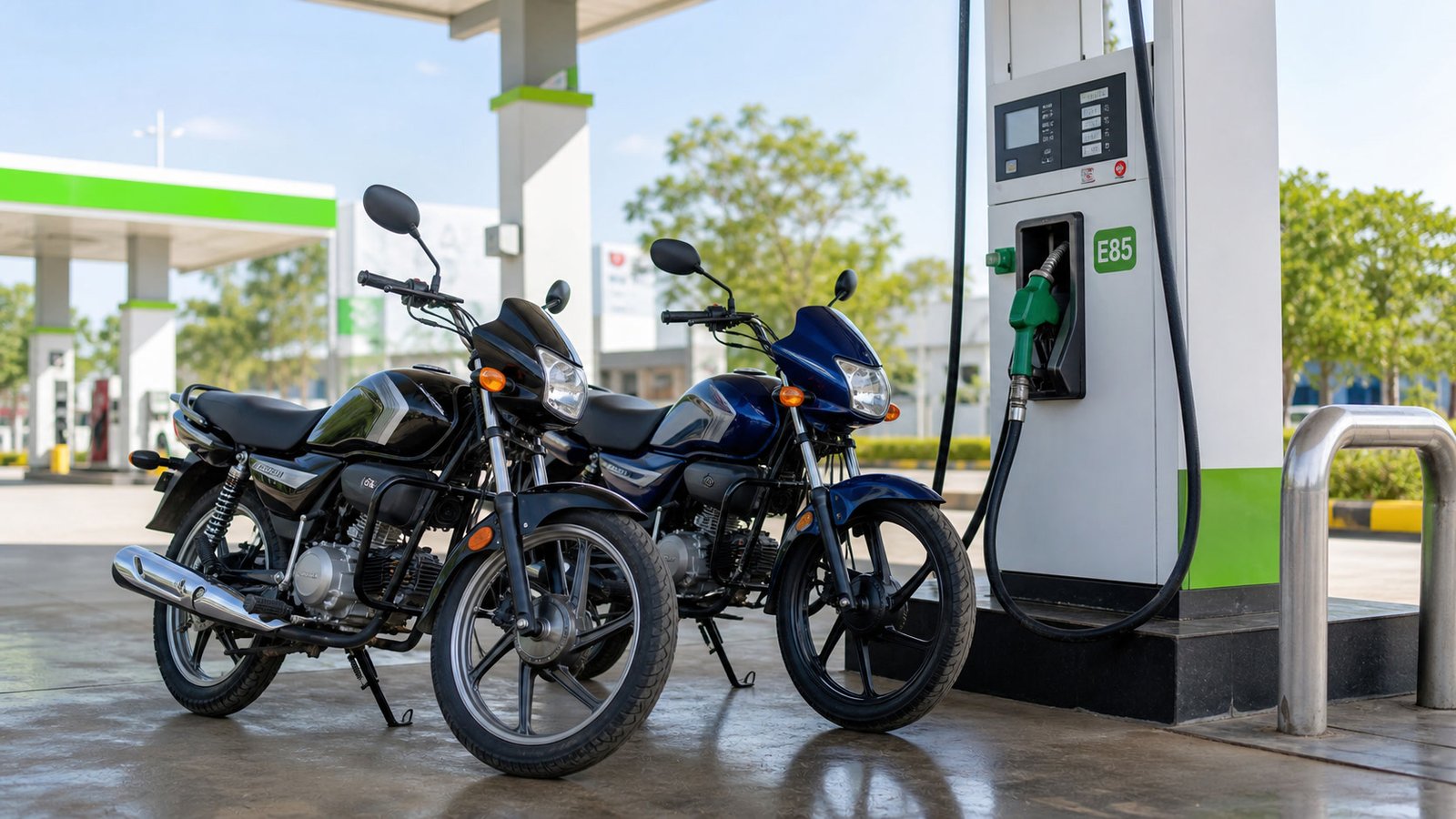
According to Economic Times and Times of India, Hero introduced these flex-fuel commuter motorcycles on June 3, 2026. Both models can run on petrol blended with up to 85% ethanol, which is a meaningful step beyond the E20 petrol that most Indian vehicles are designed around today. The company also priced them to stay within reach of mass-market buyers: the HF Deluxe Flex Fuel at Rs 72,792 ex-showroom Delhi and the Splendor+ Flex Fuel at Rs 82,710 ex-showroom Delhi.
That pricing is important because flex-fuel is only useful if consumers can justify the upfront premium. Hero is not trying to sell an expensive technology showcase. It is trying to push ethanol capability into the very commuter category that dominates India’s roads, where buyers care as much about monthly fuel spend as they do about sticker price.
What makes these bikes different
The new motorcycles keep the familiar commuter-bike formula, but the fuel system has been re-engineered to handle higher ethanol blends. TOI reported that the 97.2cc single-cylinder air-cooled engine has been extensively reworked for flex-fuel use, with the company saying the models make 7% more power and 3% more torque than the standard petrol versions. Both bikes are quoted at 8.4 hp and 8.3 Nm of peak torque.
That sounds like a technical footnote, but it matters in real life. Ethanol has different chemical properties from petrol and can change how the engine, fuel pump, filters and ECU must behave. Hero says it changed 36 parts in total, including a new fuel pump, a secondary fuel filter and a recalibrated ECU map that automatically adjusts fuel delivery depending on the ethanol blend in the tank. In other words, these are not petrol bikes with a sticker change. They are engineered for a different fuel environment.
For readers trying to understand the practical outcome, the headline is simple: a rider should be able to use the bike with E85-capable fuel without the system behaving like a regular petrol commuter machine that has been forced to adapt. That matters for durability, drivability and confidence.
| Model | Price, ex-showroom Delhi | Fuel capability | Key takeaway |
|---|---|---|---|
| HF Deluxe Flex Fuel | Rs 72,792 | Up to E85 | Lowest entry point into Hero’s flex-fuel commuter range |
| Splendor+ Flex Fuel | Rs 82,710 | Up to E85 | Flex-fuel tech brought into India’s most familiar commuter badge |
| Rollout plan | From July 2026 | Delhi and selected parts of Maharashtra first | A phased start, not an instant nationwide release |
Why this launch matters for fuel users
Hero’s launch comes at a time when India is aggressively trying to diversify transport fuel. The country has already crossed the 20% ethanol blending milestone in petrol, and recent policy discussions have increasingly focused on higher-blend fuels such as E85 and E100. For riders, the practical meaning is not just cleaner fuel headlines; it is the possibility that a future fill-up could depend less on imported crude and more on domestically produced ethanol.
The first benefit is energy-security related. Ethanol blending can reduce dependence on imported crude oil, which is important whenever global oil markets are volatile. The second benefit is policy consistency. Once Hero puts flex-fuel into commuter bikes, it becomes easier for the rest of the ecosystem - fuel retailers, suppliers, regulators and rival manufacturers - to justify investment in higher-ethanol infrastructure.
There is also a rural-economy angle. Ethanol demand supports agricultural feedstocks and the broader biofuel supply chain. That has been one of the government’s key arguments for ethanol policy, and it is one reason the launch received high-level attention from Union ministers Nitin Gadkari and Hardeep Singh Puri at the unveiling.
But a cleaner fuel story is not automatically a cheaper running-cost story. Ethanol has lower energy density than petrol, so the cost-per-kilometre calculation depends on the blend, the pump price and the bike’s calibration. That means riders should think in terms of real-world efficiency, not just the label on the pump.
The infrastructure question is still the real bottleneck
The most important constraint is not the bike. It is the fuel network. TOI recently reported that the government wants around 500 ethanol dispensing stations, or E100 pumps, by December 2026 and 5,000 by 2027. That target shows why flex-fuel vehicles are arriving now: the government wants the hardware on the road before the fuel network reaches scale, so the ecosystem can grow in parallel rather than in sequence.
For riders in Delhi and Maharashtra, where Hero’s first rollout is expected from July, the immediate question will be accessibility. If the right fuel is easy to find, a flex-fuel commuter bike can feel like a practical upgrade. If the fuel is scarce, the same bike becomes a niche experiment that only makes sense on paper. That is why the launch is best understood as a two-part story: product readiness and fuel availability.
Hero appears to be betting that mass-market users will accept the added flexibility if it comes without a dramatic price jump. That is a reasonable bet in a commuter category where customers already pay close attention to monthly fuel bills, maintenance and resale value. If E85 access improves, the model could become a template for other mainstream two-wheelers.
What to watch next
Three things will determine whether this is a landmark launch or just an early flag-bearer. First, watch how quickly Hero expands availability beyond the first launch markets. Second, watch whether the government’s E100 pump plan moves from announcement to visible retail coverage. Third, watch whether riders see a meaningful cost-per-kilometre advantage as higher-ethanol fuel rolls out.
If those three pieces line up, Hero’s flex-fuel bikes could do for ethanol mobility what the commuter motorcycle did for petrol mobility in India: turn an abstract fuel policy into a mass-market habit. If they do not, the bikes will still matter as an engineering milestone, but the real fuel-transition impact will be slower.
The bottom line is that Hero has made flex-fuel real for India’s biggest two-wheeler segment. The technology is no longer confined to concept displays and policy speeches. It now has a commuter-bike price tag, a rollout timeline and a clear link to India’s ethanol strategy. That makes the launch important not only for bike buyers, but for the country’s wider fuel and mobility roadmap.
Sources: Economic Times June 3, 2026 launch report, Times of India June 3, 2026 launch report, Times of India June 5, 2026 ethanol-pump rollout report, Times of India flex-fuel explainer.