Economic Times and ET EnergyWorld reported on 25 Nov, 2026 that India’s bulk diesel sales fell 33% year on year in October as a roughly ₹38-per-litre gap made retail pumps cheaper than market-linked bulk supply. For fleet operators, contractors and other commercial users, the development changes the fuel-procurement picture; it is not an announcement of a new retail pump-price cut for private motorists.
Key takeaways
- Bulk diesel sales reportedly fell 33% year on year in October, according to Economic Times reports citing official data.
- The reported gap between bulk and retail diesel is around ₹38 per litre, after reaching as high as ₹55 during the period covered by the report.
- Private refiners’ direct commercial diesel sales fell 43.8%, while the three state-run refiners recorded a 29.6% decline, the reports said.
- PPAC’s provisional October data shows overall HSD consumption grew 12.0% year on year, suggesting that some demand moved between supply channels rather than disappearing.
- There is no new nationwide retail price change in this report. Private drivers can check live petrol and diesel prices separately from the bulk-market story.
What changed in October
The latest reports describe a sharp fall in diesel sold directly to commercial and industrial customers. Economic Times said bulk sales declined 33% in October compared with the same month a year earlier. It also reported a combined 43.8% fall in direct diesel sales at Reliance Industries and Nayara Energy, while Indian Oil, Bharat Petroleum and Hindustan Petroleum recorded a 29.6% decline.
These are channel-level figures, not a claim that India used 33% less diesel. Bulk sales represented about 13% of India’s diesel consumption in 2025–26, according to the report. Smaller contractors, miners and road builders were among the users reported to be shifting purchases toward retail outlets, while large institutional buyers such as the defence establishment, railways and manufacturers continued to use bulk channels.
Why the bulk-retail gap matters
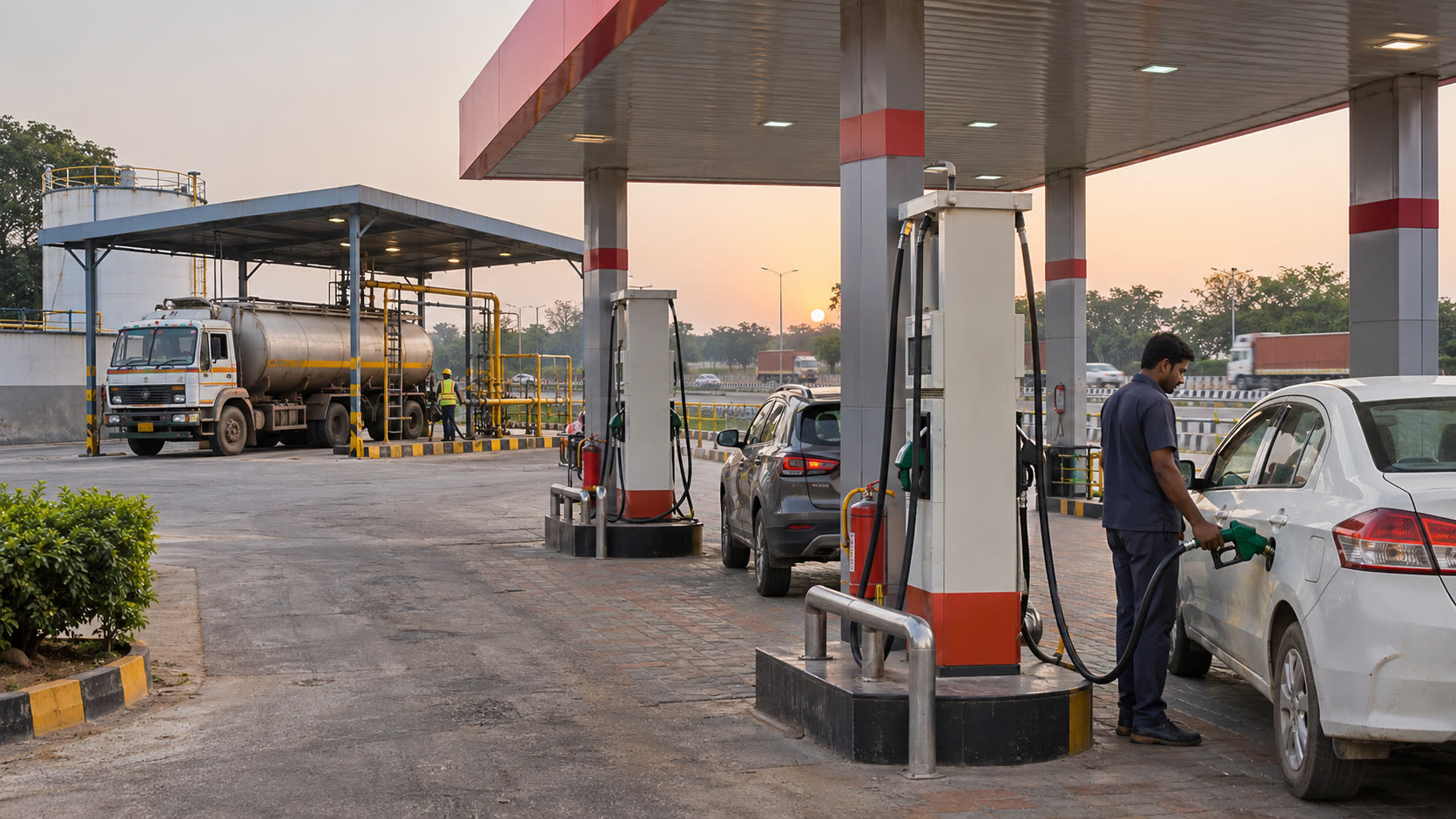
Bulk diesel prices are revised more frequently in response to international fuel costs, while state-run oil marketing companies kept retail pump prices unchanged since May, Economic Times reported. That reversed the usual relationship in which bulk procurement could be cheaper than filling up at a retail station. The latest reported gap is around ₹38 per litre; the report said it had previously widened to as much as ₹55 during the period of elevated international fuel prices.
As a simple illustration, a ₹38-per-litre difference would equal ₹19,000 on 500 litres before taxes, contracts, delivery costs and any restrictions that apply to the buyer. That is not a quoted pump price or a promise of savings. It shows why a commercial user may compare supply channels even when the vehicle’s fuel consumption has not changed.
The Petroleum Ministry had already documented this type of pressure during the West Asia disruption. In a 12 Jun, 2026 release, it said retail diesel was around ₹40 per litre cheaper than bulk diesel and that large users moving to retail outlets had created localised supply issues. The temporary 200-litre daily limit for retail diesel and the direction for industrial, institutional and commercial users to use consumer pumps were later withdrawn with effect from 1 Jul, 2026. The latest reports do not announce a fresh nationwide cap.
Why total diesel demand can rise while bulk sales fall
PPAC’s official consumption table provides an important counterpoint. Its provisional October 2026 data lists HSD consumption at 8,534 thousand metric tonnes and says diesel demand grew 12.0% year on year. That broader measure includes domestic market demand across supply channels, so it can rise at the same time that the direct bulk channel contracts.
For readers, the practical distinction is between fuel volume and the place where it is purchased. A contractor buying from a retail station may be counted in retail-channel demand instead of bulk-channel sales. The reported 33% fall therefore should not be read as evidence that truck, construction or agricultural activity fell by the same percentage.
What it means for private drivers
For a car or two-wheeler owner, the immediate effect is not a new diesel price announced by the government or an oil company. Retail prices remain a separate, city-level question. Drivers planning a long journey can use the fuel cost calculator with the current rate for their vehicle and route, rather than applying the reported bulk-market gap to an ordinary tank refill.
There may still be an indirect effect at busy stations if commercial demand adds pressure to retail inventories. The Ministry’s June release referred to localised supply issues during the earlier shift. That does not establish a shortage today, but it is a reason to distinguish a reported market trend from a station-specific availability update.
What fleets and transporters should watch
Fleet managers should separate three questions in their fuel records: the contracted bulk rate, the retail pump rate available to the vehicle and the rules governing the buyer and outlet. The latest reports do not provide a universal commercial rate, a standard contract term or a new entitlement to buy retail diesel. Actual cost comparisons also depend on delivery, storage, credit, tax treatment and the vehicle’s operating pattern.
Operators can use the diesel-price hub for Indian cities to monitor retail benchmarks, but that information should not be treated as a bulk quotation. A month of invoices, kilometres and litres purchased will give a more useful operating comparison than a headline gap alone.
What to watch next
The next meaningful indicators are the monthly PPAC consumption updates, any change in state-run OMC retail prices, and whether the bulk-retail spread narrows as international diesel costs change. A new restriction, rationing measure or procurement rule would need an official notification; the current reports describe a market shift and its commercial consequences, not a newly announced national retail-fuel rule.
Reader takeaway
The October bulk-sales decline points to a procurement imbalance: commercial buyers are responding to a large difference between market-linked bulk diesel and relatively stable retail pump pricing. Private drivers should continue to check the retail price for their city, while fleets should compare their contracted supply costs with actual fuel use and follow any applicable procurement requirements.
Sources
- The Economic Times — Bulk diesel sales slump 33% as consumers shift to retail pumps — 25 Nov, 2026
- ET EnergyWorld — Industrial diesel sales decline by 33% as consumers turn to cheaper retail options amid price gap — 25 Nov, 2026
- Petroleum Planning and Analysis Cell — Domestic Consumption of Petroleum Products, provisional October 2026 data — updated 6 Nov, 2026
- Ministry of Petroleum and Natural Gas — Government notifies control order to curb black marketing and hoarding of diesel — 12 Jun, 2026
- Ministry of Petroleum and Natural Gas — Government withdraws temporary restrictions on sale and distribution of petrol and diesel — 29 Jun, 2026