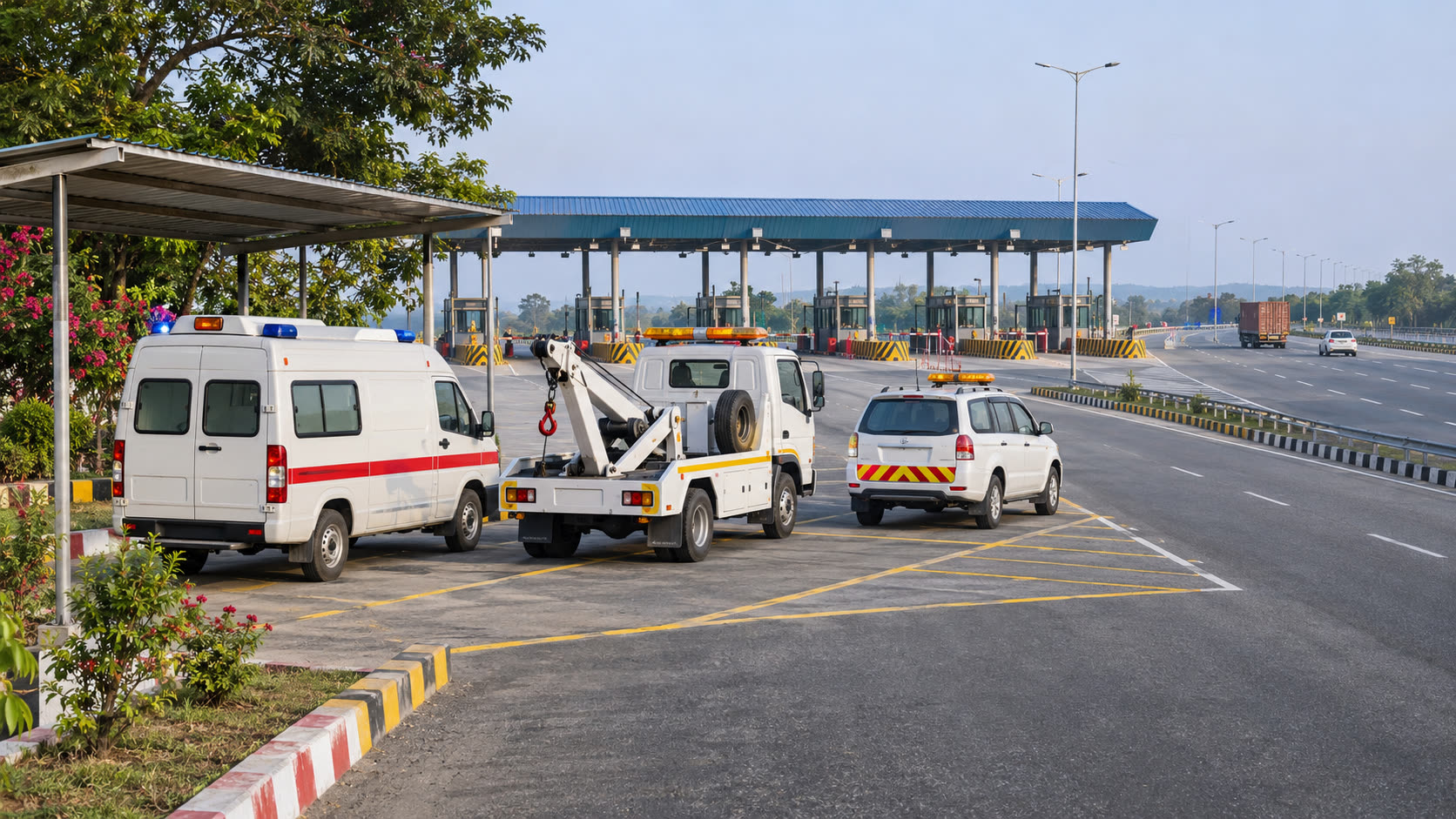
NHAI has issued guidelines requiring Incident Management Services to be available before a new National Highway stretch opens to traffic. Announced on 25 Nov 2026, the package covers rescue ambulances, route-patrol vehicles and tow-away cranes, with on-location teams linked to the 1033 National Highway Helpline and local emergency responders.
For drivers, this is a highway-safety and emergency-response requirement, not a new toll or FASTag fee. It is intended to make help available when a vehicle breaks down, a crash blocks a lane or another incident creates a hazard on the route.
Key takeaways
- NHAI says IMS must be available before a National Highway stretch is opened to traffic.
- The service package includes ambulances, route-patrol vehicles and tow-away cranes.
- Ambulances on operational stretches are to be positioned at user-fee plazas or other suitable locations based on accident data and the needs of the stretch.
- Road users can seek assistance through the 1033 helpline; the Rajmarg Yatra app is also an established access route for on-road units.
- The 25 Nov release does not announce a new toll charge or give a separate deadline for upgrading every already-open corridor.
What NHAI announced
The Ministry of Road Transport and Highways said in its 25 Nov PIB release that NHAI’s new guidelines are designed to strengthen assistance during accidents, breakdowns and other emergencies. The response system combines three practical resources: an ambulance for injured or ill road users, a route-patrol vehicle for detection and on-road support, and a tow-away crane for disabled or damaged vehicles.
The teams are also expected to coordinate with local police, fire services and hospitals. That coordination matters because clearing a disabled vehicle is only one part of restoring a safe traffic flow; an incident may also need medical evacuation, traffic control or help from a nearby hospital.
How coverage is arranged
On operational National Highway stretches, the PIB release says ambulances will be placed at user-fee plazas or other suitable locations, with the location guided by accident data and the requirements of each stretch. That gives toll plazas a second role beyond fee collection: they can serve as practical staging points for emergency response.
For National Highways entrusted to NHAI, ambulances will be deployed through a centralised agency under the delegated powers of NHAI field offices. Route-patrol vehicles and tow-away cranes will be arranged through separate tenders or included in highway-maintenance and strengthening works.
On stretches that are not entrusted to NHAI but are tolled by NHAI, the release says ambulance deployment will be coordinated by NHAI’s centralised agency with the concerned MoRTH regional office or NHIDCL. The concerned authority will arrange the patrol vehicles and cranes. The allocation is important for drivers and fleet operators because the agency responsible for the road may differ from the agency collecting the toll.
What the MoRTH circular adds
A MoRTH circular dated 21 Sep 2026 says Incident Management Services should be implemented with immediate effect on tolled National Highway stretches entrusted to state governments, Union territories or NHIDCL. It covers two-lane roads with paved shoulders and four-lane-or-wider stretches, and directs that rescue ambulances be placed at user-fee plazas or another suitable location using accident information from e-DAR. The circular also calls for integration with emergency helpline numbers 112 and 1033.
For patrol vehicles and tow-away cranes, the circular says existing contractors or concessionaires should meet the requirement where it is already part of their contract. Other gaps can be covered through maintenance, strengthening or related works, with vehicle-location tracking devices conforming to AIS-140 specifications. These details point to a staged implementation model: some corridors can use existing contracts, while uncovered sections may need new procurement.
What this means on a trip
The New Indian Express reported on 20 Nov 2026 that NHAI’s operating procedure called for a 24×7 Incident Management System before completed corridors opened, whether or not toll collection had begun. The 25 Nov PIB release confirms the pre-opening requirement and the vehicle package, but it does not itself set out a separate 24×7 deadline or say that every existing corridor has already been brought up to the new standard.
Drivers should therefore treat the announcement as a service-availability rule and keep the help channels handy. If a breakdown or crash occurs, use hazard lights, move away from live traffic only when it is safe, and call 1033 with the direction of travel, the nearest toll plaza or landmark and the vehicle’s location. The July 2026 Lok Sabha answer on highway emergency services also says that road users can invoke on-road units through Rajmarg Yatra or 1033, while NHAI’s IT system tracks unit availability and ambulance response information.
Before a long journey, use the toll charges and trip-cost calculator to identify the fee plazas on the route and keep their locations in mind when describing an incident.
The road-trip planner can help organise stops and route timing, which is useful when a breakdown or emergency changes the expected journey plan.
For a separate view of the trip budget, the fuel cost calculator can estimate running costs alongside tolls. The emergency-service rule does not change the fuel price or toll amount shown by those tools; it changes what response infrastructure should be available on the highway.
What to watch next
The next practical test will be implementation: which new stretches open only after the required vehicles and helpline links are ready, how quickly uncovered stretches are tendered, and whether users can see reliable information about the nearest response unit. The PIB announcement does not provide a corridor-by-corridor rollout list or a separate public performance target.
For now, the clearest reader takeaway is simple: a new National Highway stretch is expected to open with emergency-response arrangements in place, and 1033 remains the key helpline named in the official material. The quality of the change will depend on whether those vehicles are staffed, tracked and able to reach an incident when a real driver needs them.
Sources
- Press Information Bureau, “NHAI to Ensure Availability of Incident Management Services Before Opening of National Highway Stretches”, 25 Nov 2026
- Indian Highways / Ministry of Road Transport and Highways, “Provision for Incident Management Services (IMS) on NHs entrusted with State Governments/UTs/NHIDCL”, circular dated 21 Sep 2026
- The New Indian Express, “Emergency response plan mandatory for new highways”, 20 Nov 2026
- Lok Sabha, Ministry of Road Transport and Highways, “Emergency Services on NHs”, answered 23 Jul 2026