On 22 Sep 2026, Honda Motorcycle & Scooter India launched the QC3 electric scooter at ₹1,35,000 ex-showroom in New Delhi, with a 3 kWh battery and a claimed 145 km IDC range. The scooter is initially being sold through select RedWing dealerships in five cities, so availability is as important for buyers as the headline range.
Key takeaways
- The Honda QC3 costs ₹1,35,000 ex-showroom Delhi as of 22 Sep 2026; on-road prices will vary by city.
- Its fixed 3 kWh battery has a claimed 145 km IDC range, while Honda quotes about four hours for a full charge.
- The first rollout covers Delhi, Agra, Cuttack, Surat and Kollam through select RedWing dealerships.
- Bookings are open for ₹5,000, but Honda had not announced a delivery date at the time of reporting.
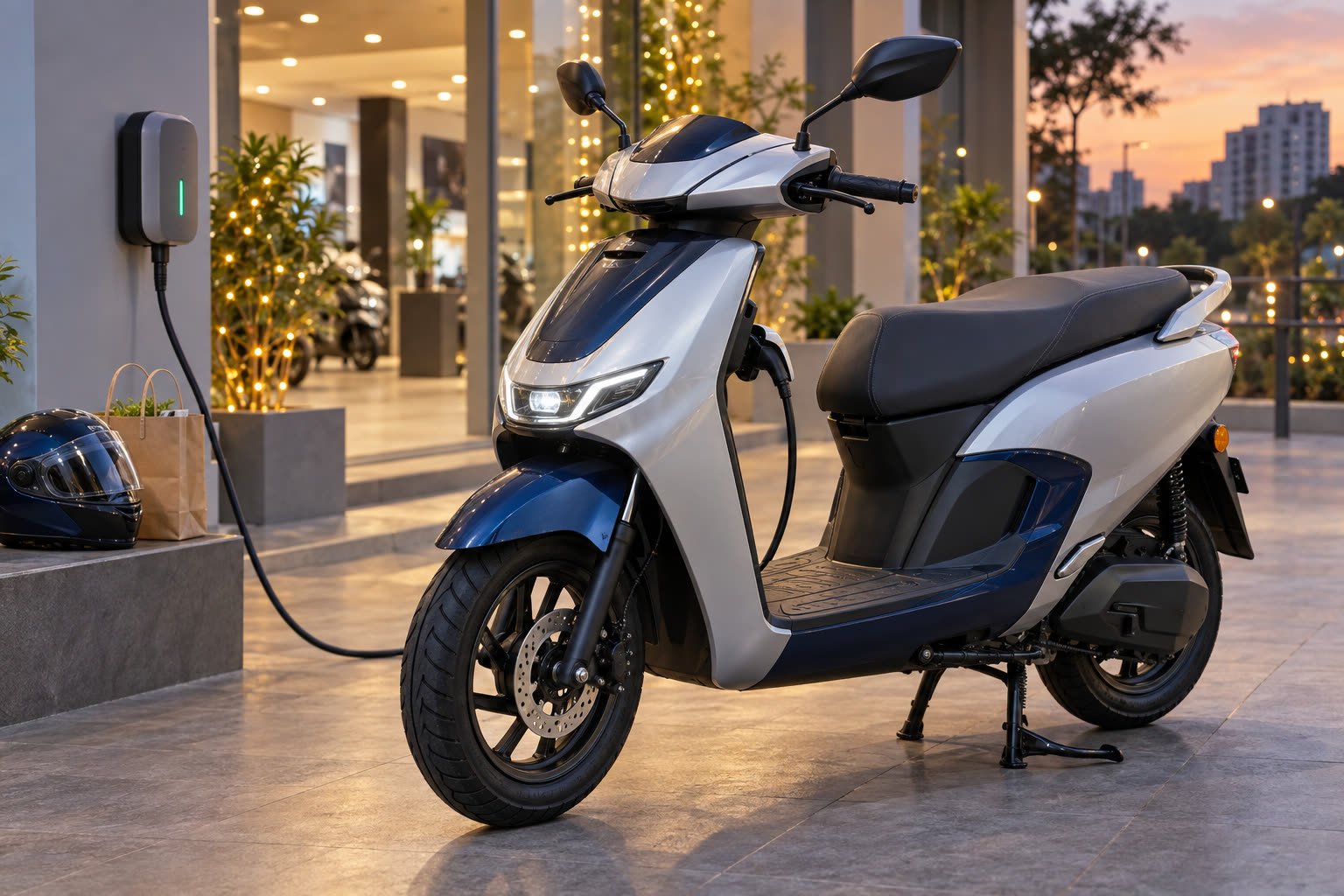
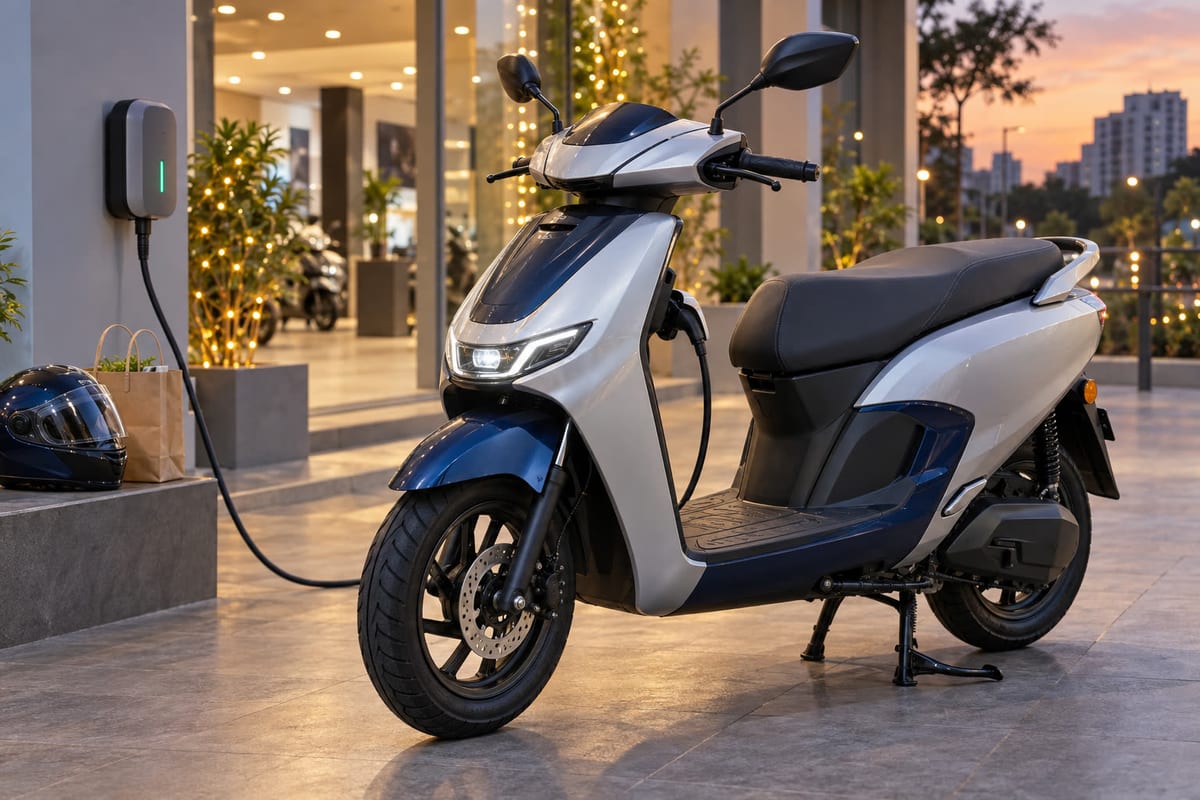 AI-generated editorial illustration of a family electric scooter charging at an Indian dealership. It is not an official Honda QC3 photograph.
The specifications cited below come from Honda’s India product update dated 24 Jul 2026 and independent launch reports published on 22 Sep 2026.
What Honda launched on 22 Sep 2026
The QC3 is Honda’s third electric scooter for India, following the QC1 and Activa e:. Honda positions it as a smart, family-focused scooter for everyday city use. The ₹1,35,000 figure is an ex-showroom Delhi price reported by Autocar India and Times of India Auto; it is not the final amount a customer will pay after registration, insurance and other local charges.
The launch matters because Honda is adding a longer-range option to its still-small electric two-wheeler line-up. The company’s own India product page lists a 3 kWh battery, a claimed 145 km IDC range and 32 litres of under-seat storage. Independent launch reports confirm the same core specifications and the five-city opening rollout.
That positioning is practical rather than purely performance-led. A fixed battery avoids the removable-battery swap routine, while the storage volume is relevant to riders using one scooter for commuting, school runs and shopping. The trade-off is that an owner will need a reliable place to charge the scooter between trips.
Battery, range and charging time
Honda quotes a claimed 145 km range under the Indian Driving Conditions, or IDC, test cycle. It should be read as a benchmark for comparison, not as a guaranteed everyday distance. Passenger load, speed, traffic, gradients, tyre pressure, weather and the battery reserve can all change actual range.
The 3 kWh battery is stated to reach 80% charge in about 2 hours and 40 minutes, while a full charge takes approximately four hours. Honda and the launch reports do not describe this as a high-power public fast-charging system, so a buyer should confirm the supplied charger, socket requirement and charging location before treating the quoted time as a daily routine.
A simple paper calculation from the published 3 kWh and 145 km figures works out to about 20.7 Wh per km before charging losses. Wall-to-wheel consumption will be higher, and the real number will depend on riding conditions. Riders can use FuelPrice’s EV charging station directory to check whether public charging is available along their regular routes, but home-charging access remains the more important question for a scooter designed for city use.
Features and everyday practicality
The QC3 gets a 5-inch TFT instrument display with Honda RoadSync connectivity and turn-by-turn navigation. It also has a Smart Key, a hub-mounted motor and a front disc brake. These are convenience and usability features; they should not be confused with an independently measured range or performance result.
The 32-litre under-seat storage is one of the clearest practical differences from Honda’s smaller QC1. It gives the QC3 room for routine carry items, although the exact fit of a full-face helmet or other bulky object should be checked in person. Honda is offering the scooter in four colour choices, according to the launch reports.
Honda has not published a peak power or torque figure in the information available at launch. That leaves acceleration, hill performance and two-up behaviour as questions for a test ride rather than numbers to infer from the battery size. Buyers planning longer urban commutes can map their actual daily distance with the road-trip planner and compare it with a conservative buffer below the claimed IDC range.
Where the QC3 is available now
The first phase is limited to select RedWing dealerships in Delhi, Agra, Cuttack, Surat and Kollam. Honda says a wider rollout will follow in phases, but a nationwide delivery timetable was not available in the launch information. The five-city start means that the advertised price and range do not by themselves confirm that a scooter is ready for delivery in every state.
Bookings are open through Honda’s website and participating RedWing dealerships for ₹5,000. Prospective buyers should get the booking terms, adjustment or refund conditions and an estimated delivery window in writing. The booking amount is separate from the ex-showroom price and does not establish the final on-road cost.
For anyone outside the first five cities, the useful next check is dealer confirmation rather than a speculative delivery date. A phased rollout can change the waiting period, service access and availability of replacement parts. Those ownership details matter more than a brochure comparison once the scooter is used daily.
What to compare before booking
- Confirm whether a participating RedWing outlet has a demonstrator, the quoted delivery window and the exact booking terms.
- Check the home parking point, electrical socket, cable length and overnight charging routine. Public chargers should be a backup, not an assumption.
- Use your own commute distance, passenger load and weather conditions when assessing the 145 km claimed range. Leave a reserve for detours and charging access.
- Compare the ₹1,35,000 ex-showroom price with the complete on-road quotation, including registration, insurance and any city-specific charges.
- Ask for the written battery warranty, service schedule, roadside assistance terms and software-connectivity conditions before finalising ownership costs.
Riders comparing the QC3 with a petrol scooter can also use the fuel-cost calculator to estimate the current petrol cost of their regular trip, then compare that with the electricity tariff and charging losses applicable at home. That comparison will be more useful than treating the IDC range alone as a promise of savings.
FuelPrice take
The Honda QC3 brings a clear set of measurable claims: ₹1,35,000 ex-showroom Delhi, a 3 kWh battery, 145 km claimed IDC range, 32-litre storage and a four-hour full-charge estimate. Its immediate limitation is equally clear: initial availability is restricted to five cities and delivery timing is not yet published.
For city riders, the decision will therefore turn on three checks: whether the scooter is available locally, whether daily routes fit comfortably within a real-world range buffer and whether home charging is convenient. The QC3’s headline specifications make it worth comparing, but the final ownership case depends on the local quotation, charging setup and service support.
Sources
- Honda 2Wheelers India — Honda New Bikes and Scooters 2026: New Launches India — 24 Jul 2026
- Autocar India — Honda QC3 launched at Rs 1.35 lakh — 22 Sep 2026
- Times of India Auto — Honda QC3 Electric Scooter Launched At Rs 1.35 Lakh: 145 Km Range, 32-Litre Storage And More — 22 Sep 2026
- BikeWale — Honda QC3 Launched at Rs. 1.35 Lakh — 22 Sep 2026