Hyundai Motor India's Tamil Nadu EV plan has moved from a broad investment promise to a sharper manufacturing and localisation story. The company is positioning Tamil Nadu as its flagship electric-vehicle hub, with a Chennai-made mass-market EV expected this year, deeper local sourcing for battery and vehicle components, and about 2,000 additional jobs linked to the next phase of its EV ecosystem.
For a fuel and mobility reader, the headline is not just that another EV is coming. The more important point is where it will be built, how much of it will be localised, and whether that makes electric cars easier to buy, service, charge and insure over the next few years. A factory-led EV strategy can influence vehicle prices, delivery timelines, dealer readiness, component logistics and the pace at which petrol and diesel buyers feel confident about switching.
What changed now
Business Standard reported on June 4, 2026 that Hyundai sees Tamil Nadu as a flagship EV hub and plans to strengthen the state ecosystem. The reported plan includes two new models this year, one of them Hyundai Motor India's first mass-market EV from its Chennai facility. The update also points to higher localisation: the upcoming EV is already around 82 percent localised and the company aims to take that to about 90 percent over the next five to six years.
That 82-to-90 percent shift is the core of the story. Imported parts can make EV pricing vulnerable to currency movement, shipping cost and global supply-chain shocks. Localised parts can reduce some of that exposure, create supplier depth near the plant, improve parts availability and make future model updates faster. For buyers, localisation does not automatically mean an immediate price cut, but it improves the conditions under which EVs can become more competitively priced.
| Signal | Why it matters |
|---|---|
| Chennai-made mass-market EV this year | Moves the EV push from imports and niche volumes toward India-scale manufacturing. |
| Localisation target rising from 82 percent toward 90 percent | Reduces reliance on imported components and can improve cost stability over time. |
| About 2,000 additional jobs | Expands the manufacturing and supplier workforce needed for high-volume EV production. |
| Battery and charging ecosystem focus | Addresses two buyer concerns: upfront cost and day-to-day usability. |
Why Tamil Nadu is central to the EV plan
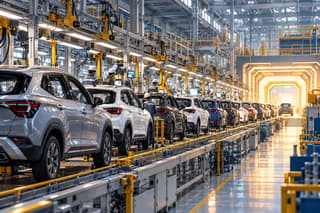
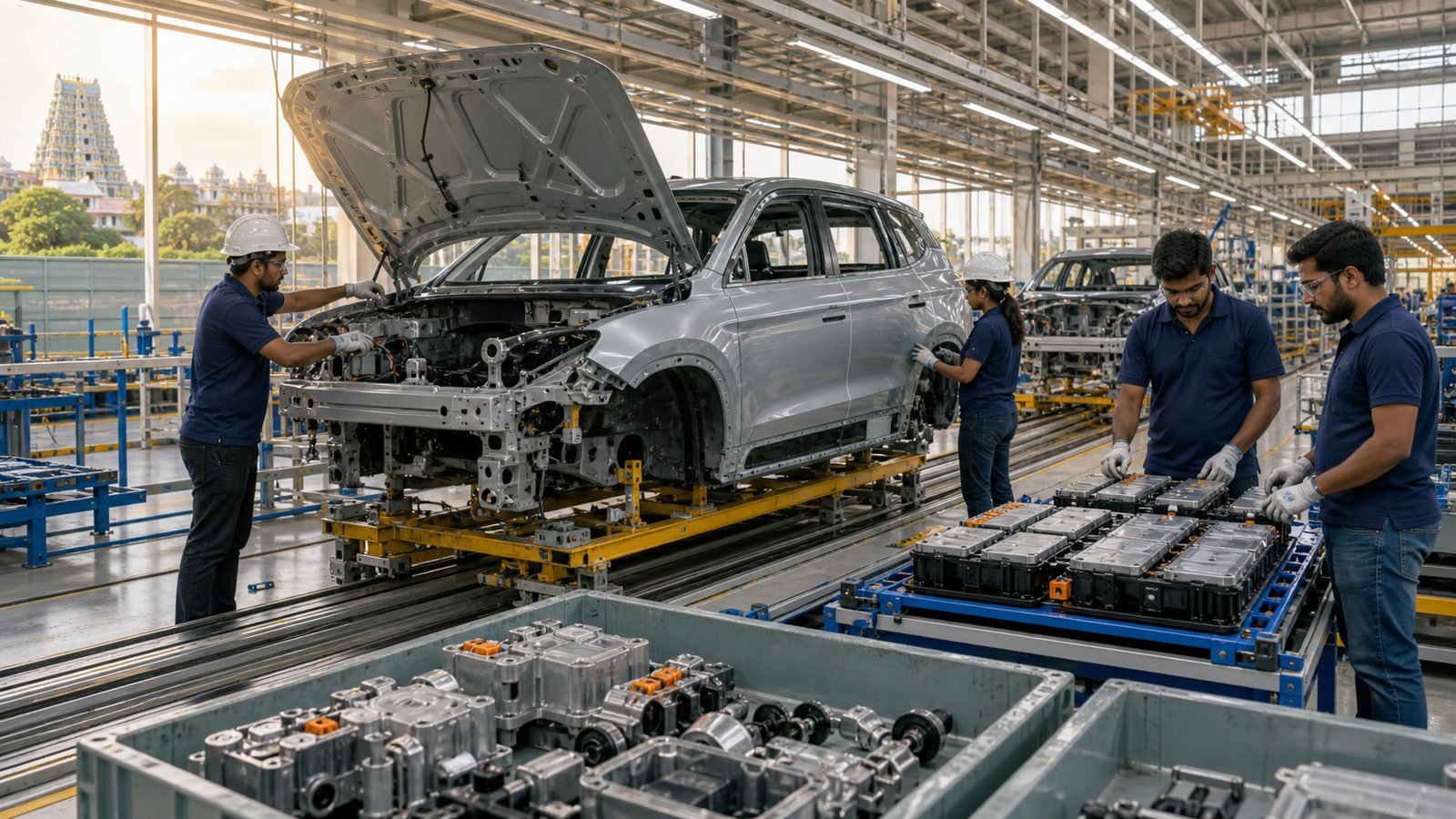
Tamil Nadu already has one of India's deepest automotive supply chains. Hyundai's Chennai operation gives it an existing manufacturing base, vendor network, port access, trained workforce and dealer pipeline. In EVs, that base matters because a car is no longer just an engine, gearbox and body shell. The value chain shifts toward batteries, power electronics, motors, thermal systems, software, charging interfaces and diagnostics.
The state is also important because Hyundai has previously committed large investment in Tamil Nadu. Business Standard reported in 2024 that Hyundai Motor India pledged USD 2.45 billion of investment in the state. The June 2026 update builds on that direction by tying the investment story more directly to EV production, component sourcing and employment.
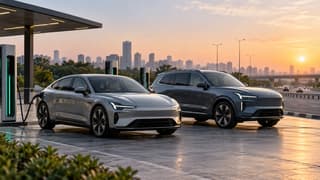
Motoring Trends reported that Hyundai is working with the Tamil Nadu government to strengthen the EV ecosystem, including manufacturing, supplier development, skilling and charging infrastructure. It also cited a state focus on public charging, with Hyundai linked to DC fast-charging points across Tamil Nadu. Hyundai's own India release from December 2024 had earlier said the company planned to expand its EV charging network with nearly 600 public fast chargers over seven years. Charging is not the same as manufacturing localisation, but both are needed if mass-market EVs are to move beyond early adopters.
Impact on vehicle buyers and fuel users
For a petrol or diesel car owner comparing an EV, the decision usually comes down to four questions: purchase price, range, charging access and resale confidence. Hyundai's localisation push can directly influence the first and fourth points. If more high-value components are sourced locally, the company has more room to manage costs, respond to demand and support long-term parts availability. That does not remove battery-cost pressure overnight, but it makes the EV business less exposed to imported-kit economics.
For daily users, EV economics still depend on charging pattern. Home charging keeps running costs low. Public fast charging adds convenience but can cost more per kilometre than home electricity. The useful change is that a locally made EV from a mainstream brand can pull more buyers into showrooms, especially if the vehicle is priced below imported or premium EV alternatives and backed by a wider service network.
The petrol and diesel impact is indirect but real. India's EV transition will not sharply reduce fuel demand from one model launch. However, if high-volume manufacturers localise EVs and keep adding charging access, the passenger-vehicle market can gradually shift some city commuting away from petrol. That affects long-term fuel demand growth, urban emissions, service business models and dealer inventory planning.
Why suppliers and logistics operators should track this
Localisation changes the freight map. A larger local EV supply chain means more movement of battery modules, electronics, castings, stamped parts, wiring harnesses, thermal-management systems and packaging material around the Chennai manufacturing cluster. Suppliers near the plant can win more predictable business, while logistics firms may see more specialised handling requirements for battery and electronic components.
The jobs angle is also not limited to the factory floor. EV production needs line technicians, quality engineers, software diagnostics teams, battery-pack handlers, charging-installation technicians, supplier auditors and service-network trainers. If Hyundai adds about 2,000 jobs around this push, the state gains not only employment but also EV-specific industrial skills that can support future models and other manufacturers.
What to watch next
The next important marker will be the identity, price band and specifications of the Chennai-made mass-market EV. Buyers should watch whether Hyundai positions it against Tata, Mahindra, MG and Maruti's upcoming EV products, and whether the company can offer a convincing real-world range, warranty and charging package. The difference between a strong EV announcement and a strong EV business is sustained delivery volume.
The second marker is localisation depth. A 90 percent target is meaningful only if high-value systems such as battery packs, motors, control electronics and thermal systems are included in the local base rather than only low-value trim and body components. The third marker is charging execution. More chargers along highways, office clusters and residential catchments would make Hyundai's EV plan more practical for owners who cannot rely only on home charging.
Reader takeaway: Hyundai's Tamil Nadu EV hub update matters because it joins product launch timing with manufacturing depth. If the Chennai-made EV arrives with high localisation, stronger charging support and service confidence, it can make the shift from petrol to electric feel less experimental for mainstream buyers.
Sources
- Business Standard: Hyundai sees Tamil Nadu as flagship EV hub
- Motoring Trends: Hyundai Motor India and Tamil Nadu EV ecosystem
- Mint: Hyundai Motor India EV outlook and market context
- Hyundai Motor India: EV charging network expansion plan
- Financial Express: Hyundai Motor India FY26 business outlook
- Business Standard: Hyundai Tamil Nadu investment context