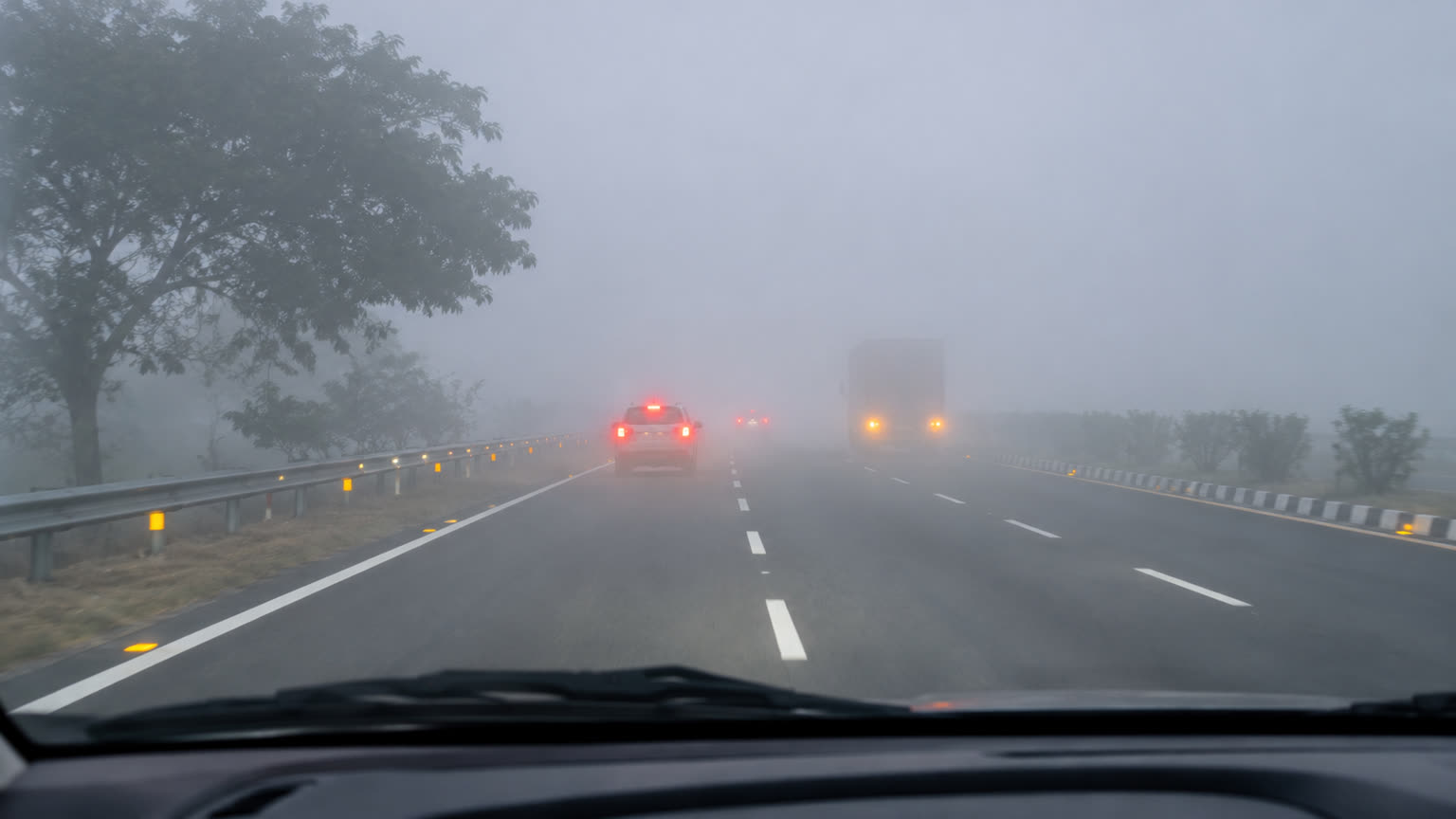
The India Meteorological Department (IMD) has warned of dense fog in isolated pockets of Haryana, Chandigarh, Delhi and Punjab from 26 to 28 November 2026, with Himachal Pradesh covered by a wider warning through 29 November. The department says fog can affect highways, slow journeys and raise the risk of road collisions, making early-morning and night travel the main concern for drivers, riders and fleet operators.
Key takeaways
- The IMD's 26 November subdivision warning marks dense fog for Haryana, Chandigarh, Delhi and Punjab on 26, 27 and 28 November.
- The department's 25 November national press release also lists Himachal Pradesh through 29 November, parts of the Northeast through 27 November and Odisha through 26 November.
- IMD says dense fog may affect some highways, railway routes and airports, causing difficult driving conditions and slower journey times.
- The warning is for isolated pockets and does not announce a blanket highway closure or any toll change.
What the latest IMD warning says
The IMD's current subdivision-wise page, issued on 26 November, shows a dense-fog warning for Haryana, Chandigarh and Delhi on 26–28 November. It gives the same three-day window for Punjab and shows no warning in those entries from 29 November onward. That is the most current position for the two northwestern warning blocks, so travellers should use the latest bulletin rather than rely on an older screenshot or message.
A separate IMD national press release issued on 25 November gives a broader regional picture. It says dense fog is very likely in isolated pockets of Himachal Pradesh through 29 November, in Assam and Meghalaya and Manipur and Tripura through 27 November, and in Odisha through 26 November. The wording is important: this is a forecast for isolated pockets, not a claim that every road in each state will be covered in fog.
In its impact guidance, the weather department says fog may affect some highways, railway routes and airports. It warns of difficult driving conditions, slower journey times and possible road collisions unless precautions are taken. The IMD's listed action guidance includes using fog lights while driving and staying in touch with airlines, railways and state transport operators when a journey connects multiple modes.
Why it matters for highway trips
For a private car or two-wheeler, the immediate effect is less useful visibility during the hours when many inter-city journeys begin or end. Lane markings, signs, stopped vehicles and the edge of the carriageway can become harder to pick out, so a journey that is normally predictable may need a slower pace and more time.
For buses, trucks and delivery fleets, the issue is also operational. Slower movement can push arrival windows later, while a cautious convoy or an unplanned stop can change a driver's fuel and rest plan. It is better to build a time buffer into the itinerary than to try to recover lost minutes through faster driving.
Before leaving, use the FuelPrice road-trip planner to review the route, likely travel time and possible stopping points. The tool helps with planning; it is not a live fog or closure feed, so the final decision should follow the latest official and local traffic information.
Checks for drivers before departure
Check the warning for the actual corridor
Start with the latest IMD warning for the districts on the route, then look for updates from the relevant traffic police, district administration, highway authority or bus operator. A state-level warning can cover a large area, while actual visibility can differ between open fields, city edges, bridges and low-lying road sections.
Prepare the vehicle for low visibility
Clean the windscreen, mirrors, lamps and reflective surfaces before leaving. Check the wipers and demister, and use fog lights when visibility drops as advised by the IMD. Reduce speed to a level that leaves enough distance to stop safely, avoid abrupt lane changes and do not treat a clear-looking stretch as proof that the fog has ended.
Plan time, fuel and toll stops separately
Fog does not change the listed fuel price or toll rate, but slower traffic and waiting can increase the fuel used on a trip. The fuel cost calculator can help test the planned distance and a longer alternative. For toll roads, check the toll-charge calculator hub separately; it can estimate ordinary user fees but cannot predict a temporary traffic restriction.
EV drivers taking a longer route should also confirm that charging points remain practical for the revised itinerary through the state-wise EV charging directory. A longer or slower journey can change the preferred charging stop even when the road itself remains open.
Who is most likely to feel the impact
Daily commuters and inter-city travellers on routes across Delhi, Haryana, Punjab and Chandigarh are the most directly exposed during the warning window. Two-wheeler riders have less protection from cold and poor visibility, while truck and bus drivers may face longer operating times if traffic slows. Travellers continuing into Himachal Pradesh should account for the longer warning window in that state.
There is no blanket closure in the IMD warning, and it does not change FASTag, toll collection or fuel prices. The practical effect is local and time-sensitive: some stretches may remain clear while another part of the same corridor becomes difficult during the night or early morning. Keep the route flexible and check conditions again before the return journey.
What to watch next
The IMD's warning pages can change as new observations arrive. For Haryana, Chandigarh, Delhi and Punjab, the current page shows no warning from 29 November, but that is not a guarantee that visibility will be uniform or that later bulletins cannot revise the outlook. Operators planning early departures should recheck the warning and any local road advisory before dispatching vehicles.
Reader takeaway
The latest fog alert is a reminder to plan for slower movement, not a reason to assume that every highway is closed. Check the official warning for the corridor, prepare the vehicle, allow extra time and keep fuel, toll and charging plans flexible. If a local authority or transport operator issues a stronger restriction, follow that instruction over a pre-booked itinerary or normal map estimate.
Sources
- India Meteorological Department — “Sub-Division-wise Warnings for Haryana, Chandigarh & Delhi and Punjab” (26 Nov 2026)
- India Meteorological Department — “Press Release: Fog warning and transport impact guidance” (25 Nov 2026)
- India Today — “Delhi braces for dense fog as winter tightens grip across North on Thursday” (25 Nov 2026)
- United News of India — “IMD issues dense fog warning for Haryana, Punjab, Delhi; road, rail and air traffic may be affected” (25 Nov 2026)