The International Maritime Organization (IMO) is taking its draft Net-Zero Framework into a decisive round of negotiations from 23 to 27 November 2026, but governments still disagree over how ships should comply with cleaner-fuel standards and emissions payments. For road users and fleet operators, this is not an immediate petrol-price rule; it is a global shipping-fuel decision that could influence freight costs, cargo routes and the pace at which lower-emission marine fuels become commercially available.
Key takeaways
- The IMO's intersessional greenhouse-gas working group meets from 23 to 27 November 2026, ahead of the Marine Environment Protection Committee's 30 November to 3 December 2026 session.
- The draft framework combines a lifecycle fuel-intensity standard with a pricing mechanism for emissions above set thresholds.
- The framework is still proposed, not in force. If adopted, the IMO says it would be expected to enter into force about 16 months later under the treaty process.
- The main dispute is how ships that cannot secure cleaner fuels or compliance credits would pay, and how any fund or revenue would be governed.
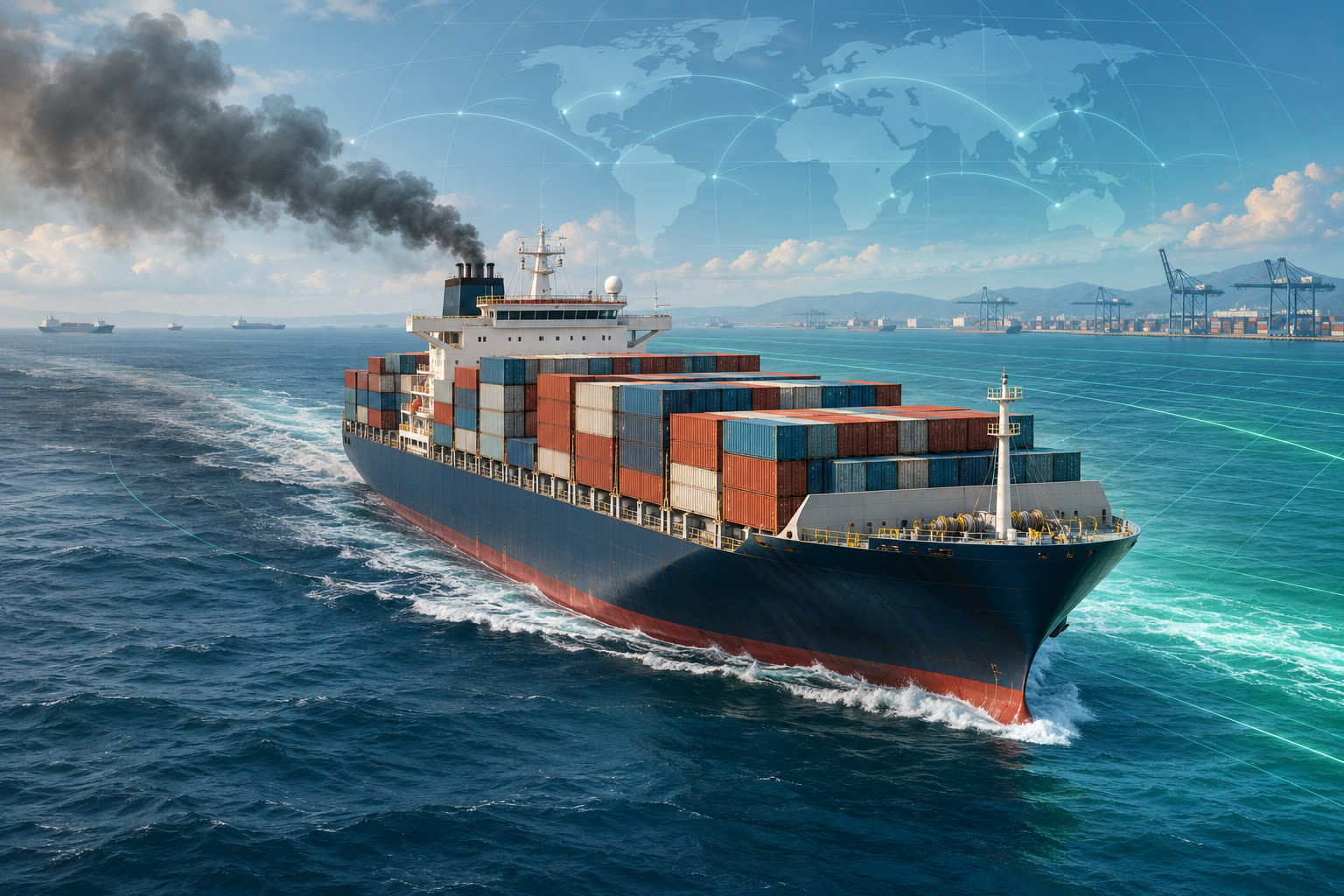
Illustrative image: a non-official editorial depiction of a container ship and the shift towards lower-emission marine fuels.
Why the shipping decision matters beyond ports
Marine fuel is an upstream cost for international trade. Ships carry vehicles, spare parts, food, machinery and energy equipment across borders, so a global rule can affect freight planning even when the final customer never buys marine fuel directly.
A common standard could give shipowners, ports and fuel suppliers a clearer basis for investment. A delayed or fragmented outcome could leave operators managing overlapping regional requirements and different definitions of a lower-emission fuel. S&P Global reported on 20 November 2026 that industry groups are seeking enforceable global rules with flexible compliance options, while warning that duplicated obligations could add costs for shipping companies.
What the IMO framework would change
The IMO's Net-Zero Framework FAQ describes two linked parts: a global fuel standard that lowers the permitted greenhouse-gas intensity of marine energy over time, and a pricing mechanism for emissions. The proposed system measures emissions across the fuel lifecycle, from production to use onboard, rather than looking only at the ship's exhaust.
The draft legal text would amend Annex VI of the MARPOL convention. The IMO has not yet made it legally binding. The proposal generally covers oceangoing ships above 5,000 gross tonnage, subject to specified exclusions, according to the IMO FAQ and a 20 November 2026 analysis by Norwegian law firm Selmer.
That status matters for readers: there is no new worldwide marine-fuel charge that applies today. The IMO says that, after adoption, the amendments would normally pass through the treaty's circulation and acceptance steps before enforcement. Its FAQ and Selmer both put the expected entry into force at approximately 16 months after adoption, so the schedule is not the same as an immediate price change.
Why compliance costs are still unresolved
The technical direction is easier to describe than the payment system. The framework would reward ships that outperform their fuel-intensity limits and require remedial action from ships that exceed them. The unsettled question is whether that remedial action should rely mainly on mandatory payments into an IMO-managed fund, tradable or banked compliance units, alternative investments, or a combination.
S&P Global reported that the United States opposes mandatory payments, while China and Norway have proposed multiplier-based approaches and several countries have suggested investments in maritime decarbonisation projects as an alternative route to compliance. Selmer's review, also published on 20 November 2026, says the United States continues to reject mandatory payments and an IMO-administered fund. It also describes a shipping industry's call for a stable global framework that recognises fuel availability, cost and technological readiness.
These positions are not a final rule. They are negotiating positions, and the design can still change before adoption. That is why claims that the IMO has already imposed a global carbon tax would be inaccurate: the IMO describes the draft as a performance-based system with tiered compliance fees and a dedicated fund, not a single national-style tax.
What it could mean for fuel users and freight
The direct impact would fall first on ocean carriers, fuel suppliers, ports and cargo owners. A stricter lifecycle standard could increase demand for certified low- and near-zero-emission fuels and for the infrastructure needed to store, bunker and verify them. If cleaner fuels remain scarce on a route, the cost of compliance could instead show up through fuel procurement, vessel choice, route planning or freight contracts.
That does not mean a fixed surcharge will automatically appear on a household's fuel bill. Any pass-through would depend on the final payment level, the vessel's performance, fuel availability, freight-market conditions and whether regional systems continue alongside the global framework. For a local trip, readers can still check current pump rates in the fuel prices hub and estimate a route's road-fuel component with the fuel cost calculator; those tools measure a different part of the transport chain.
What to watch next
The immediate timetable is clear even though the outcome is not. The IMO lists the working group for 23 to 27 November 2026 and MEPC 85 for 30 November to 3 December 2026. A resumed extraordinary session on 4 December 2026 is subject to confirmation by MEPC 85, according to the IMO schedule and Selmer's review.
The useful signals will be whether governments narrow the gap over emissions payments, agree how lifecycle fuel data will be certified, and keep one global framework rather than adding competing regional charges. Until those points are settled, the story is an important market and policy signal, not an effective consumer rule.
For continuing coverage of fuel, transport and energy developments, readers can use FuelPrice's latest news archive.
Sources
- International Maritime Organization — Meeting Summaries and Schedule (accessed 22 Nov, 2026)
- International Maritime Organization — The IMO Net-Zero Framework: FAQs (accessed 22 Nov, 2026)
- S&P Global — IMO faces tough compromise on shipping emissions rules amid US opposition (20 Nov, 2026)
- Selmer — Shipping's GHG framework: will we get a December decision? (20 Nov, 2026)
This article is for general information only and is not financial, insurance or legal advice.