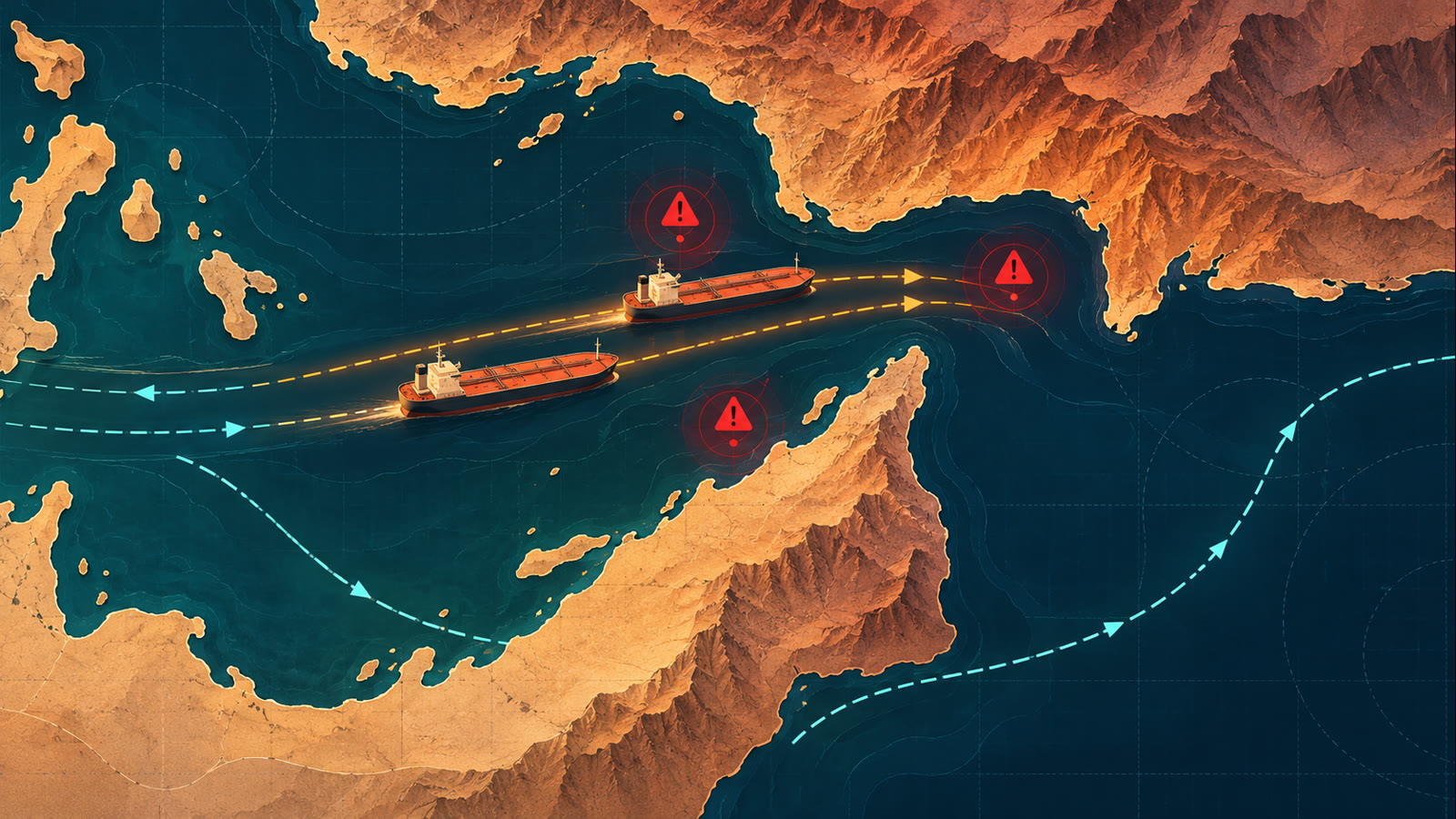
Two commercial tankers were hit by unknown projectiles while transiting outbound through the Strait of Hormuz on 21 Nov 2026, according to warnings from the United Kingdom Maritime Trade Operations (UKMTO); the agency reported no casualties, although environmental impact remains unconfirmed. The incidents add a fresh shipping and fuel-supply risk at a chokepoint used by global oil and gas trade, but they do not by themselves prove a physical fuel shortage or an immediate pump-price move.
Key takeaways
- UKMTO issued two attack warnings on 21 Nov for outbound tankers near Khasab, Oman.
- One tanker was hit on the stern and another in the engine room; no casualties were reported in either warning.
- Iran's navy separately said a tanker caught fire after striking a naval mine, but the account could not be independently verified or linked to the two UKMTO reports.
- The main risk for fuel users is a prolonged disruption to shipping, insurance, freight or cargo availability—not an automatic change at every petrol or diesel pump.
What UKMTO reported on 21 November
UKMTO Warning 215-26 said a tanker travelling outbound through the strait was hit on its stern at 0500 UTC, about 11 nautical miles north of Khasab, Oman. Warning 216-26 followed at 0550 UTC: a second outbound tanker was hit in its engine room about 17 nautical miles east of Khasab. Both warnings cited military authorities, said no casualties had been reported and advised vessels to transit with caution.
The independent reporting broadly matches the official alerts. The Associated Press reported that at least two tankers were struck by projectiles while exiting the Persian Gulf through the strait. Al Jazeera, drawing on AFP and Reuters reporting, placed the two incidents at about 20 kilometres north and 31 kilometres east of Khasab, consistent with the distances in the UKMTO warnings. The outlets also reported that no casualties were known at the time of publication.
The location matters because Khasab sits on Oman's Musandam Peninsula beside the narrow sea passage. A ship can be physically outside a port and still face a commercially significant delay if crews, owners, charterers or naval escorts reassess the risk of completing the transit. The warnings do not say that the two tankers sank, that cargo was lost or that the waterway has closed. Those distinctions are important: an attack report is confirmed, while the wider market effect is still developing.
Iran's separate mine account remains unverified
Iranian state media carried a navy statement saying another tanker caught fire after striking a naval mine east of the strait. The Associated Press and Al Jazeera both reported the Iranian account, including Tehran's claim that the vessel had ignored warnings and was travelling with identification and navigation equipment switched off. Neither report could independently verify the claim, and it was not clear whether the burning tanker was one of the vessels described in the UKMTO warnings.
That difference in attribution should stay visible. UKMTO's warnings describe two projectile strikes reported by maritime or military sources. Iran's account describes a mine incident and assigns responsibility to the ship's alleged conduct. The available reporting does not establish that all three accounts refer to separate ships, nor does it independently establish who launched the projectiles.
Why this matters for global fuel flows
The Strait of Hormuz connects major Gulf export routes with the Indian Ocean and the wider global market. Tankers moving crude, refined products and other energy cargoes do not need every sailing to stop for the risk premium to rise. Owners can slow departures, wait for updated guidance, seek escorts, change routes or ask for higher insurance and freight cover. Refiners and traders may then have to compare a longer voyage or an alternative cargo with the cost of drawing on existing inventories.
This is why a security incident can matter before a measured supply loss appears in official production data. The first signals to watch are vessel movements, official maritime warnings, confirmed damage or pollution, changes in loading schedules and whether cargoes continue to clear the strait. A single incident can be contained; repeated incidents can turn a safety problem into a logistics problem, and a logistics problem into a price problem.
The U.S. Maritime Administration's active advisory for the Persian Gulf, Strait of Hormuz and Gulf of Oman says risks to commercial shipping remain high. It tells U.S.-flagged operators to plan voyages with maritime authorities, avoid hazard areas where possible and report suspicious activity. That is operational guidance for vessels, not a new retail-fuel rule for drivers, but it shows how the security issue is being treated by an official maritime authority.
What drivers and fleets should expect
There is no confirmed global petrol or diesel shortage in the reports above, and the incidents do not create a one-for-one pump-price increase. Retail fuel prices also depend on crude benchmarks, refinery margins, freight, taxes, exchange rates, local inventories and the pricing decisions in each market. The sensible reading is that the risk of volatility has increased if shipping disruption persists; it is not that every driver will immediately pay more.
For a trip or a monthly commute, the useful starting point is the posted rate in the market where the vehicle is refuelled. Readers can check current fuel prices before making a cost estimate. Fleet operators and transport planners can use the fuel cost calculator to separate a vehicle's actual distance and efficiency from a broad geopolitical headline.
Commercial users should also watch freight and delivery updates rather than only crude headlines. If tanker availability tightens, the impact may first appear in cargo timing, working capital, bunker costs or refinery feedstock choices. Those effects can reach road transport and consumer goods even when local filling-station boards have not changed.
What to watch next
The next useful evidence will come from further UKMTO or other maritime warnings, confirmation of the vessels' damage and environmental status, and any change in tanker traffic or cargo-loading patterns. Market participants will also watch whether governments issue new escort, routing or export guidance, and whether crude and refined-product prices respond to an actual interruption rather than to the headline risk alone.
This is a material new development from the earlier Hormuz shipping reports: two fresh UKMTO attack warnings were issued on 21 Nov, close together in time and in the same outbound transit area. Readers can review FuelPrice's earlier coverage of the Hormuz shipping disruption for the background, but the latest warnings should be assessed on their own evidence as authorities investigate.
The reader takeaway is measured. Commercial shipping through a critical energy route has faced two newly reported projectile strikes, and Iran has offered a separate, unverified mine explanation. That raises the chance of higher logistics and fuel-market volatility, but a confirmed attack is not the same as a confirmed supply outage. The clearest signal for drivers will be sustained changes in cargo flows and local fuel prices, not a single alarming image or headline.
Sources
- UKMTO — “Warning 215-26: Attack” — 21 Nov 2026
- UKMTO — “Warning 216-26: Attack” — 21 Nov 2026
- Associated Press — “Iran strikes tankers and Israeli hit on food truck in Gaza kills 3” — 21 Nov 2026
- Al Jazeera — “Tankers hit in Strait of Hormuz as Iran tightens grip on shipping” — 21 Nov 2026
- U.S. Maritime Administration — “2026-011: Persian Gulf, Strait of Hormuz and Gulf of Oman—Iranian Attacks on Commercial Vessels” — active advisory accessed 21 Nov 2026
This article is for general information only and is not financial, insurance or legal advice.