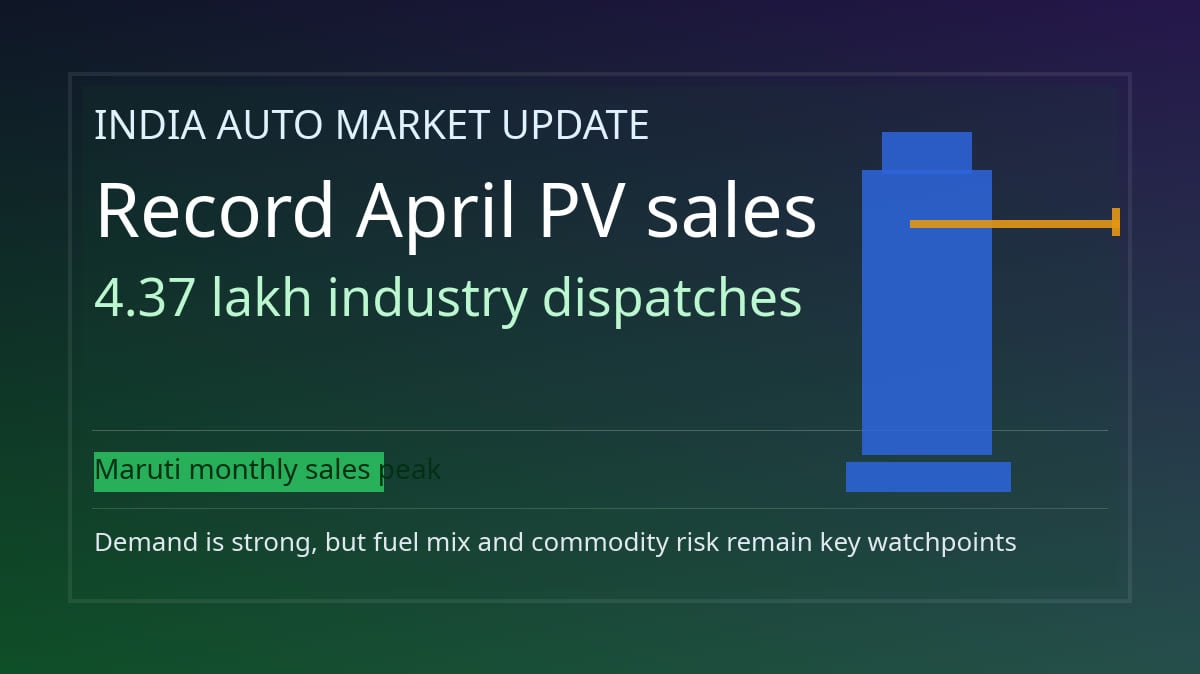
India auto demand started FY27 with a clear number-led signal: SIAM says passenger-vehicle dispatches touched a record 4,37,312 units in April 2026, while Maruti Suzuki reported 2,39,646 units as its highest-ever monthly sales.
This is not just a volume headline. It matters for fuel demand planning, model-mix strategy, dealer inventory discipline, and investor expectations for the auto value chain.
April 2026 delivered record dispatch and strong retail momentum, but the quality of demand will depend on fuel mix, commodity cost and regional balance.Key Highlights
- SIAM reports April 2026 passenger-vehicle dispatches at 4,37,312 units, highest ever for the month.
- Maruti reports 2,39,646 total sales in April, its highest-ever monthly sales volume.
- Autocar, citing FADA retail data, reports car retail sales at 4,07,335 units in April, up 12.21 percent YoY.
- Fuel mix is shifting: EV and CNG shares are rising in YoY terms, while petrol and diesel shares are lower than a year ago.
- SIAM has also flagged commodity-price concerns linked to West Asia disruptions.
What Happened
On 14 May 2026, SIAM released April industry performance and stated that passenger vehicles recorded their highest-ever sales for April at 4.37 lakh units, up 25.4 percent over April 2025. The same release highlighted strong growth across two-wheelers and three-wheelers as well.
Earlier, on 1 May 2026, Maruti Suzuki announced its April sales at 2,39,646 units, calling it the company highest-ever monthly sales volume. Maruti also disclosed domestic all-time-high sales of 1,91,122 units and exports of 40,054 units.
Together, these two data points establish a strong demand setup entering FY27, but they also require careful reading across dispatches, retail conversion and cost environment.
Dispatch vs Retail: Why The Distinction Matters
Dispatch data (OEM-to-dealer) and retail data (dealer-to-customer) can diverge in the short term. Autocar reported April retail sales of 4,07,335 units from FADA, up YoY but down sequentially from March, which often reflects year-end push and inventory normalization.
For readers and investors, this means one month of record dispatch should be read with retail trend, regional split and inventory cycle, not in isolation.
| Metric | April 2026 Value | Source | Signal |
|---|---|---|---|
| PV dispatches | 4,37,312 units | SIAM | Record monthly industry dispatch |
| Maruti total sales | 2,39,646 units | Maruti official release | Highest-ever monthly volume for company |
| PV retail sales | 4,07,335 units | Autocar using FADA data | Strong YoY, but sequential cooling vs March |
Fuel-Mix Angle: Why It Matters For Fuel And Auto Ecosystem
Autocar reported an important demand-quality shift in April fuel mix: petrol and diesel share were lower YoY, while EV and CNG shares showed YoY gains. Reported shares were petrol 45.95 percent versus 49.03 percent a year ago, diesel 17.39 percent versus 18.85 percent, CNG/LPG 22.62 percent versus 19.84 percent, and EV 5.77 percent versus 3.70 percent.
This shift has direct implications for fuel retailers, CNG infra planning, EV charging expansion, and product strategy for OEMs competing in mass segments.
Who Gains, Who Faces Pressure
- Likely gainers: brands with broad CNG, strong small-car execution, and credible EV pipelines.
- Potential pressure points: high commodity-cost exposure, weak retail throughput, and aggressive discount-led volume strategies.
- Dealers: need tighter inventory control if dispatch outpaces local retail in selective pockets.
- Consumers: may see better choice and sharper offers, but running-cost math remains fuel-type dependent.
Risk Watch: Commodity Prices And West Asia
SIAM specifically noted concerns around high commodity prices from disruptions in West Asia, even while acknowledging healthy demand. That warning is important: if input or logistics costs rise, OEM pricing actions, waiting periods, and discount structures can change quickly.
For FuelPrice readers, the practical interpretation is to track not just launch news but also monthly fuel trends, variant-level price revisions, and regional delivery timelines.
Reader Takeaway
April 2026 confirms that India passenger-vehicle demand remains strong at both OEM and retail levels. But the next phase will be decided by demand quality, not only volume: fuel mix evolution, commodity cost pressure, and channel inventory health are the three metrics to watch in June and July data cycles.
Final Verdict
This is a high-quality demand signal for the auto sector, not a simple one-way rally headline. Record numbers from SIAM and Maruti show momentum, but sustained strength will depend on how retail conversion, fuel preference and cost pressure evolve over the next two reporting months.