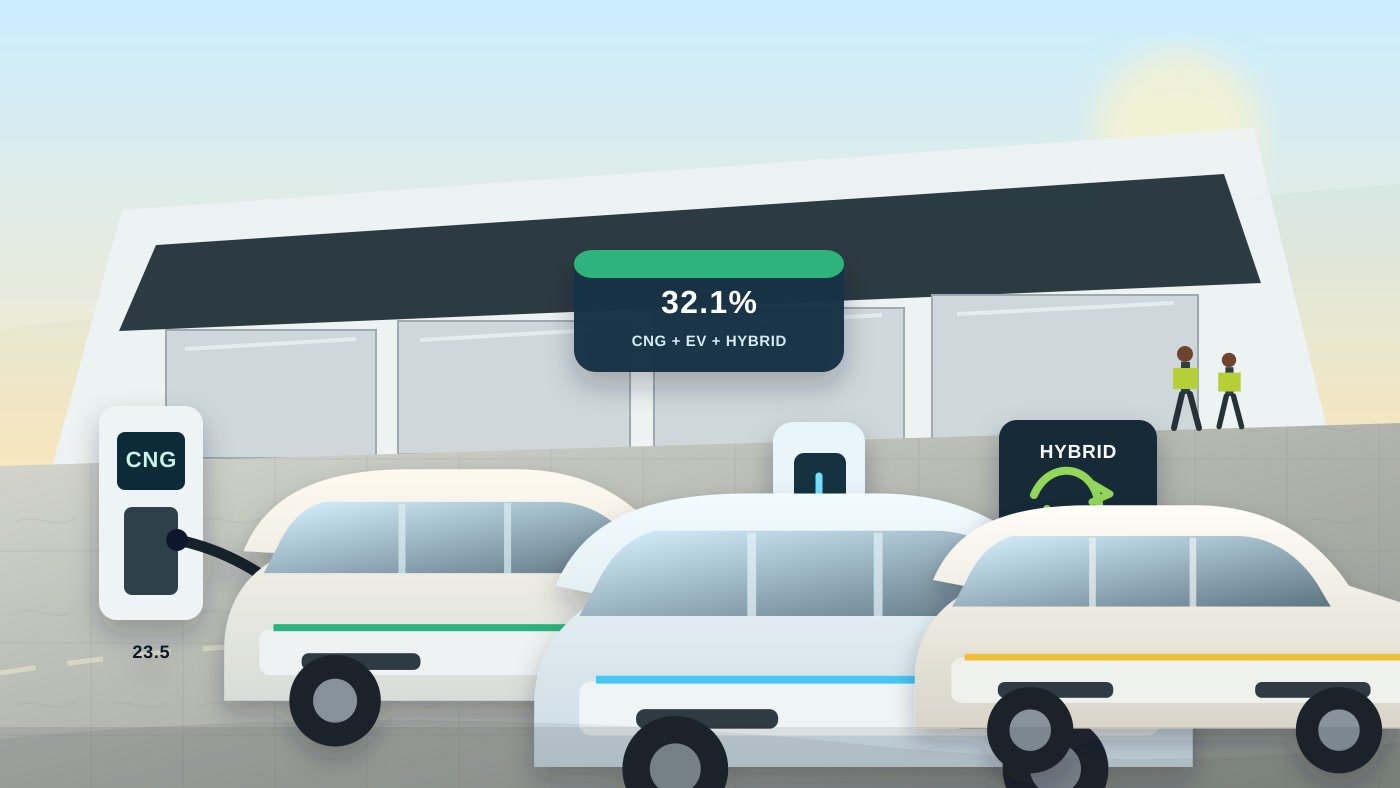
India's passenger-vehicle market is no longer just a petrol-versus-diesel story. In May 2026, CNG, electric vehicles and strong hybrids together accounted for 32.1 percent of passenger-vehicle sales, up from 27.2 percent a year earlier, according to ICICI Direct Research citing media data. That means nearly one in three new passenger vehicles was sold with an alternative-fuel or electrified powertrain.
The shift is not evenly distributed. CNG remained the largest alternative-fuel choice with 23.5 percent share of passenger-vehicle sales. EV penetration rose to 6.6 percent from 4.6 percent a year ago. Strong hybrids, however, slipped to 2 percent even though fuel-price pressure would normally be expected to support them. Petrol and diesel combined fell to 67.9 percent from 72.9 percent, while diesel's market share declined sharply year on year.
What changed in May?
Before this shift, many car buyers treated alternative powertrains as niche decisions: CNG for taxi and high-mileage users, EVs for early adopters and urban families, and strong hybrids for premium buyers seeking fuel efficiency without charging dependence. May 2026 shows a broader market change. Fuel prices moved several times during the month, and buyers appear to be comparing running cost, refuelling access, purchase price and resale confidence more actively than before.
Autocar Professional reported that electric passenger-vehicle retail sales reached a record 26,221 units in May 2026, up 80 percent year on year, based on Vahan portal data available on June 1. The publication also linked the surge to four petrol and diesel price hikes and two CNG revisions during the month. That does not mean every buyer switched because of one fuel bill, but it does show how quickly powertrain decisions can respond when fuel uncertainty becomes visible.
The powertrain split that matters
| Powertrain group | May 2026 share | What it signals |
|---|---|---|
| CNG | 23.5 percent | Cost-conscious buyers still prefer lower running cost and an existing fuel network. |
| Electric vehicles | 6.6 percent | EV adoption is rising, led by record monthly retail sales and wider model availability. |
| Strong hybrids | 2 percent | Fuel efficiency is attractive, but higher upfront price and limited model choice remain barriers. |
| Petrol and diesel combined | 67.9 percent | Conventional fuels still dominate, but their combined share is shrinking. |
Why CNG is still leading the shift
CNG's advantage is practical. It offers a lower running-cost proposition than petrol in many cities, usually at a lower purchase-price premium than a full EV or strong hybrid. The refuelling network is also more familiar to fleet operators, cab drivers and private high-mileage users in large CNG markets. This explains why CNG can remain the largest alternative-fuel choice even when EV demand is growing faster.
There are limits. CNG queues, tank-space compromise, city-wise availability and recent CNG price hikes can reduce the appeal for some buyers. Still, for a household or fleet that drives enough kilometres every month, the per-kilometre calculation often matters more than powertrain excitement. That is why CNG's 23.5 percent share is a buyer-economics signal, not just an environmental one.
EVs are gaining because the economics are clearer
EV penetration rising to 6.6 percent in passenger vehicles is important because the segment is now being tested by mainstream buyers, not only early adopters. Autocar India reported that Tata crossed 10,000 monthly EV sales for the first time in May, while Mahindra, MG, Maruti, VinFast and BYD also shaped a broader competitive field. More choice improves confidence because buyers can compare price, range, charging speed, service reach and battery warranty instead of evaluating one or two models.
Financial Express also reported that EV penetration across India's overall retail auto market crossed 10 percent for the first time in May, reaching 10.7 percent, while CNG vehicles also increased their share. That wider market signal matters because passenger cars do not exist in isolation. Charging infrastructure, battery supply, finance products and resale confidence are shaped by two-wheelers, three-wheelers, cars, buses and commercial vehicles moving together.
Why hybrids did not get the expected lift
Strong hybrids should theoretically gain when petrol gets expensive because they reduce fuel use without asking the buyer to depend on charging. Yet their share slipped to 2 percent in May. The likely explanation is not weak technology, but limited accessibility. Strong hybrids are concentrated in fewer models and often sit at higher price points. For a price-sensitive buyer, the fuel-saving benefit must overcome a larger upfront gap.
This is where the next launch cycle matters. If more mass-market hybrids arrive at reachable prices, the category could recover. If EV prices keep falling and charging access improves, hybrids may remain a bridge technology in select segments rather than a mass-market default. Buyers should judge hybrids by their real-world fuel efficiency, city-highway use pattern and upfront premium, not just by headline mileage claims.
What this means for buyers and automakers
- Fuel bills are now a central purchase factor, especially after recent petrol, diesel and CNG price revisions.
- Automakers need a multi-powertrain portfolio because different cities solve running cost differently.
- CNG demand supports affordability, while EV demand supports long-term fuel substitution and compliance goals.
- Hybrid success depends on model availability, pricing and whether tax policy remains favourable.
- Dealers will need clearer ownership-cost explanations instead of only ex-showroom price comparisons.
The reader takeaway is clear: India's fuel shift is not moving in one straight line. CNG is winning on affordability and network familiarity, EVs are gaining from product choice and fuel-price anxiety, and hybrids are still searching for the right price-volume balance. For FuelPrice readers, the 32.1 percent alternative-fuel share in May 2026 is the clearest sign yet that running cost is changing the car market faster than brand marketing alone could.
Sources checked
Sources: ICICI Direct Research; Autocar Professional; Financial Express; Autocar India; AutoPunditz.