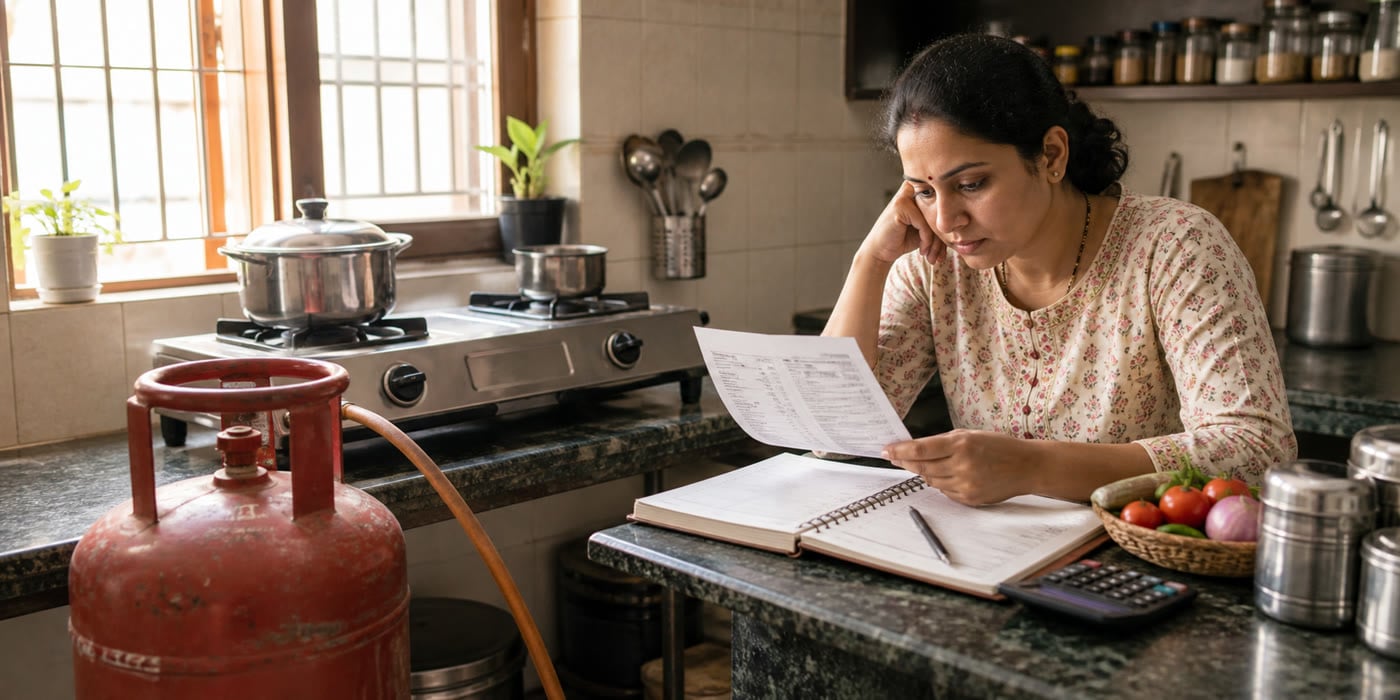
Domestic cooking gas has become costlier from June 7, adding another direct pressure point to household budgets. Oil marketing companies have raised the price of a 14.2-kg domestic LPG cylinder by Rs 29, taking the Delhi price for a general consumer to Rs 942 from Rs 913. For Pradhan Mantri Ujjwala Yojana households, the effective price is Rs 642 after the Rs 300 per-cylinder subsidy credited to beneficiaries.
This is the second domestic LPG increase in three months after a Rs 60 hike on March 7. The latest revision is smaller than the March move, but it arrives in a broader fuel-cost environment where petrol, diesel, CNG and commercial LPG have also moved higher in recent weeks. For households that depend on LPG for daily cooking, the change is immediate: the next refill costs more, even if the government and oil marketing companies continue to absorb part of the international cost shock.
What changed from June 7
The standard 14.2-kg domestic LPG cylinder is now Rs 29 costlier across India, though final city prices vary because of local taxes and transportation costs. Delhi's price has moved from Rs 913 to Rs 942. Economic Times also reported city-wise rates such as Rs 941.50 in Mumbai, Rs 968 in Kolkata, Rs 957.50 in Chennai and Rs 1,031.50 in Patna after the revision.
The price hike affects general household consumers first because the amount paid at booking rises. Ujjwala consumers still receive an additional Rs 300 per cylinder subsidy, which brings their effective price to Rs 642 in Delhi for eligible cylinders. That subsidy makes the Ujjwala bill materially lower than the general consumer price, but the cash-flow reality depends on how quickly the direct benefit transfer reaches the bank account after purchase.
Why prices were increased
The Petroleum Ministry's statement said the Saudi Contract Price benchmark for LPG has risen by about 46 percent between February and June 2026 as West Asia-linked supply stress tightened Gulf energy markets. The government said the cost of supplying a 14.2-kg domestic cylinder has risen to over Rs 1,600. Even after the latest hike, the ministry said public sector oil marketing companies continue to absorb an under-recovery of about Rs 700 per domestic cylinder.
This explains the policy tension. Consumers see a higher bill. Oil marketing companies still argue that the retail price is far below market-linked cost. The exchequer is also involved because the government has approved Rs 30,000 crore in compensation to public sector marketing companies against domestic LPG under-recoveries. The ministry said cumulative under-recovery on domestic LPG has moved towards Rs 60,000 crore in the last full year, up from Rs 41,338 crore the year before.
Why this matters for household budgets
A Rs 29 rise may look modest compared with the total cylinder price, but the impact is not the same for every household. For a family that refills frequently, the extra cost adds up through the year. For lower-income households, the refill purchase is often a lumpy expense, competing with groceries, school transport, mobile bills, electricity and medical costs. That is why LPG price changes are felt more sharply than many smaller daily price movements.
The price also changes the way families compare cooking-fuel options. LPG remains cleaner and more convenient than traditional biomass fuels, and it is safer and easier to use than makeshift alternatives when handled properly. But if refills become too expensive for a household, consumption can become irregular. That risk is especially relevant for Ujjwala users, where connection ownership does not automatically guarantee steady refill affordability.
Ujjwala users and the subsidy cushion
The government has emphasised that Ujjwala consumers receive Rs 300 per cylinder, and the Petroleum Ministry said this reaches more than 10.58 crore connections. After the June 7 revision, the effective Ujjwala price in Delhi is Rs 642. The ministry also said this is around 60 percent below the actual international price of an LPG cylinder, while the non-PMUY price of Rs 942 is around 45 percent below the international price.
The subsidy cushion is important, but consumers still need to pay the booking amount upfront in many cases before subsidy credit. That makes timing important for households with tight monthly cash flow. If refill demand rises around festivals, school reopening periods or monsoon cooking needs, even subsidised users may feel the pressure if income has not moved in line with fuel costs.
Key numbers at a glance
| Metric | Latest update | Why it matters |
|---|---|---|
| Domestic LPG hike | Rs 29 per 14.2-kg cylinder | Direct increase in refill cost from June 7 |
| Delhi general consumer price | Rs 942, up from Rs 913 | Benchmark urban price for household users |
| Ujjwala effective price | Rs 642 after Rs 300 subsidy | Shows subsidy cushion for eligible households |
| Supply cost cited by government | Over Rs 1,600 per cylinder | Explains under-recovery pressure on OMCs |
| Saudi CP increase | About 46 percent between February and June | Shows import-linked benchmark pressure |
Supply security is part of the story
The ministry linked LPG cost pressure to West Asia and Strait of Hormuz disruption. It said more than half of India's LPG consumption has exposure to the route, making household cooking gas directly sensitive to Gulf supply conditions. The government said India kept energy cargoes moving and maintained domestic LPG availability, while also increasing domestic production and diversifying imports.
For consumers, this means the LPG price is not only a local retail decision. It is connected to international contract prices, shipping routes, import availability, rupee movement, oil marketing company losses and fiscal support. That chain is why cooking gas can become more expensive even when domestic distribution is stable and there is no visible shortage at the distributor level.
What to watch next
Households should watch city-wise LPG rates, Ujjwala subsidy credit timing, any further global LPG benchmark movement, and the next monthly fuel-price decisions by oil marketing companies. Another important signal is whether international prices ease or stay elevated through the West Asia disruption. If global LPG costs remain high, the pressure on OMCs and the fiscal bill can continue even after the Rs 29 pass-through.
The final takeaway is practical: the June 7 hike makes the next cooking-gas refill costlier, but it still does not fully pass through the global cost of LPG to consumers. General households will pay more immediately, Ujjwala users remain protected by subsidy, and oil marketing companies continue to carry under-recoveries. For FuelPrice readers, the number to remember is Rs 942 in Delhi for a standard domestic cylinder, and the question to watch is whether international LPG costs soften before the next refill cycle.
Sources: PIB Petroleum Ministry statement; Business Standard LPG price report; Economic Times LPG price report; Financial Express domestic LPG price report; Indian Express on OMC under-recovery.