India may be preparing its next big fuel transition after E20: a reported roadmap for E100, or 100 percent ethanol fuel, could take the network to 5,000 dispensing stations within two years. The plan is important for crude-import reduction, but it is not yet a simple green signal for petrol-car buyers to switch without checking vehicle compatibility, pricing and real-world mileage.
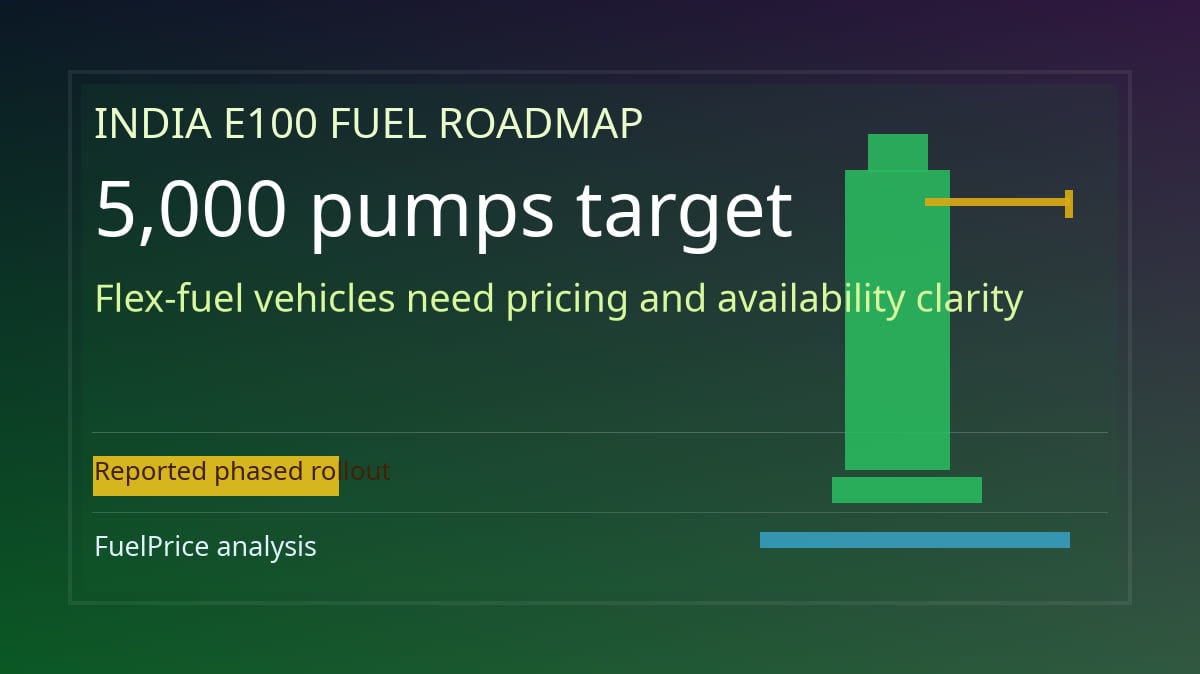
The strongest number in the report is the phased retail target: 150 outlets first, 500 outlets in 6-12 months, and 5,000 outlets over 24 months. For FuelPrice readers, this is not just a fuel-station story. It is a buyer-cost, auto-industry and infrastructure-readiness story.
The reported E100 roadmap could reshape fuel retailing, but adoption will depend on compatible vehicles, pump availability and clear pricing.Key Takeaway
- Reported plan: India is looking at a phased E100 retail network with a 5,000-pump mid-term target.
- Why it matters: E100 can reduce petrol-linked crude imports, but it needs flex-fuel vehicles.
- Buyer warning: Regular petrol vehicles should not be treated as E100-ready unless the manufacturer clearly certifies them.
- Market test: Pricing must compensate for lower fuel efficiency, otherwise adoption may remain limited.
What Has Been Reported
Economic Times reported that the Centre is working on fast-tracking E100 availability by putting in place 5,000 dispensing stations over two years. The report says representatives from automobile companies and oil marketing companies were briefed on a roadmap for flex-fuel vehicle infrastructure on 4 May 2026.
The first phase reportedly targets 150 retail outlets across Delhi, Mumbai, Pune and Nagpur. The next stage could expand the network to 500 outlets over 6-12 months, with deeper coverage in Delhi-NCR and Maharashtra and expansion to Bengaluru, Chennai, Kolkata and Hyderabad. The 5,000-outlet target is described as a mid-term goal within 24 months.
This should be read carefully: the plan is reported as a roadmap and industry briefing, not as proof that E100 will be available everywhere or suitable for every existing petrol vehicle immediately.
What E100 Means
E100 means fuel that is essentially ethanol rather than a petrol-dominant blend. It is very different from E20, where petrol still forms the large majority of the mix. Because ethanol has different combustion, material and energy-density characteristics, vehicles need dedicated flex-fuel engineering to use high ethanol blends safely and efficiently.
A flex-fuel vehicle can run on a range of ethanol-petrol blends, depending on design and calibration. This flexibility is the point of the technology: it lets users buy the fuel available at the pump, while allowing the country to increase domestic ethanol usage when supply and pricing permit.
Why This Matters For Fuel Prices And Oil Imports
India imports a large share of its crude oil requirement. ET reported that crude imports totalled around Rs 10.9 lakh crore in FY26. Higher ethanol usage is being discussed because ethanol is domestically produced and can reduce petrol-linked import exposure if supply, pricing and vehicle adoption align.
For the government, E100 is not only a transport-fuel idea. It links farm supply chains, sugar and grain-based ethanol, oil-marketing-company investment, vehicle engineering, emission compliance, pump infrastructure and consumer cost economics.
For users, the key question is simpler: will E100 reduce running cost enough to offset any mileage loss and the higher cost of flex-fuel vehicle technology?
The Buyer Question: Should You Wait For A Flex-Fuel Car?
Most Indian petrol cars on sale today are designed around current fuel norms such as E20 compatibility. E100 is a different fuel environment. Buyers should not assume that an existing petrol car, even a modern one, can safely run on E100 unless the official owner manual or manufacturer communication clearly says so.
If you are buying a vehicle in 2026, the smart approach is not panic. Ask sharper questions:
- Does the variant officially support E85 or E100, or only E20?
- Will warranty remain valid if higher ethanol fuel is used?
- What is the expected mileage difference between petrol, E20 and high-ethanol fuel?
- Will E100 be available in your city and on your regular highway routes?
- Will the pump price be low enough to make the total running cost attractive?
Infrastructure And Pricing Are The Real Test
Fuel transitions do not work only through policy announcements. They need pumps, storage tanks, transport logistics, safety procedures, consumer awareness and vehicle availability. Business Standard has separately reported that moving beyond E20 will test ethanol supply, storage and distribution at scale.
There is also a pricing issue. Since ethanol can deliver lower fuel efficiency than petrol depending on blend and vehicle calibration, E100 must be priced in a way that makes the cost per kilometre attractive. If the retail price is too close to petrol, a user may see little benefit after accounting for lower range per litre.
That is why industry suggestions around tax incentives, lower GST treatment for flex-fuel vehicles and pricing clarity matter. Without that, E100 can remain a pilot-style product rather than a mainstream fuel.
Impact On Automakers And Fuel Retailers
For automakers, E100 is an engineering and warranty challenge. Fuel lines, seals, engine calibration, cold-start behaviour, emission performance and long-term durability need validation. A flex-fuel vehicle also needs sensors and control systems that can adjust to different ethanol percentages.
For oil marketing companies, the challenge is network economics. Dedicated storage and dispensing equipment may be needed. The pump must also be located where compatible vehicles exist, otherwise offtake can stay weak. ET reported that earlier E100 pilot availability had limited consumer uptake because the base of flex-fuel vehicles in India is still small.
| Stakeholder | Opportunity | Risk To Watch |
|---|---|---|
| Vehicle buyers | Possible lower fuel-cost option if pricing works | Compatibility, warranty and mileage confusion |
| Automakers | New flex-fuel product category | Higher engineering cost and unclear demand |
| Fuel retailers | New fuel offering at strategic city pumps | Low offtake if vehicles are not available |
| Ethanol producers | Higher domestic demand over time | Feedstock, storage and year-round supply balance |
What Existing Petrol-Car Owners Should Not Do
Existing petrol-car owners should not treat E100 as a direct replacement for normal petrol. Higher ethanol blends can require ethanol-compatible materials, special calibration and fuel-system changes. Using an unsupported fuel can affect drivability, durability and warranty.
The practical rule is clear: use the fuel grade your vehicle manufacturer approves. If the car is certified for E20, stay within that limit unless an official manufacturer update says otherwise.
Final Verdict
The E100 roadmap is one of the most important fuel-policy signals for India after the E20 transition. The 5,000-pump target shows serious intent, but consumer adoption will depend on three things: certified flex-fuel vehicles, clear fuel pricing and reliable pump availability.
For now, this is a strong watchlist story rather than a buy-now trigger for every petrol-car owner. The next updates to track are the final government notification path, automaker launch timelines, city-wise E100 pump locations and whether pricing makes E100 cheaper on a per-kilometre basis.