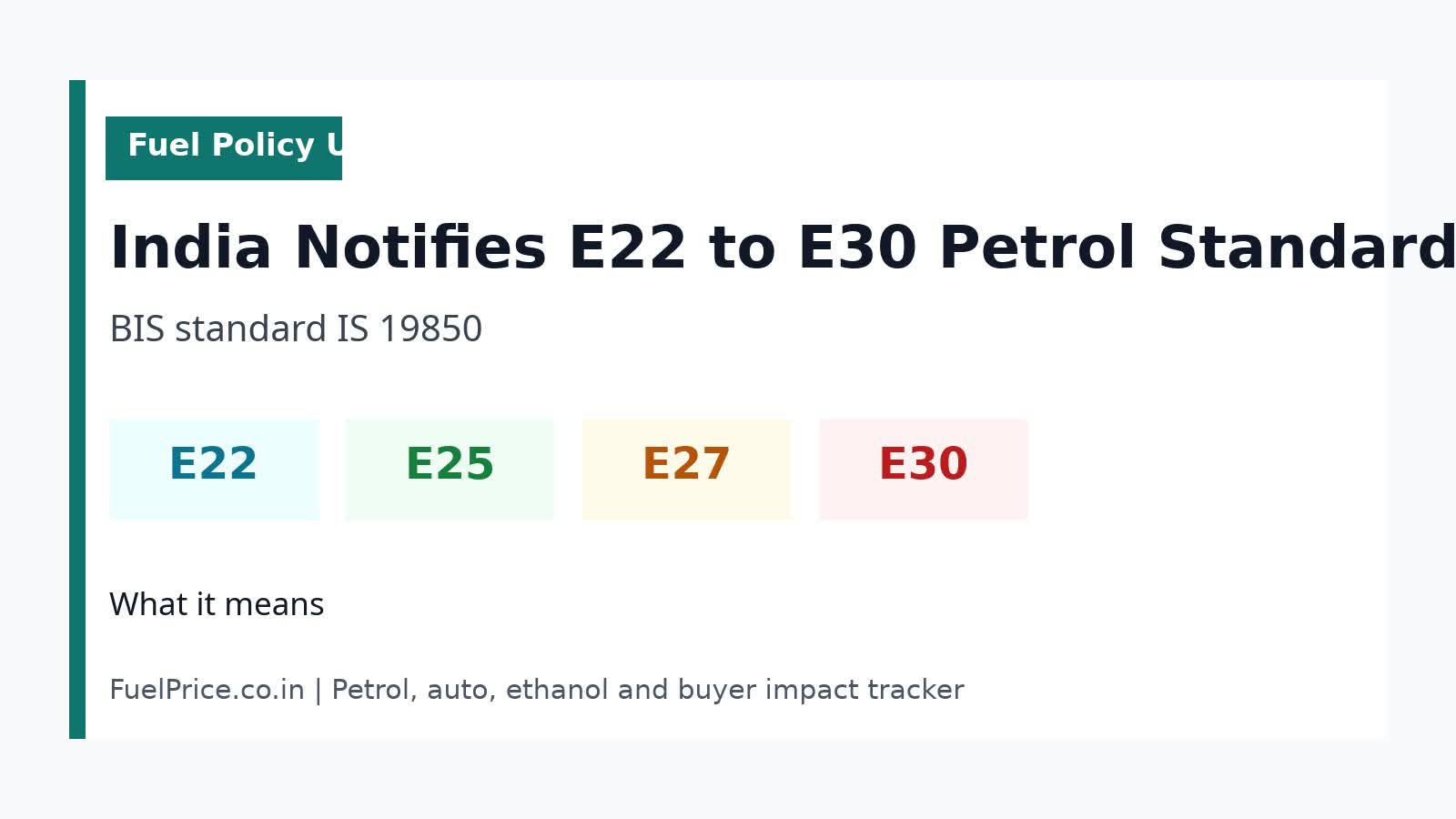
Short take: India has formally created fuel-quality standards for petrol blends beyond E20. The Bureau of Indian Standards has notified IS 19850:2026 for E22, E25, E27 and E30 ethanol-blended petrol, with the standard established on 15 May 2026.
India has created a technical fuel-quality framework for E22, E25, E27 and E30 petrol blends. This is a standards move, not an immediate nationwide pump rollout.The biggest fact is simple: India now has a formal standard for petrol blends with up to 30 percent ethanol. This matters because E20 is already the current national direction, and the new standard gives oil companies, automakers, testing agencies and component suppliers a reference point for the next stage of petrol-fuel planning.
For ordinary car and bike owners, the key point is equally important: this notification does not automatically mean E30 petrol will appear at every pump tomorrow. It means the technical framework has been prepared. Actual rollout, compatibility rules, labelling, pricing and consumer guidance still need clear policy execution.
What changed
- New standard: IS 19850:2026 has been established for E22, E25, E27 and E30 fuel.
- Fuel type: The standard covers anhydrous ethanol blended with motor gasoline for petrol-powered, positive ignition engine vehicles.
- Effective date: The establishment date listed in the Gazette notification is 15 May 2026.
- What it signals: India is preparing the technical base for higher ethanol blending beyond E20.
- What it does not confirm: It does not by itself mandate immediate E30 supply at pumps across India.
Why this is important for FuelPrice readers
This is a fuel-policy story with direct user impact. Higher ethanol blending can reduce crude-oil import dependence and support domestic ethanol production, but it also raises practical questions for millions of petrol vehicle owners.
The immediate discussion is likely to shift from only fuel price to fuel compatibility. Buyers will want to know whether a new petrol car or bike is ready for future blends. Existing owners will want clear advice from manufacturers before using anything beyond the fuel grade their vehicle was designed for.
What E22, E25, E27 and E30 mean
The number after E indicates the ethanol share in the petrol blend. E20 means petrol with up to 20 percent ethanol. E30 means a blend with up to 30 percent ethanol and the remaining share as gasoline, subject to the technical parameters defined under the notified standard.
| Fuel grade | Ethanol share | Why it matters |
|---|---|---|
| E22 | Around 22 percent ethanol | A step above E20, useful for gradual fuel-quality planning. |
| E25 | Around 25 percent ethanol | The blend most likely to attract compatibility testing debate first. |
| E27 | Around 27 percent ethanol | A higher intermediate grade that needs stronger engine and material validation. |
| E30 | Around 30 percent ethanol | The headline grade because it marks a major move beyond the current E20 framework. |
What changes for existing petrol car and bike owners?
For now, owners should avoid panic and avoid assumptions. A fuel standard is not the same as a consumer instruction. The sensible action is to follow the fuel compatibility mentioned in the vehicle manual or by the manufacturer.
- Do not assume older vehicles are E30-ready: Many older petrol vehicles were designed for lower ethanol blends.
- Watch for OEM advisories: Car and bike manufacturers will need to communicate which models can safely use higher blends.
- Long parking matters: Ethanol-blended fuel can raise concerns around moisture absorption and fuel-system material compatibility if the vehicle remains unused for long periods.
- Warranty clarity is essential: Buyers should check fuel compatibility before booking a petrol vehicle in 2026.
Impact on automakers and suppliers
For the auto industry, the new standard moves the conversation from policy intent to engineering readiness. Higher ethanol blends can require changes in calibration, fuel lines, seals, pumps, injectors and emission-control validation. Newer vehicles may be easier to adapt, but the large existing vehicle parc makes the transition more complex.
The next meaningful development will be testing. Industry reporting indicates that government agencies and automakers are expected to examine how existing E10 and E20-compliant vehicles respond to higher blends such as E25. That testing will matter more to users than the notification headline itself.
Fuel pump and pricing angle
For fuel retailers, the standard creates a reference point for quality control, blending, storage and dispensing. If higher blends are rolled out in future, pumps will need clear grade labelling and consumer communication. Pricing will also become important because users will compare pump savings, mileage impact and vehicle compatibility together.
What buyers should check now
- Is the petrol vehicle officially E20-compliant or higher?
- Has the manufacturer issued a statement on E25 or E30 compatibility?
- Will warranty terms remain valid if higher ethanol blends are used?
- What is the real-world mileage impact if ethanol share rises further?
- Is a hybrid, CNG or EV alternative more practical for the buyer use case?
Final takeaway
The BIS E22-E30 notification is one of the most important fuel-policy signals of May 2026. It does not mean every petrol user must prepare for immediate E30 fuel at the pump, but it does show that India is building the standards framework for a future beyond E20. For buyers, fleet owners and automakers, the next phase is about compatibility proof, clear labelling and honest running-cost math.
Sources checked
- Gazette notification mirror: BIS notification dated 15 May 2026, listing IS 19850:2026
- Business Standard: BIS lays groundwork for E22-E30 fuel blends
- Autocar India: Government notifies standards for petrol blends beyond E20
- Economic Times: What E22 to E30 petrol variants mean for fuel, vehicles and ethanol use
- Moneycontrol: India moves beyond E20 as government notifies E30 petrol standards