India registered 3,723 electric buses in the April–September 2026 half-year, a 55% year-on-year rise and the highest first-half total reported, according to Vahan data cited by Mint on 5 Oct 2026. For commuters and fleet operators, the result signals that public-transport electrification is moving beyond small pilots, but the benefit on a particular route still depends on tenders, depots and charging equipment becoming operational.
Key takeaways
- Electric-bus registrations reached 3,723 units in April–September 2026, up 55% from the same period a year earlier.
- Electric buses accounted for 8.55% of bus registrations in H1 FY27, compared with 5.47% in H1 FY26.
- Overall bus registrations fell 0.4% year on year to 43,561 units during the same half-year.
- The official PM E-DRIVE plan has an allocation of ₹4,391 crore for 14,028 e-buses, but a scheme allocation is not the same as a bus already running on a city route.
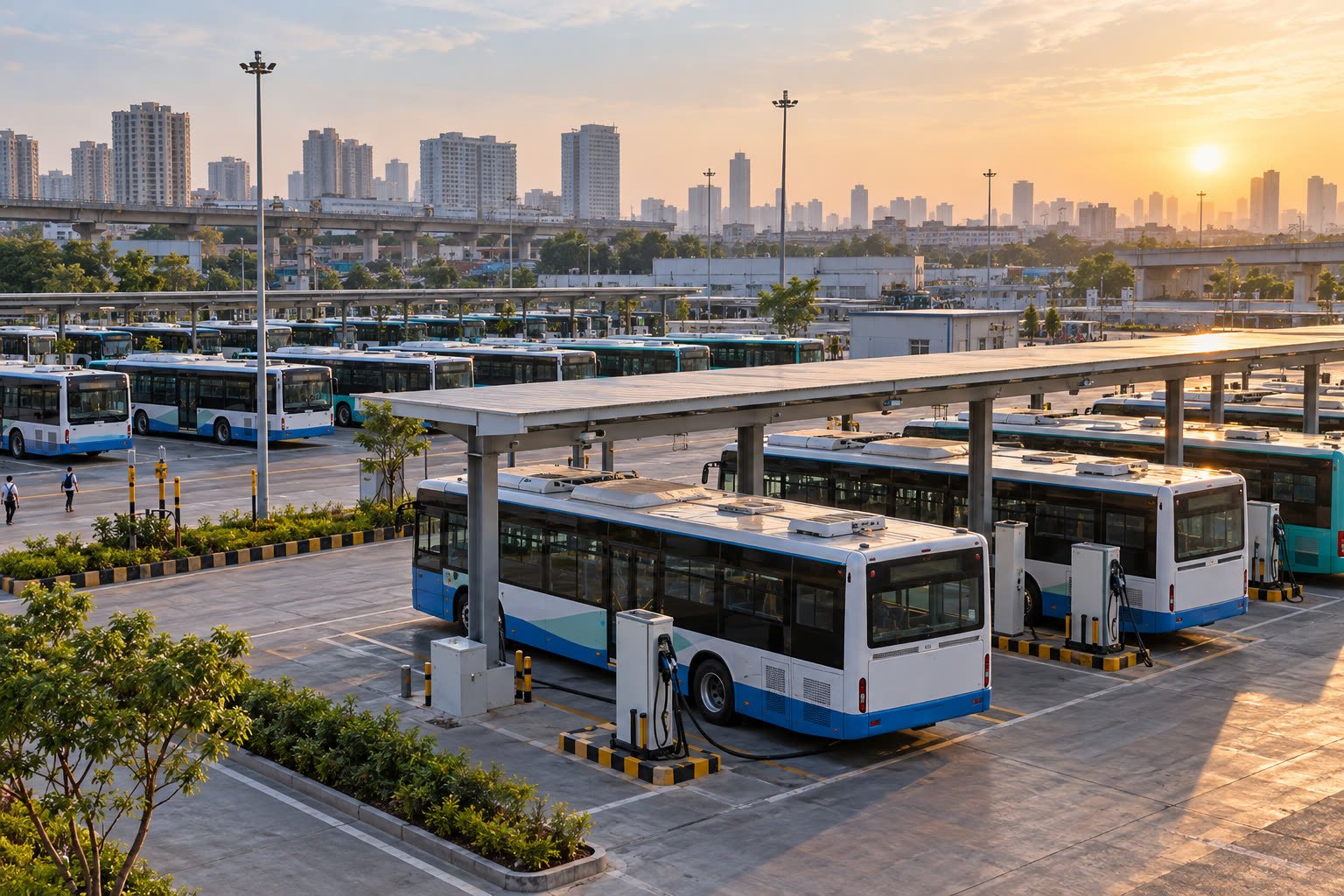
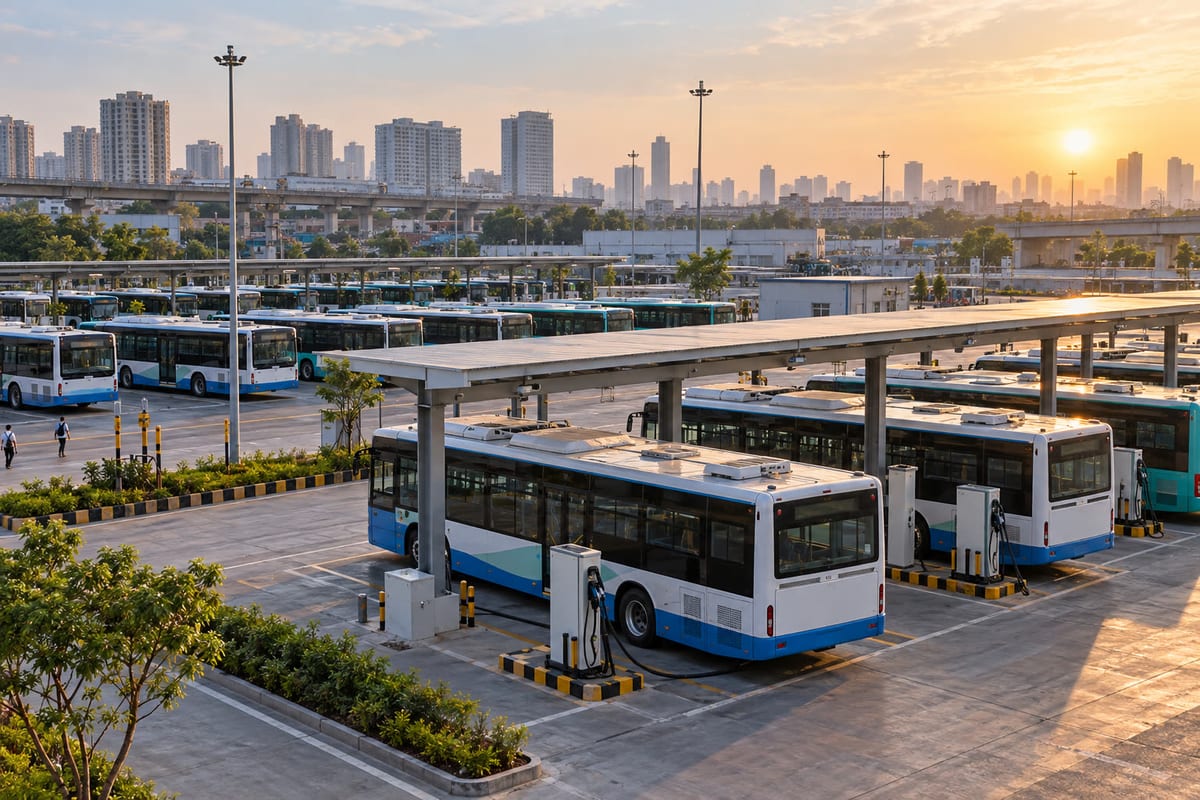 Illustrative editorial image of a multi-bus electric fleet charging at a city depot; it is not an official photograph of a specific operator or fleet. Credit: FuelPrice illustration.
What the latest e-bus number shows
Mint’s 5 Oct report, based on the government’s Vahan registry of new vehicles, puts electric-bus sales at 3,723 units for April–September 2026. The 8.55% figure is the segment’s share of new bus registrations, not the share of all vehicles registered in India. It is therefore a useful measure of the direction of bus procurement and adoption, but not a direct count of buses already carrying passengers every day.
| Measure | Latest figure | Comparison |
|---|---|---|
| Electric-bus registrations | 3,723 units | 55% higher year on year |
| Electric-bus share | 8.55% | 5.47% in H1 FY26 |
| All bus registrations | 43,561 units | 0.4% lower year on year |
The primary data source is the Ministry of Road Transport and Highways’ Vahan public report. The distinction matters because a Vahan registration, a tender award, a vehicle delivered to a depot and a bus entering scheduled service are four different checkpoints. A national registration record cannot by itself confirm a new route, a shorter wait or a lower fare for a commuter.
Why electric buses are gaining ground
Electric buses are being adopted through public procurement and operating contracts as much as through individual consumer choice. Mint reported that government contracts to replace urban diesel fleets are a major driver of the expansion. It also described the gross-cost-contract model, in which a private operator supplies, runs and maintains the buses while a public transport authority pays an agreed amount linked to kilometres operated.
This structure changes the decision-making chain. The operator has to plan vehicle availability, charging windows, battery warranties and maintenance, while the transport authority has to match the buses with routes, depots and service obligations. For passengers, the visible change comes only after those pieces work together.
The government’s policy support is substantial but should not be confused with the latest sales figure. A 12 Aug 2026 Press Information Bureau release said PM E-DRIVE had allocated ₹4,391 crore for deployment of 14,028 e-buses, of which 14,000 had been allocated at that point. The same release earmarked ₹2,000 crore for pan-India public charging stations. These are programme and deployment figures; they do not mean that all allocated buses were registered or operating during the April–September period.
What it means for commuters and fleet operators
For commuters, the record is a direction-of-travel signal rather than a route announcement. A city may have an allocation or a contracted operator, yet service can still wait for depot land, grid connection, charger commissioning, driver training, permits and a timetable. Local transport-agency notices remain the right source for deciding whether a particular service has changed.
For fleet operators, the useful comparison is a full duty-cycle calculation: daily kilometres, passenger load, charging time, electricity tariff, maintenance, battery warranty and the reserve vehicles needed when a bus is unavailable. The 8.55% national share does not establish that every route or operator will have the same economics. For diesel feeders or mixed fleets, the fuel cost calculator can turn distance, mileage and current pump rates into a trip estimate. EV owners and transport planners can use the state-wise EV charging directory to check whether public charging is available along a regular route, while remembering that a directory listing is not a guarantee of charger uptime.
What to watch in the next six months
First, the key test will be whether electric-bus registrations remain strong after the first half of FY27, when procurement schedules and festive demand can affect monthly numbers. A single half-year record is encouraging, but a sustained run would show that the market is moving from tender awards to repeat deployment.
Second, readers should watch the gap between allocations and buses in service. The practical indicators are commissioned depots, live chargers, published route schedules and passenger-facing service data. This is where the national policy story becomes a daily mobility outcome.
Third, Mint reported that the government was working on cheaper financing support for private operators of electric buses and trucks. That remains a reported policy development, not a confirmed loan benefit that operators can claim. Any final notification would need to specify eligibility, lender participation, repayment support and the treatment of charging infrastructure.
Reader takeaway
India’s 3,723 electric-bus registrations show that the public-transport EV market is scaling even as overall bus registrations softened. The number is important for the direction of the industry, but it is not a promise of an immediate route change or fare reduction. Commuters should watch local deployment updates, while operators should separate tendered units from delivered and working buses and compare the complete cost of running each duty cycle.
Sources
- Mint, “India records highest e-bus sales in April-September period, adoption jumps to 8.55%” — 5 Oct 2026.
- Ministry of Road Transport and Highways, “Vahan Public Report” — accessed 5 Oct 2026.
- Press Information Bureau, “Ministry of Heavy Industries FAME India Scheme Phase-II: Progress in Electric Vehicle Adoption and Charging Infrastructure” — 12 Aug 2026.