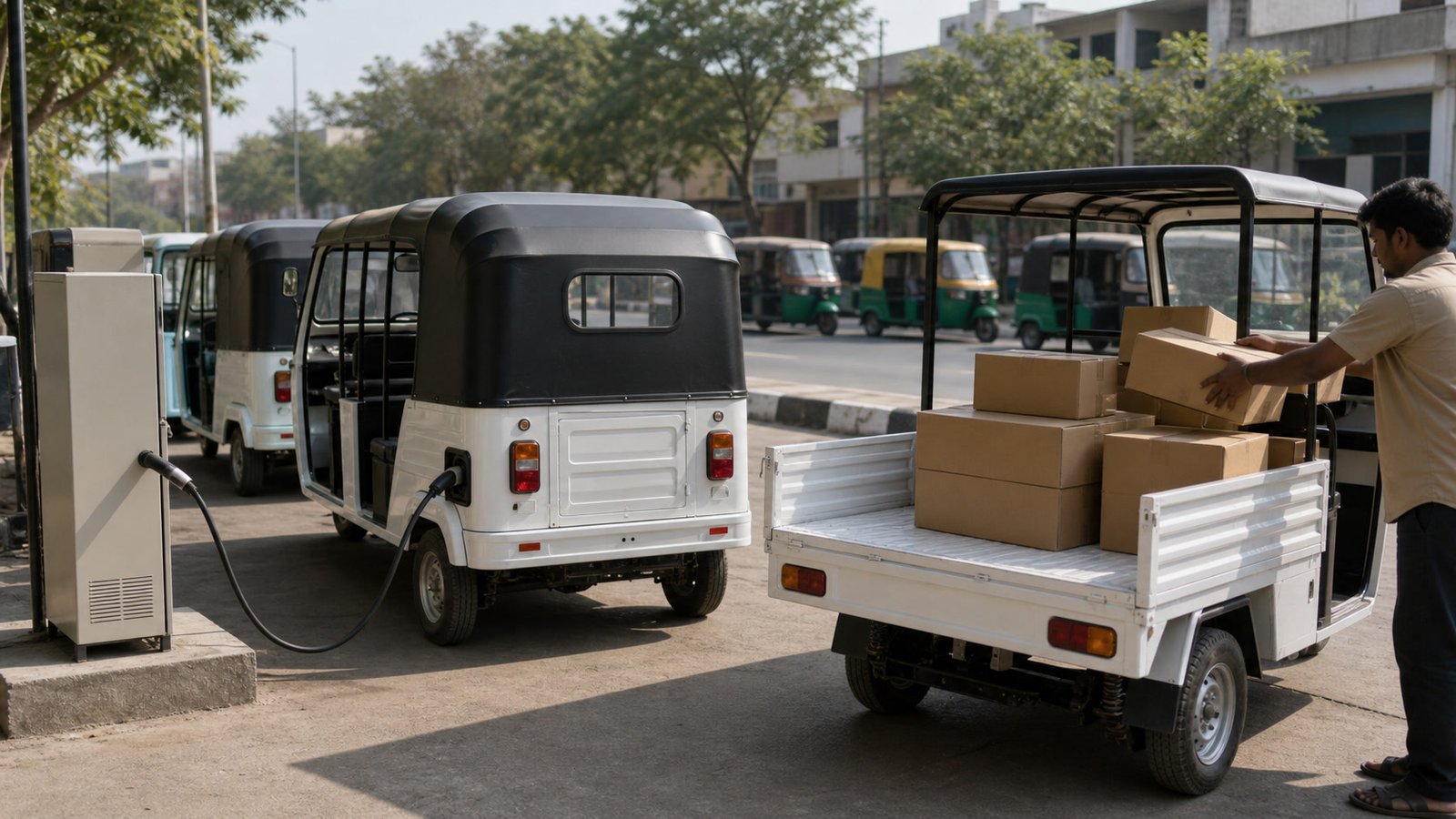
India's electric three-wheeler market has crossed from early adoption into mainstream last-mile transport. Retail registrations in May 2026 reached 71,865 electric three-wheelers, up 9 percent from 66,185 units in May 2025, according to Vahan data analysed by Autocar Professional. The bigger signal is not only the volume. Electric three-wheelers accounted for 64 percent of the total 111,523 three-wheelers sold across fuels in May, while CNG three-wheelers fell 5 percent year on year to 24,093 units.
Electric three-wheelers are now a direct fuel-market story because they replace CNG, petrol and diesel trips in passenger and cargo last-mile use.What changed in May?
The May data shows a sharper leadership fight among legacy manufacturers. Bajaj Auto sold 11,904 electric three-wheelers, its highest monthly e-3W retail tally, and edged Mahindra Last Mile Mobility's 11,169 units by 735 units. It was the third time in 2026 that Bajaj outsold Mahindra in monthly e-3W sales after January and February. TVS Motor, which entered the segment much later, delivered 3,590 units, its best month so far and a 122 percent year-on-year increase.
Combined, Bajaj, Mahindra Last Mile Mobility and TVS sold 26,663 electric three-wheelers in May. That gives the three legacy OEMs a 37 percent share of the month's 71,865 e-3W registrations. In a segment once dominated by hundreds of small e-rickshaw makers, the numbers show a clear shift: established OEMs are using finance, dealer reach, service support and better-built vehicles to capture a larger slice of the electric last-mile market.
| May 2026 metric | Value | Why it matters |
|---|---|---|
| Electric 3W registrations | 71,865 units | Fourth-highest monthly retail tally for India's e-3W industry |
| EV share of total 3Ws | 64 percent | Shows electric is now the default direction in three-wheelers |
| CNG 3W registrations | 24,093 units | Down 5 percent year on year, with share slipping to 22 percent |
Why this is a FuelPrice story
Three-wheelers are small vehicles, but their fuel-market impact is large because they run all day. Passenger autos, e-rickshaws and small cargo three-wheelers operate in dense urban routes, station areas, markets, housing clusters and last-mile delivery corridors. A private car may travel once or twice a day; a commercial three-wheeler can complete dozens of short trips. When these vehicles move from CNG, petrol or diesel to electric power, the fuel saving shows up repeatedly.
The impact is most visible in cities where CNG queues, refuelling downtime and fuel-price sensitivity affect driver earnings. Financial Express, citing FADA data, noted that electric three-wheelers crossed 60 percent share in FY26 and that analysts saw CNG buyers shifting because electric models offered lower operating costs and fewer refuelling constraints. The same report cited an industry view that electric three-wheelers can offer more than 15 percent improvement in total cost of ownership over diesel, helped by lower running and maintenance costs.
Who benefits and who faces pressure?
Drivers and fleet operators benefit if daily energy cost, maintenance downtime and charging access are predictable. E-commerce, grocery delivery and urban logistics fleets benefit because cargo e-3Ws can lower per-trip cost on short routes where fixed schedules and depot charging are possible. Cities benefit through lower tailpipe emissions and quieter operations in congested areas. But the shift also puts pressure on CNG filling demand, small e-rickshaw makers, fuel retailers in high-auto-density locations and conventional three-wheeler product lines.
For OEMs, the May result confirms that the e-3W market is no longer just a low-speed e-rickshaw story. Bajaj's rise, Mahindra's fightback and TVS's climb show that passenger and cargo operators are increasingly choosing vehicles backed by larger sales and service networks. That is why market share is becoming strategically important: whoever wins drivers now can influence financing, battery service, charging partnerships and replacement cycles for years.
What to watch next
The first signal is whether e-3W registrations stay above 70,000 units in June and July, or whether May was a temporary spike linked to fuel-price pressure and local buying cycles. The second signal is CNG three-wheeler demand. If CNG volumes keep falling while total three-wheeler demand remains healthy, the market is not shrinking; it is changing fuel type. The third signal is charging reliability. Drivers will only stay with electric if charging downtime, battery warranty and service response support daily earnings.
For FuelPrice readers, the takeaway is direct: electric three-wheelers are already changing India's fuel consumption pattern in last-mile mobility. May 2026 did not just produce a sales leaderboard. It showed a segment where electric has become the majority choice, CNG is losing share, and legacy OEM competition is making the transition more credible for drivers, fleet owners and urban logistics users.
Sources: Autocar Professional May 2026 e-3W sales analysis; Financial Express on FY26 electric three-wheeler transition; Informist/FADA FY26 EV retail data; Autocar Professional on FY26 e-3W and CNG 3W share; Vahan dashboard.